Hespero, Alberta
Hespero, Alberta in the Eckville–Sylvan Lake Finnish District
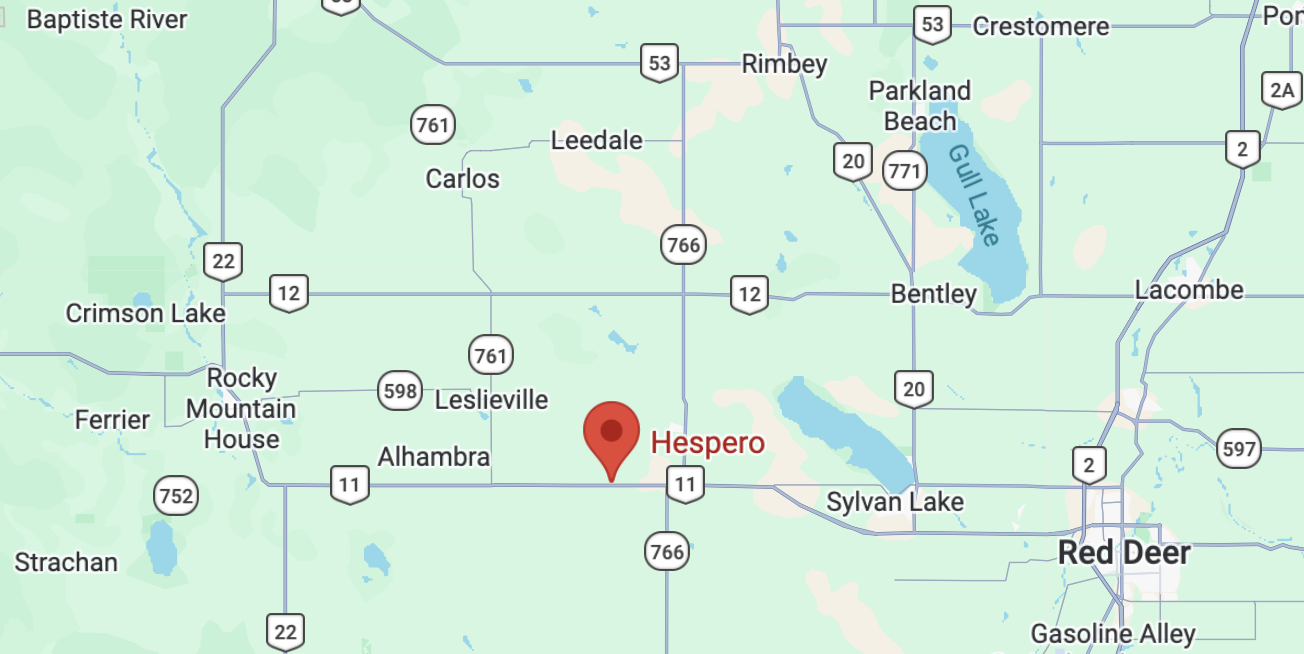
Betty Speirs was born at Hespero, Alberta, in 1931. Her father, Neil Humalamaki, had come from Finland, as had her maternal grandparents, who took a homestead north of Eckville in 1903. Neil died when Betty was one, and her mother, Emma, moved Betty and her brother into Eckville. Finnish was spoken in her home, according to an account written by her son, Dale Speirs, and published in the Alberta Palaeontological Society Bulletin in 2018. The account does not specify whether that language use began at Hespero, continued in Eckville, or both.
Varpu Lindström-Best’s national survey describes Alberta’s Finnish farm concentration as part of the Red Deer district, with a few hundred Finns living near Sylvan Lake, rather than identifying Hespero as a separate Finnish colony. Hespero sat approximately seven kilometres southwest of Eckville and later acquired a Canadian Pacific Railway station and post office. Its Finnish history survives in a family account, official place-name records, immigration scholarship, and an archival inventory of correspondence connected to the Finnish Canadian Press. Together, these sources connect Hespero to the wider Eckville–Sylvan Lake district while preserving evidence filed under Hespero’s own name.
Finnish Families Arrived Before the Name
Any account of Finnish settlement in the district begins within a longer Indigenous history. The nearby Town of Sylvan Lake acknowledges Treaty 6 territory and Métis Nation of Alberta Region 3. Its acknowledgement identifies the region as meeting grounds, gathering places, and travel routes for Cree, Dene, Blackfoot, Métis, Saulteaux, and Nakota Sioux peoples.
Finnish immigration into the Red Deer district grew from a federal recruitment campaign at the end of the nineteenth century. Canada’s colonization department and the Canadian Pacific Railway distributed Finnish-language folders and maps in Ostrobothnia. In 1899, the federal government sponsored five Finnish delegates to inspect possible group-settlement sites. They selected the Red Deer district and agreed to promote an annual migration of 4,000 Finnish settlers. The forecast did not materialize. Lindström-Best found that only a few hundred Finns established themselves near Sylvan Lake.
Speirs’s maternal grandparents were Finnish residents north of Eckville by 1903. The name Hespero came later. The Canadian Pacific Railway established a station there in 1914 and chose a name derived from Hesper, the evening star in Greek mythology. A post office operated under the Hespero name from June 1916 until September 1960; it had previously been called Pitcox.
Finnish families were therefore living in the wider Eckville–Sylvan Lake district more than a decade before the railway station at Hespero was established. The surviving evidence does not show exactly when the first Finnish household occupied the specific locality later called Hespero.
The Eckville–Sylvan Lake Finnish District
Nearby place names reveal how Finnish settlement extended beyond one railway point. Kuusamo, approximately six kilometres southwest of Sylvan Lake, carried a Finnish name translated in Alberta’s official place-name history as “green trees” or “spruce trees.” That source states that the area was originally settled by Finns. Kuusamo School District No. 755 was established in 1902, and a Kuusamo cemetery was located nearby.
Hespero and Kuusamo were separate localities, yet their dates place them within the same broader Finnish geography west of Red Deer. Kuusamo’s school district was operating before the Hespero station opened. Speirs’s maternal grandparents took their homestead north of Eckville one year later. By the time CPR trains stopped at Hespero, Finnish households had been present in the surrounding district for more than a decade.
This pattern differs from that of a single, clearly bounded ethnic colony. The proposed Finnish block settlement fell far short of its recruitment target, producing a district of several hundred Finnish residents rather than the thousands its promoters had anticipated. Lindström-Best’s survey also identifies clearly named Finnish districts in Manitoba, including Lac du Bonnet–Elma and Rorketon–Meadow Portage. West-central Alberta developed through smaller farm neighbourhoods and service points whose residents used Eckville, Sylvan Lake, Hespero, Kuusamo, and other nearby names.
Lindström-Best found that many Finnish farm families on the Prairies relied on income from mining, lumbering, or construction, sometimes travelling seasonally between wage work and their farms. The sources examined here do not provide Hespero employment records, so that broader pattern cannot be assigned automatically to every local family. Her findings caution against reconstructing Finnish Prairie life from crop production and land records alone.
Finnish in the Speirs Family
The Speirs family account supplies a detail that government land and railway records usually omit: Finnish remained a household language. Neil Humalamaki and Emma’s parents had come from Finland. Betty was born at Hespero in 1931, but after Neil died the following year, Emma moved Betty and her brother into Eckville. The account says that Finnish was spoken in Betty’s home without identifying whether this refers to the family’s time at Hespero, its life in Eckville, or both.
One family biography cannot establish the rate of language retention across the district. It does document Finnish language use within a family whose Alberta history extended from the grandparents’ 1903 homestead to Betty’s childhood in the 1930s. It supports a history of intergenerational language continuity within the family, though not a claim about every Finnish household near Hespero.
Broad immigration narratives can pass over a place as small as Hespero. Railway and land records also omit the language a child heard from her mother and relatives. Speirs’s account supplies that evidence for one documented family.
Hespero in the Finnish-Language Press Network
Edward W. Laine’s inventory of the Finnish Organization of Canada collection lists an Alberta district correspondence file under Vapaus for Hespero covering 1935 to 1952. It lists Sylvan Lake–Eckville separately for 1935 to 1949, followed by later Sylvan Lake files.
The inventory therefore preserves Hespero under a separate place-name heading from Sylvan Lake–Eckville. It does not identify the correspondents or summarize the letters, and the listing does not prove that Hespero maintained a chartered local of the Finnish Organization of Canada. Until the file itself is examined, it establishes that correspondence associated with Hespero entered the Finnish Canadian archival network, but not the membership, leadership, or activities behind it.
The Finnish Organization of Canada emerged through several organizational changes. The Finnish Socialist Organization of Canada formally began operations in 1911. A provisional Finnish Organization of Canada was established in December 1918 and operated for about a year. The federally incorporated Finnish Organization of Canada came into being on October 24, 1923, later receiving assets held by the reconstituted Finnish Socialist Organization and some of its locals.
Finnish working-class organizations placed cultural and social programs alongside labour politics. Lindström-Best cautioned that participation in dances and hall activities could increase membership figures without necessarily indicating the same degree of ideological commitment among every participant. That national context helps explain the range of people who might have used a Finnish-language newspaper or organizational network, but it does not establish what occurred at Hespero.
Hespero’s file begins in 1935, when Vapaus and the Finnish Canadian organizational network were already established. A named Hespero file indicates that contacts associated with the locality corresponded through that network. The sources reviewed for this article do not confirm a Finnish hall at Hespero or identify a local program of plays, sports, lectures, or political meetings. The correspondence file offers a precise next step for research rather than evidence that activities documented in other Finnish communities also occurred there.
The Hespero correspondence file ends in 1952, while separate Sylvan Lake files continue into later years. Laine’s inventory does not explain the difference.
Final Thoughts
Hespero’s Finnish history rests on several verifiable points. Finnish-directed immigration promotion brought attention to the Red Deer district in 1899. Finnish families were established in the wider Eckville–Sylvan Lake area by the beginning of the twentieth century. Betty Speirs was born at Hespero in 1931, and Finnish was spoken in her family home. From 1935 to 1952, correspondence associated with Hespero was preserved under its own heading in the records connected to Vapaus, separate from Sylvan Lake–Eckville.
The surviving record supports a small locality connected to a wider Finnish district through family histories and a Finnish-language correspondence network. It does not yet support claims that Hespero was a large, formally bounded Finnish colony or that it maintained its own documented hall or organizational branch. In Laine’s inventory, Hespero appears as a separate Alberta correspondence heading for the years 1935 to 1952. The contents of that file may provide the next part of the community’s history.
Further Reading
Varpu Lindström-Best, The Finns in Canada (Canadian Historical Association, 1985).
Michel S. Beaulieu, David K. Ratz, and Ronald N. Harpelle, eds., Hard Work Conquers All: Building the Finnish Community in Canada (UBC Press, 2018).
Edward W. Laine, On the Archival Heritage of the Finnish Canadian Working-Class Movement (Institute of Migration, 1987).
Arja Pilli, The Finnish-Language Press in Canada, 1901–1939: A Study in the History of Ethnic Journalism (1982).
Eckville and District Historical Society, Homesteads and Happiness (1979). Dale Speirs, “Betty Speirs 1931–2002: An Alberta Fossil Collector,” Alberta Palaeontological Society Bulletin 33, no. 3 (September 2018).
Tracey Harrison, ed., Place Names of Alberta, Volume III: Central Alberta (University of Calgary Press and Alberta Community Development, 1994).
Parks Canada, Rocky Mountain House National Historic Site of Canada Management Plan (2020).