
Do I belong in church?
and other musings for a Sunday afternoon
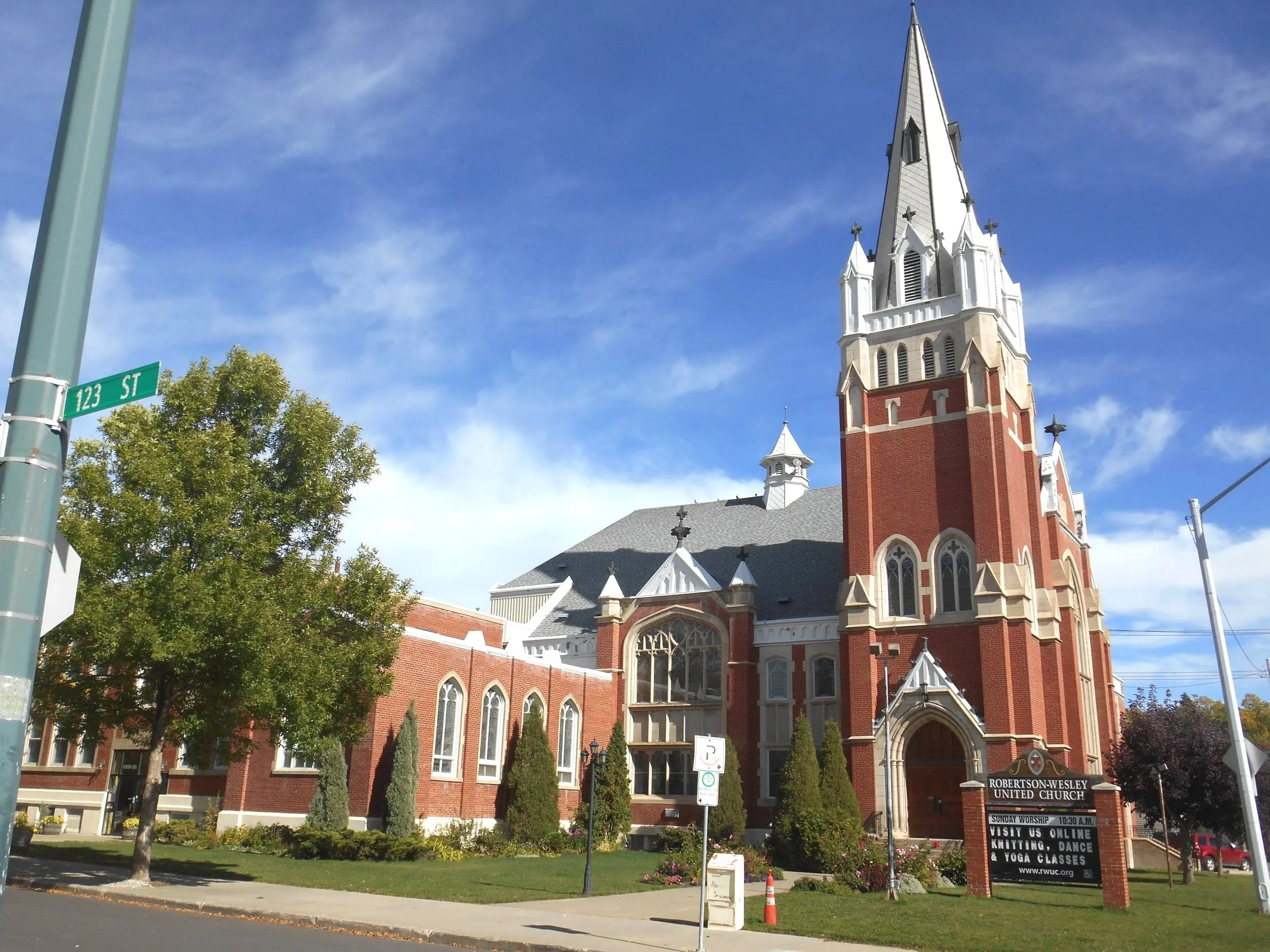
Robertson Wesley United Church. Photo from Wiki Commons
It’s Sunday and I’m thinking about church. If you’ve known me in my adult life, you may think this is strange. I’ve had an aversion to structured religion since my late teens/early twenties. It wasn’t always like that. I grew up going to the Gaetz United Memorial Church in Red Deer. I participated in the youth events, went to Sunday school, and for a period I felt religion very deeply.
As I got older, I became more aware of the harm the “church” had done so many people. The harm to Indigenous communities, LGBTQ+ people, women and children. The idea of worshiping a male figure for whom wars had been forged, that expressed that women should be subservient, and under whose roof so many young boys, nuns, and women had been assaulted was repellant.
By this, I mean the idea of church in general, and (to my knowledge) not the church where I was raised. In fact, I have held some level of gratitude for having been raised in a church that led the way in allowing women to become ministers and marrying queer couples far before it was the norm. Albeit, the family story goes that my parents picked our church because they had the best daycare in town … probably more joke than truth because they had been married in that church nearly a decade before they had kids.
In my early thirties I attended a history class where the instructor gave a brief lecture on how academics and students tended to look down on the church’s role in Canada’s early years. There was judgement and even eyerolling on the idea of church and God from a diverse group of students who were pushing back (I assume) on the dogma of their youth. The instructor said that kind of thinking often didn’t give credit to what churches did offer, a sense of community, a sanctuary, and a safe haven for many people. Maybe he was religious. I don’t know.
I know that this was only true for people who fit into a certain set of thinking and a specific way of life. People who were BIPOC, LGBTQ+, or who had somehow crossed God. (committed a sin) were not welcomed into the community in the same way.
Yet, I had never thought of church specifically as a community. I had always thought of it as a religious home, a place to find God, and a place to worship.
~
My mom was religious, although defining it is difficult. We all attended church when I was young, but drifted away as we got into our teenage years. Surprisingly, I was the one who held on longest, finding comfort in the belief of something outside myself as I weathered bullying and other challenges.
Mom continued to demonstrate Christian beliefs in ways like choosing to say “Oh my Word” instead of taking God’s name in vain. If I challenged her on ideas, she would simply say that being Christian meant God was love and nothing else mattered. I remember one conversation when I was in my teens and she told me that the bible was not a literal retelling of events but a series of metaphors, allegories, and lessons on humanity and life. No one, not in Sunday school, or out in the world had made that clear to me. To this day, I wonder what percentage of Christians think that the bible is a literal retelling and what percentage think it should be interpreted and contextualized. Some of the loudest voices on TV, the news, and social media seem to take it quite literally.
My grandma seemed to have similar views to my mom. The only time I remember her going to church was with us, but she definitely believed in God. She was Lutheran, although I don’t know why I know that. It was just known. And I have no memory of witnessing it, but my cousin once told me she read the bible every night. While I cannot speak for them with any kind of authority, I think they both felt that God was everywhere and within you and not housed in a church.
~
A few months ago I was driving around Edmonton. We are relatively new to the city and I don’t have the family of friends that I had when I was living in the West Kootenays. Community is something that is much harder to find when you are older and I didn’t really know how to go about finding my people. I drove past the Robertson Wesley United Church. No matter my mixed feelings on churches, I always love their old architecture. I peered into the dark at the church and saw a sign that said something along the lines of “Saturday, Community Dinner, all welcome.”
It was the community part that caught my attention, followed by the plethora of LGBTQ+ flags. I’m not talking about some rainbow stickers in the window or a token rainbow flag. I say it was aggressively inclusive in the best way. There were progressive pride flags, trans flags, non-binary flags. They were very proactive in their welcoming.
After I got home I went to their website and found that not only were they inclusive, they were very active with activities every day of the week. Activities that supported the community, activities that supported the congregation, activities that supported the individual.
I took my daughters there the next Sunday and found a peace I had forgotten. It wasn’t the biblicality of the sermons. God did not speak to me. It was the building, the space, and the people. Some of it was nostalgia as I remembered a sense of ritual and belonging that I had slipped into the recesses of my mind. I remembered the crisp, snowy drives to church on Sunday morning and being knee-high to adults in their Sunday best and warm perfumes as they joyfully greeted each other.
After the service there is always a coffee hour and people were always happy to welcome me at their table. Not only that but I was randomly given a full gallon of coleslaw on one Sunday and a bag of clothes that were enroute to be thrifted on another. Everyone looks out for everyone else there, no matter how long you’ve attended.
A few Sundays in, I didn’t pay attention to the schedule and went down for coffee after the service as usual only to find myself in the middle of the AGM — too far from the door to make a polite exit. I participated in it and was shocked to find that not only was it aggressively inclusive to people who are LGBTQ+ as well as historically being progressive about including women, it was being proactive about removing colonial language from their documentation.
This wasn’t just a pleasant surprise; it shocked me. Decolonizing is an action that still feels very new. Not a lot of organizations are actively decolonizing beyond performative words. They also started a path to offering ASL for at least the Sunday services. I was right in my label that they were aggressively inclusive. They weren’t just speaking to a generation that demanded equality, they were being proactive in making sure anyone who wanted a spiritual community could find one. Other than all the Jesus talk, this was exactly where I wanted to be.
And then my mom died.
Before she died, I talked to my mom about being torn about going back to church. I am sure she was excited, but she just listened to me talk myself in circles about where my spiritual journey was leading.
I had decided that my beliefs were threefold. First, whatever divinity is, it is in all of us. Divinity should not be gatekept. We do not need to meet a set of criteria before we have access to divinity. It is within us. To some degree, this stems from earlier studies I did in Buddhism.
Second, church is less about finding God and more about building community. We do not need the church to find God, we need the church to find each other.
And third, no matter what our beliefs we are meant to take care of each other.
At my mom’s funeral the family member who gave mom’s eulogy spoke about my belief that we are living divine lives. I wondered, had I said that? I had talked to him about my (threefold) beliefs and how I was questioning if I belonged in church. Ever since, I’ve been mulling over the question of is it true that if we are all divine we are all living divine lives? I feel like it must be, and if that’s the case, it changes everything.
~
My mom’s funeral took place at Gaetz United, the church I grew up in and the church my parents were married in. The minister for that church was not available. On a bit of a whim, I sent the lovely reverend at Robertson Wesley a “Hi, you don’t know me well but I was wondering…” email and asked her if she would lead the service at my mom’s funeral. She quickly agreed.
I was grateful because it felt like I could bring a little bit of my life into the moment rather than having a stranger do it. I was even more grateful at the professional, compassionate, and intuitive way she led the service. People messaged me weeks after, noting what a wonderful job she had done. It felt almost serendipitous the way the pieces came together.
~
Today, I attended church. It is Pride Month and National Indigenous People’s Day. Pride has been incorporated into all the services this month and today the entire service was based on Indigenous teachings with Ojibwe author Richard Wagamese’s book of spiritual reflections Embersbeing centred. They referenced the great spirit, the divine, and how God is in everything and it felt absolutely divine.
"Nowadays, I figure life is pretty simple: Creator is everywhere and divine light shines through everything and everyone all the time. My work is to look for that light. In those fleeting, glorious instances when I see it, I am made more, right then, right there."
~ Richard Wagamese
By the time Lord Dufferin left Gimli in September 1877, New Iceland had already spent months governing many of its local affairs under rules its residents had adopted themselves.