
Kuusamo, Alberta: The Finnish Farming District Near Sylvan Lake
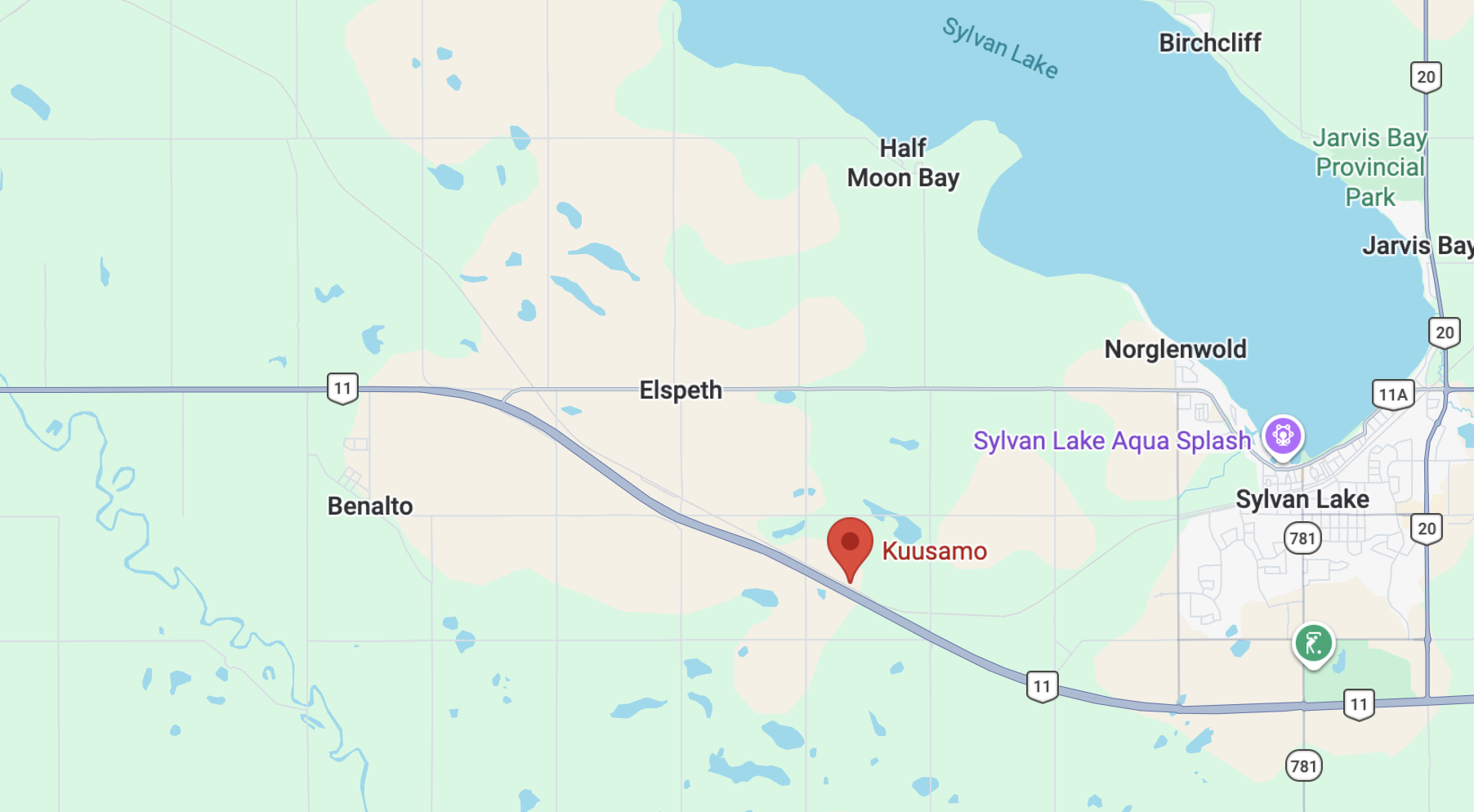
Kuusamo Alberta is between Sylvan Lake and Benalto on Hwy. 11.
Finnish families established farms, a school, cemeteries and community gathering places southwest of Sylvan Lake—and named the district after one settler’s birthplace in Finland.
Kuusamo remains an official place name in central Alberta, although government records classify it as a railway point rather than a town or hamlet.
The Canadian Geographical Names Database places Kuusamo at 5-26-38-2-W5, approximately six kilometres southwest of Sylvan Lake. Alberta’s provincial place-name history says the surrounding area was originally settled by Finns and connects the name with Kuusamo School District No. 755.
The story behind the name is recorded in Along the Burnt Lake Trail, a district history published by the Burnt Lake History Society in 1977. According to that account, two early residents drew straws for the right to name the school district. Peter Wetelainen won and selected Kuusamo, the name of his birthplace in Finland.
Finnish families arrived through the United States
The first recorded meeting to organize Kuusamo School District No. 755 was held at the home of A. Parvi on Aug. 17, 1902.
According to Along the Burnt Lake Trail, at least 40 families were living on homesteads within the proposed district. Most were originally from Finland and had moved to Alberta from the United States. The number of families had created an immediate need for a local school.
Peter Wetelainen’s history shows how that migration route worked for at least one Kuusamo family.
The district history says Wetelainen was born in Kuusamo, Finland, in 1849. After the death of his first wife and child, he emigrated to North Dakota, where he remarried and farmed for five years. He later read about homestead land west of Red Deer in a Finnish newspaper.
Wetelainen, his wife and their five children left Kulm, North Dakota, with the A. Parvi family in March 1900. They arrived in Red Deer in early April with three horses, household belongings and a wagon. After crossing the Red Deer River, they travelled west to Burnt Lake before beginning work on their homesteads southwest of Sylvan Lake.
Other Finnish families soon settled nearby. The school history lists Matt Kaila, Alex Kinnunen, August Pass, Victor Pastobak, Aatu Kangas and several other residents in the district by 1900. More families, including the Mattsons, Kujalas, Lunds, Porttins and Woimas, arrived in 1901. Jacob Ropsfelt was among those listed as arriving between 1902 and 1905.
The result was not a compact Finnish town. It was a broad farming district made up of homesteads connected through roads, schools, churches, halls and family relationships.
A Finnish name chosen by drawing straws
According to the school history, Peter Wetelainen and A. Parvi were asked to draw straws for the privilege of naming the new district. The person drawing the shorter straw would make the choice.
Wetelainen won and named the district Kuusamo after the place where he had been born. Along the Burnt Lake Trail translated the name as “a place where spruce trees grow.” Alberta’s provincial place-name reference later gave the meaning as “green trees” or “spruce trees.”
The choice gave the central Alberta district a direct connection to northeastern Finland. It was not simply a Finnish-sounding name chosen because the land was wooded. The local record identifies Wetelainen, his birthplace and the process through which the name was selected.
On Nov. 3, 1902, local ratepayers elected the district’s first trustees: Alex Kinnunen, August Halstein and August Pass. J.W.W. Slack became secretary-treasurer, collector and assessor. The records were initially filed under Kuusamo School District No. 755 of the Northwest Territories because Alberta did not become a province until 1905.
Building Kuusamo School
The first school site was the northwest corner of SW 25-38-2-W5. According to Along the Burnt Lake Trail, the district bought the Canadian Pacific Railway land for $10.
In February 1903, ratepayers approved borrowing $600 to build and furnish the school, purchase the site and cover other costs. A construction bid of $93 from J.W.W. Slack was accepted that May. The wooden building had a shingled roof, brick chimney, desks, blackboards and a large iron stove in the centre of the room.
Kuusamo School opened on April 1, 1904. It closed during July and August that year before reopening for September, October and November.
The original school district was large. The local history described its eastern boundary as Sylvan Lake’s main street and its western boundary as six miles west of the street. The district extended from the Sylvan Lake shoreline in the north to four miles south of what later became Highway 11.
Those boundaries changed as settlement increased and additional schools were organized.
In December 1911, the board called a special meeting to choose a more central site. Education officials recommended a two-acre property on the northwest corner of Section 35-38-2-W5. The landowner offered the site without charge as long as it continued to be used for school purposes.
The original grounds were sold for $10. By June 1912, the new property had been cleared, and R. Murphy moved the school building to the site for $275. This second location, near the later United Grain Growers elevator, is the school site identified in Alberta’s provincial place-name history.
A two-room rural school
Kuusamo grew beyond the capacity of its original classroom.
In 1919, the school board accepted a $1,587 construction bid for a second classroom with space for 45 pupils. The new room allowed the district to divide younger and older students between two teachers. Grades one through five occupied the junior room, while the senior room taught older pupils.
The school also became one of the district’s gathering places. According to the local history, social evenings included programs, debates, singalongs, box socials, games and dances. The Kuusamo Literary Society later sponsored projector and lantern-slide presentations.
Christmas programs were held at the school or at Elspeth Hall nearly every year after about 1913. Between 1925 and 1935, the programs could attract approximately 300 people. They included music, folk dances, dialogues, tableaus and a visit from Santa, followed by lunch and a dance.
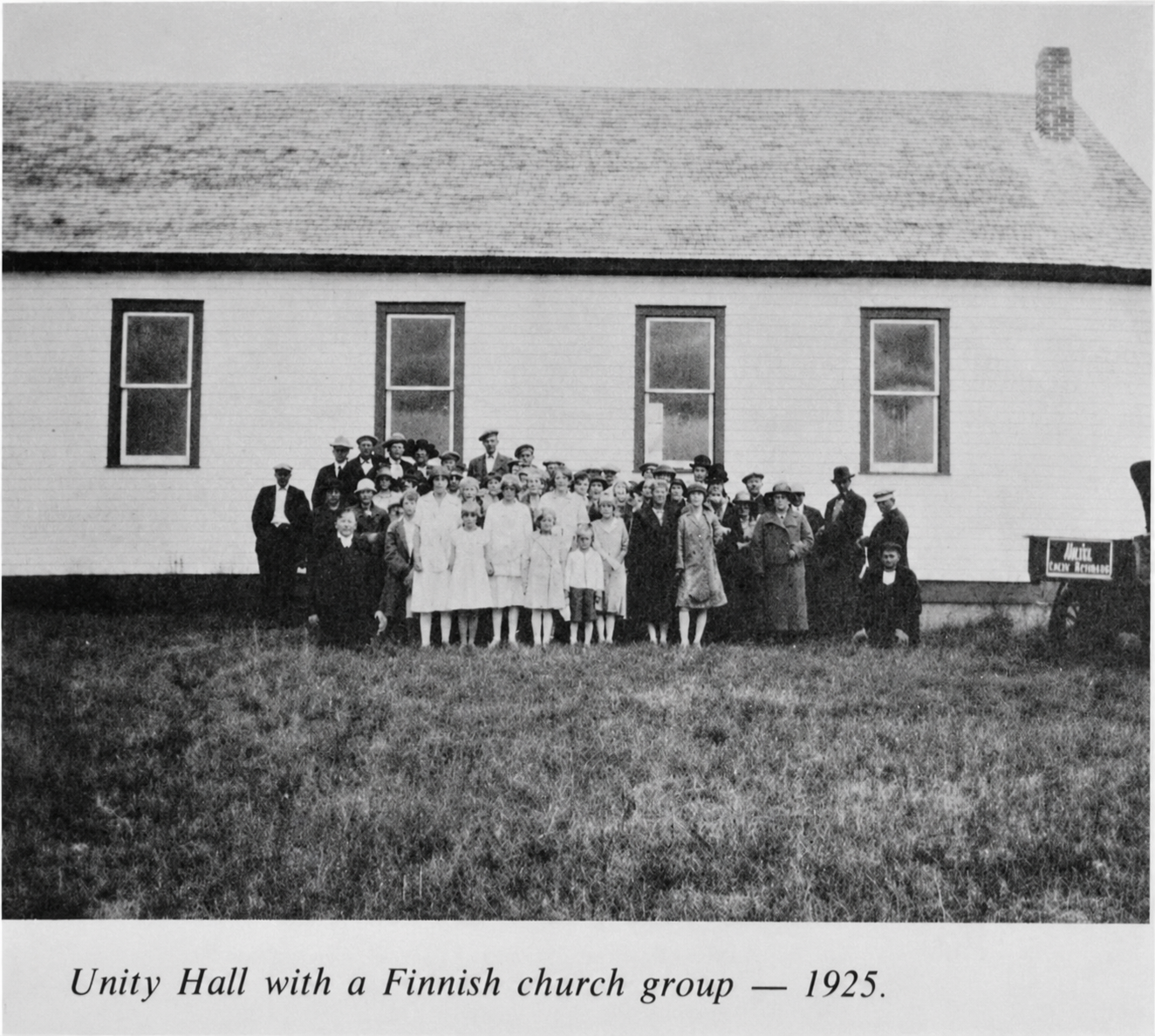
Church services were also held in the school and in private homes. The district history records Finnish religious leaders serving the area and says the Finnish Evangelical Lutheran church owned a hall and manse on NE 26-38-2-W5. Finnish churches and organizations also built Elspeth Hall and Unity Hall in the district.
The surviving Kuusamo School District records cover 1902 to 1952. According to the Alberta on Record archival catalogue, the collection includes school board minutes, attendance registers, correspondence and financial statements.
The school closes
Kuusamo School operated until the centralization of local education in 1952.
That September, all Kuusamo students from grades one through 11 began travelling by bus to Benalto School. The final school board consisted of Emil Mattson, Lynn Burdick and Ernest Kinna.
The site was sold to Ernest Kinna for $50. The newer high school building was moved away, while Ernest Woima purchased the original school building.
The closure ended five decades of local schooling, but it did not immediately remove Kuusamo from Alberta’s records. The name continued to be used for the railway point, cemetery and grain elevator.
Kuusamo had two cemeteries
The district history records two separate burial grounds carrying the Kuusamo name.
Kuusamo Cemetery No. 1 was a 1.66-acre property on A. Parvi’s homestead at NW 24-38-2-W5. When Along the Burnt Lake Trail was published in 1977, the cemetery had not been used or maintained for many years.
The history estimated that the burial ground contained approximately a dozen graves. Among those buried there were the twin sons of August Johnson and his infant daughter Meimi. The cemetery company’s surviving documents included a 1910 letter, ownership records and minutes written in Finnish.
Kuusamo Cemetery No. 2 was established on two acres bordering Highway 11. According to the district history, Henry Lund Sr. donated the property, and his daughter Maimie was the first person buried there.
Community directors maintained the second cemetery, kept burial records, arranged cleanup bees and looked after its roads, fences and tools. Red Deer County later provided an annual maintenance grant.
Today, Discover Alberta Ancestors, a project of the Alberta Family Histories Society, lists Kuusamo Cemetery on Township Road 390 east of Range Road 23 in Red Deer County.
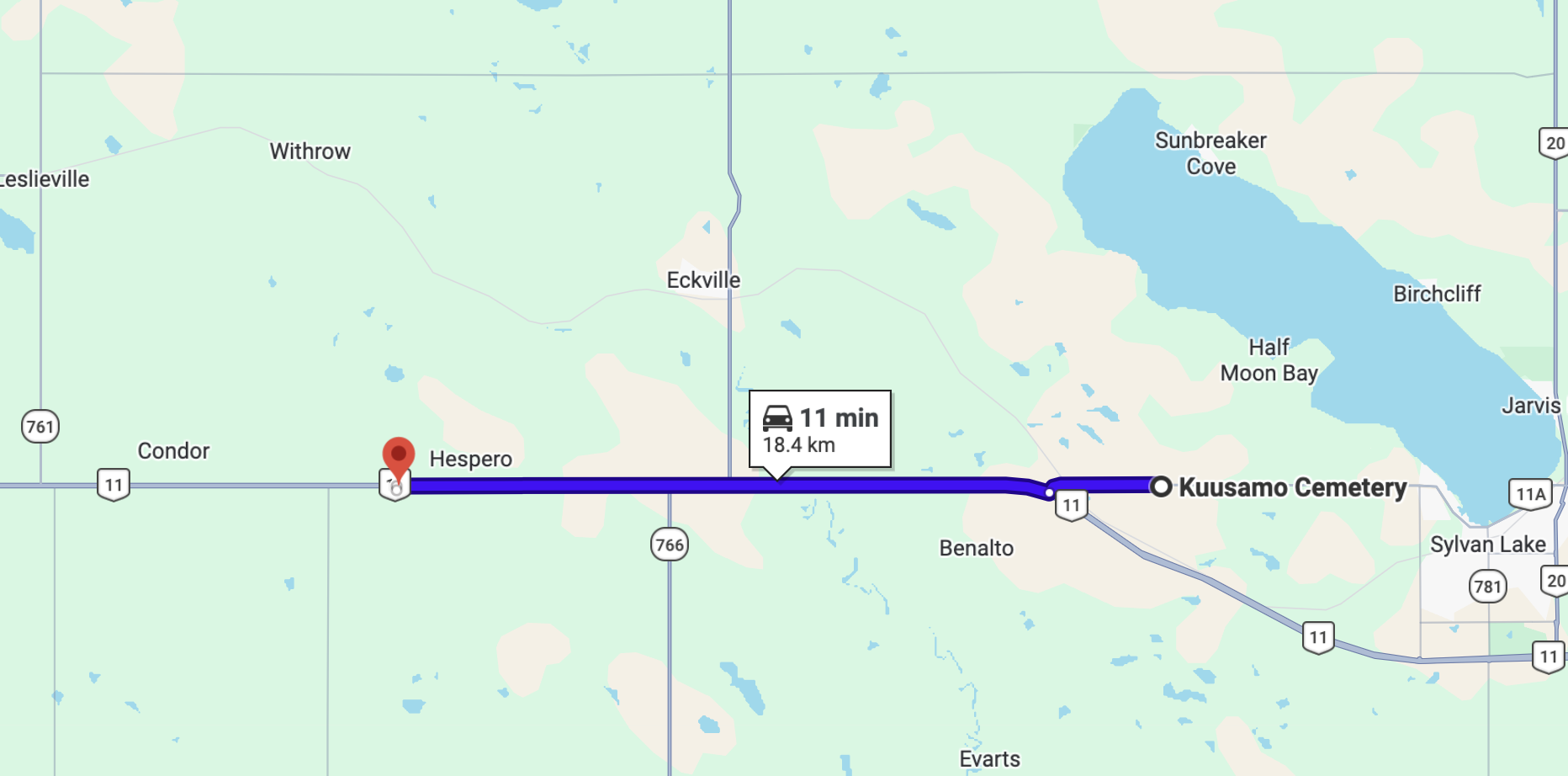
Not far to the west is another Finnish community, now marked — just like Kuusamo — with a cemetary. Read more about Hespero here.
Kuusamo in Alberta’s grain records
The Kuusamo name also became attached to a railway and grain-handling point.
Alberta’s provincial place-name reference located the railway point at 5-26-38-2-W5 and noted that the later Kuusamo School site was near a United Grain Growers elevator. The federal Canadian Geographical Names Database continues to list Kuusamo as an official Alberta railway point.
The name was still being used by the grain industry a century after the school district was created.
As of Aug. 1, 2002, the Canadian Grain Commission listed Kuusamo as a Canadian National Railway station with a licensed primary elevator operated by United Grain Growers Limited under the Agricore United name. The elevator had a recorded capacity of 5,180 tonnes.
The railway designation, school records and cemetery preserved the name even as residents increasingly used Sylvan Lake, Benalto and other nearby communities as their postal and commercial centres.
A Finnish district in central Alberta
Kuusamo’s documented history begins with Finnish families who arrived through the United States and established homesteads southwest of Sylvan Lake.
When those families needed a school, Peter Wetelainen and A. Parvi drew straws to decide who would name the district. Wetelainen chose the name of the Finnish community where he had been born.
Over the next 50 years, Kuusamo School educated children from the surrounding farms and provided space for meetings, performances, religious services and community celebrations. Two cemeteries, Finnish halls, a railway point and a grain elevator further established Kuusamo as a recognizable part of central Alberta.
The school buildings are gone, but Kuusamo remains an official Alberta place name—and a direct record of the Finnish families who established their lives there.
Did someone in your family attend Kuusamo School or live in the district southwest of Sylvan Lake? Nordic Prairie Life would like to hear from descendants with photographs, documents or family stories.




In 1888, David — or Taavetti — Kautonen registered a 160-acre quarter-section northeast of Whitewood, in the District of Assiniboia in what was then the North-West Territories. His claim, SW-36-17-1-W2, placed him within the Dominion survey grid that was reshaping the geography of settlement across the Prairies.