
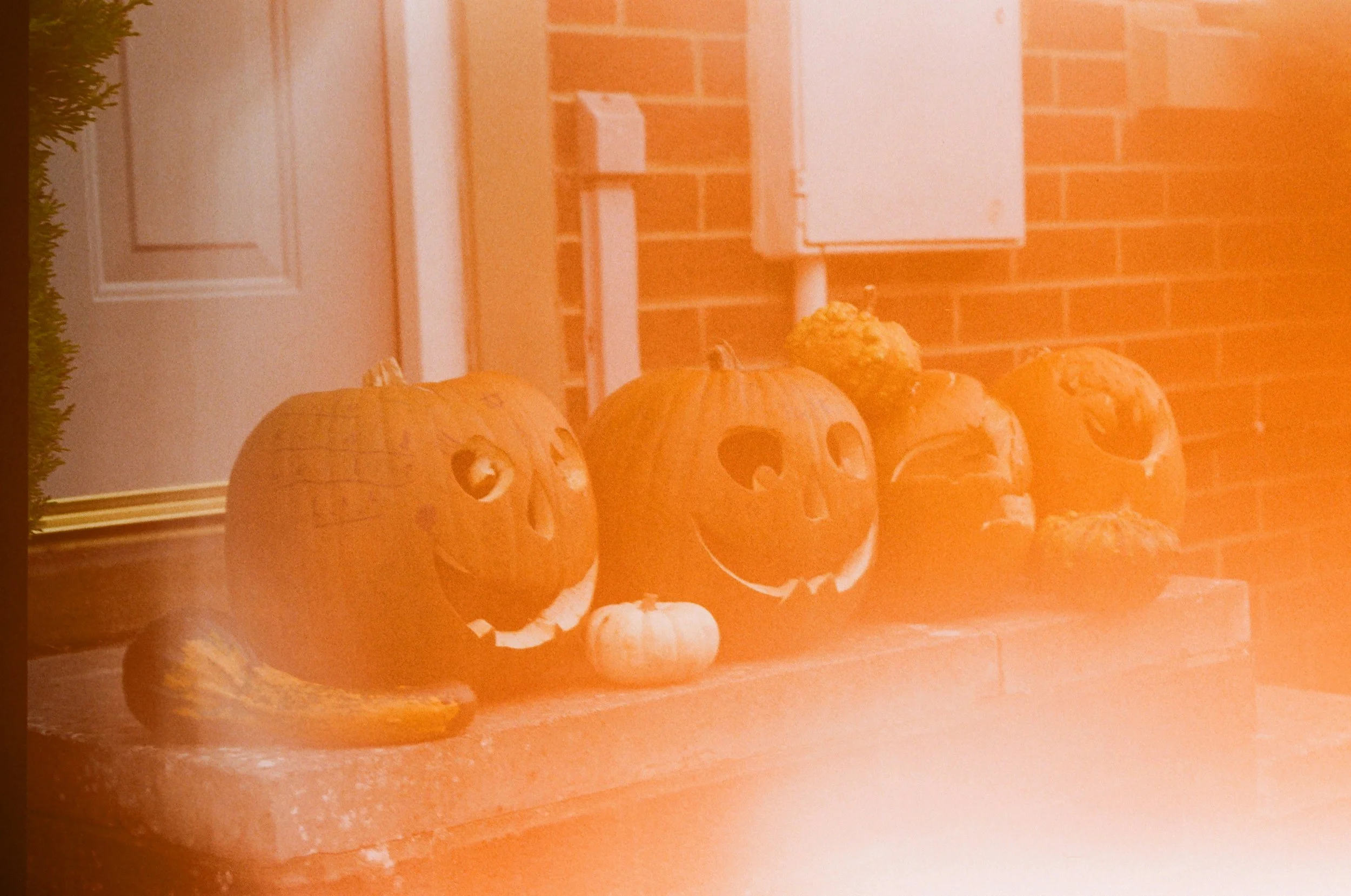
Carved pumpkins decorate a front porch in a contemporary Halloween photograph. The scene is illustrative, not an archival view of Canadian celebrations.
Photo credit: Nik
In Sault Ste. Marie, Ontario, Halloween night in 1917 brought snow, disguises and an ultimatum at the front door. The next morning, the Sault Daily Star described groups of children wearing masks, large hats, long skirts and loose trousers. Some had soaped windows; others had been throwing snowballs. As the youngsters made their rounds, the newspaper reported, householders could hear the call: “Tricks or treats.”
The treat was not necessarily candy. According to the November 1 account, a householder who handed over a coin could expect to avoid being targeted, at least until another group came along. The report belongs to a Halloween that was already familiar in Canadian towns, even if its rules differed from those of today's orderly doorstep visits. It also complicates a frequently repeated story that the phrase “trick or treat” first appeared in Alberta in 1927.
So who brought Halloween to Canada? Irish and Scottish immigrants were among its most important carriers during the nineteenth century. What Canadians eventually made of the holiday developed through neighbourhood customs, clubs, churches, schools and businesses. There is no documented national starting line or single immigrant community to which the entire celebration can be credited.
From Scottish customs to Canadian parties
Halloween takes its name from All Hallows' Eve, the evening before the Christian feast of All Saints on November 1. Its history also intersects with older seasonal observances in Ireland and Scotland, including traditions associated with Samhain. The relationship between those practices and modern Halloween was a long process of change. By the nineteenth century, the customs carried across the Atlantic included disguises, mischief, gatherings around the fire and games intended to reveal something about a future sweetheart or marriage.
Apple-bobbing, trying to bite an apple suspended on a string, and roasting nuts were familiar Halloween entertainments. The City of Edmonton Archives records games of divination and courtship in its early Halloween material. Canadian newspapers recorded other forms of Halloween observance decades earlier: historian Nicholas Rogers cites an 1866 Kingston Daily News account of masked youngsters roaming the streets after dark and making candlelit faces from pumpkins.
In Western Canada, the paper trail soon extends beyond the family parlour. An advertisement in the Edmonton Bulletin on October 17, 1902, announced a Halloween ball at Robertson Hall to raise money for the Public Hospital. The City of Edmonton Archives identifies it as the earliest Halloween party documented in its local collection. Costumes and dancing were accompanied by tea, coffee, cakes and sandwiches.
Scottish identity remained explicit in some events. In 1908, the Edmonton Caledonian Society invited members to celebrate what it called an “old-fashioned Scottish festival,” according to research by Alberta heritage historian Allan Rowe.
Tricks, treats and trouble on the Prairies
Newspaper editors were particularly attentive to street pranks. In an 1897 report from Innisfail, the Calgary Herald described several small buildings being moved around town on Halloween. Provincial heritage historian Allan Rowe found comparable stories from other Alberta communities and years, involving gates removed, windows soaped and wagons shifted. Such incidents were often described as harmless mischief, although the people whose property disappeared might have disagreed.
Rowe's survey of Alberta newspapers found that Halloween damage in Edmonton in 1917 included vandalism directed at Chinese laundries, as well as damage to sidewalks, fences and outbuildings. The Edmonton Bulletin condemned the destruction.
The emerging demand for a treat could serve as a bargain between children and householders. The Sault Ste. Marie report from 1917 records it plainly. Other Prairie accounts have been traced through later transcriptions of the newspapers, rather than independent inspection of the original pages. The Edmonton Bulletin reported the variation “Treat up or tricks” in 1922. In Saskatchewan, a 1923 dispatch from Rouleau in the Regina Leader said that treats prevailed over tricks; the Saskatoon Daily Star described children seeking treats in Rosetown, where merchants supplied fruit and candy and wagons were moved about.
By 1925, the Red Deer News was describing children making house-to-house visits in costume and using the words “trick or treat.” Household supplies included candy, peanuts and apples. The newspaper also recorded signs hoisted onto telephone poles and vehicles moved about.
The more famous record comes from the Blackie Times of November 3, 1927, which printed the same familiar phrase. For years, Blackie and nearby southern Alberta towns were cited as the location of its earliest newspaper appearance. Calgary's Lougheed House has since drawn attention to the earlier 1917 Ontario and 1925 Red Deer reports. These printed examples tell us when particular words appeared in surviving newspapers; they cannot establish precisely where someone first spoke them.
The Halloween Nordic newcomers encountered
Immigrants from Iceland, Norway, Sweden, Denmark and Finland developed Prairie communities with churches, schools, newspapers and associations. Their histories also intersect with federal settlement policy. In 1875 the Canadian government reserved land on the western shore of Lake Winnipeg for New Iceland; Icelandic immigrants settled there in 1875 and 1876. According to Fisher River Cree Nation's account of its own history, Chief David Rundle's people had requested land near Grassy Narrows and the Icelandic River but were refused in 1875 because it was being reserved for Icelandic settlement. Under Treaty 5, the government offered them reserve land at Fisher River instead. Gimli lies within Treaty 1 territory, with longstanding Anishinaabe and Red River Métis histories; the Treaty 5 land decision involved a different location.
Scandinavian immigrants also formed associations in Alberta communities where Halloween was already reported. In Edmonton, a Scandinavian youth and literary circle began producing the Norwegian-language paper Vikingen in 1911. Historian Per Anders Rudling examined surviving handwritten issues and found debates about language, women's suffrage and prohibition. The newspaper records how its contributors approached life in Canada, but the material located for this article does not establish that they held a Halloween celebration.
Finnish settlers near Sylvan Lake developed institutions of their own. In 1924, members of a Finnish young people's society built Unity Hall for dances, plays, meetings and church services. A later local history describes the group's eventual switch to English-language meetings to include more young people. That is evidence of cultural adjustment, but no contemporary record of a Halloween event at Unity Hall has been established.
These examples place Nordic immigrant associations within Prairie communities where Halloween was already taking hold. They do not show particular Finnish, Icelandic or Norwegian families adopting the holiday. No named household or Nordic organization has been identified in a contemporary Halloween notice examined for this article.
How Halloween became familiar
Community organizations also sought to make Halloween more manageable. During the 1920s, Edmonton's YMCA and other groups offered organized activities, and an October 1929 Edmonton Bulletin report describes an Optimists' Halloween party in Glenora. Churches and clubs held gatherings as well. According to a newspaper transcription gathered by researcher Barry Popik, Porter's Pharmacy advertised “Trick-or-Treat Candy” in the Red Deer Advocate on October 25, 1928.
After the Second World War, trick-or-treating expanded into a more widespread annual routine, according to Rowe's account of Alberta Halloween. The change should not be mistaken for the invention of candy-giving: Rosetown shops had supplied fruit and candy in 1923, and Red Deer householders were distributing sweets, nuts and apples in 1925.
A Gavinchuk Studio photograph from 1951 records a Halloween party at Smoky Lake School in rural Alberta, decades after Prairie newspapers described costume gatherings, children seeking treats and pranks in the streets.



In Sault Ste. Marie, Ontario, Halloween night in 1917 brought snow, disguises and an ultimatum at the front door.