
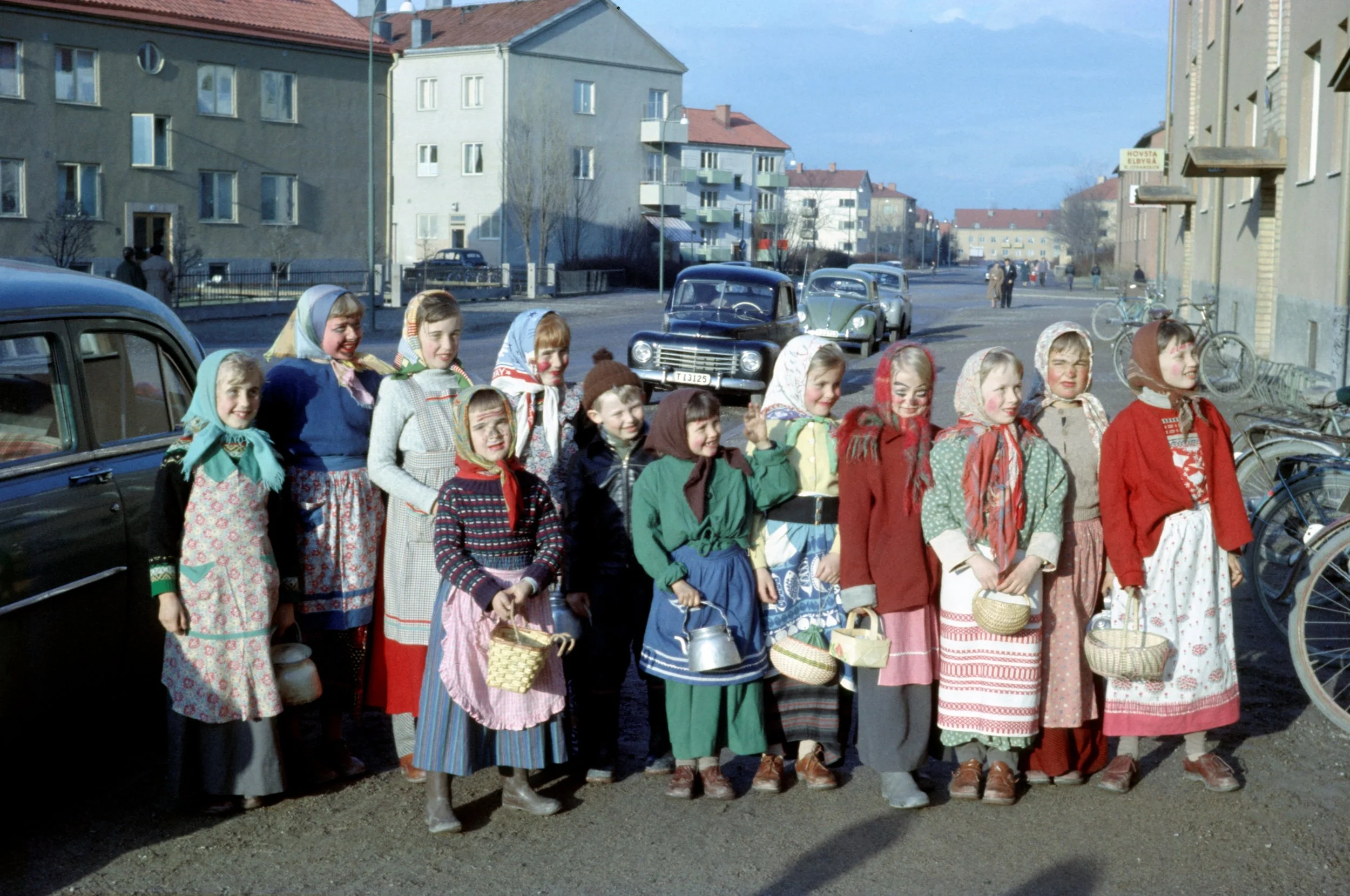
Children dressed as Easter witches on Ullavigatan in Örebro, Sweden, in 1957.
Photo credit: Anders Andersson / Örebro läns museum,
When Edvard Andersson recalled the Easter masquerades of his youth in Värmland, the disguises were designed to fool the neighbours. Boys dressed in women's clothes and girls in men's. They put on old rags, blackened their faces with soot and sometimes wore their shoes on the wrong feet. Moving from farm to farm, they disguised their voices, played tricks and drew the people they visited into dances. Their reward might be something to eat or drink.
Andersson, born in 1857 in Nedre Ullerud, left this account in a recollection preserved by Sweden's Institute for Language and Folklore. His Easter visitors are recognizable ancestors of the påskkärringar, the Easter witches who still appear in Swedish towns and neighbourhoods.
Today a Swedish Easter witch is often a small child wearing a headscarf and apron, with rosy cheeks and freckles painted on. The costume may include a broom, a basket or an old-fashioned coffee pot. Children sometimes knock on doors, offer drawings or Easter cards and receive sweets in return. To a North American reader, the resemblance to Halloween is obvious.
A journey to Blåkulla
The Easter connection comes from stories once told about witches travelling to Blåkulla, a legendary gathering place where they were said to meet the Devil. In Swedish folklore, the days before Easter were considered an especially dangerous time for such journeys. Witches were said to leave on broomsticks, poles or even the backs of cattle. These were beliefs and accusations, not accounts of supernatural events that actually occurred.
Easter supplied a powerful religious setting. Maundy Thursday, or skärtorsdagen, commemorates the Last Supper in the Christian calendar. Holy Saturday, påskafton, comes just before the celebration of the Resurrection.
People took precautions against what they feared. Folklore records describe brooms and other possible flying implements being hidden, tar crosses painted on barn doors and steel placed near entrances. Easter fires and loud reports could also be explained as attempts to drive troublesome powers away. In an account from Vitsand in Värmland, Marrit Jönsson, born in 1850, remembered fears that witches might enter through chimneys or ride farm animals to Blåkulla.
The deadly history behind the stories
The Blåkulla stories also belong to one of Sweden's most disturbing historical episodes. During the major witch persecutions of 1667–1676, people were accused of making pacts with the Devil and carrying children away to witches' gatherings. The Swedish National Archives, Riksarkivet, preserves records from these proceedings, including testimony from children who said they had been taken to Blåkulla at night.
Riksarkivet estimates that a couple of thousand people were accused during the persecutions of 1667–1676. Special witchcraft commissions sentenced approximately 300 women and men to death. Most of those executed during the major persecutions were women.
The children now wearing witch costumes are separated from those trials by centuries of change. It would be misleading to draw a straight line from the courtrooms of the 1600s to an Easter basket filled with candy. Historical evidence for the masquerading custom becomes much clearer later, particularly in the nineteenth century.
When the witches came calling
Folklorist Fredrik Skott has studied the Swedish Easter-witch tradition through historical records and accounts collected from people who remembered older customs. His research places many nineteenth-century masquerades in western Sweden, including Värmland, Halland, Bohuslän and neighbouring districts.
The participants were often young people, rather than the small children most closely associated with the custom today. Some dressed as witches; others appeared as påskgubbar, or Easter old men, or as other frightening and comic figures. Homemade masks, borrowed clothes, soot and exaggerated behaviour helped conceal their identities. Visitors might perform, dance or ask for refreshments, but some visits were unwelcome. In a recollection from Östra Emtervik in Värmland, Anna Katarina Nilsson described scratching on house walls, disturbances at windows and stones dropped down chimneys.
Easter letters, known as påskbrev, were another part of these festivities. Disguised visitors could toss illustrated greetings or comic verses into a house and run away without waiting for a response. Others who visited homes accepted refreshments. Today, children may hand over drawings or Easter cards openly and receive sweets.
There was no single Swedish rule about when witches were abroad. The Institute for Language and Folklore notes that Maundy Thursday was especially associated with Blåkulla journeys in much of Sweden, while in western Sweden Easter Saturday often carried that association. The difference also affected masquerades, fires and visiting customs. Even today, children may go calling on Thursday or Saturday, depending on where they live; in some places they visit on several days.
A children's custom takes over
During the twentieth century, the Easter masquerades spread more widely and became increasingly centred on younger children. The frightening masks and deliberate attempts to remain unrecognized gave way to costumes adults could easily recognize and children could wear comfortably. The headscarf, long skirt and apron became familiar features, along with freckles and a dab of red on the cheeks.
The transformation did not mean every community followed the same path. Door-to-door visits remain part of the tradition in some places, while elsewhere adults organize Easter parades and other activities. The Institute for Language and Folklore notes that parades allow small children to take part without visiting strangers' homes on their own.
There is also a visual difference between the Swedish Easter witch and the witch familiar from Halloween. A tall, pointed black hat is central to the modern Halloween costume, but Swedish Easter witches traditionally wore headscarves. Skott has traced how the pointed hat became a stronger witch symbol in Sweden alongside the growth of Halloween in the 1990s.
Sweden is not alone in having witches appear at Easter. In Swedish-speaking parts of Finland, children have also dressed as Easter witches. In other Finnish communities, dressing up has mixed with virpominen, a Palm Sunday custom involving decorated willow twigs and spoken good wishes.
The soot in Andersson's recollection helped masqueraders avoid recognition. Today, the painted freckles help identify a child's costume as that of an Easter witch.
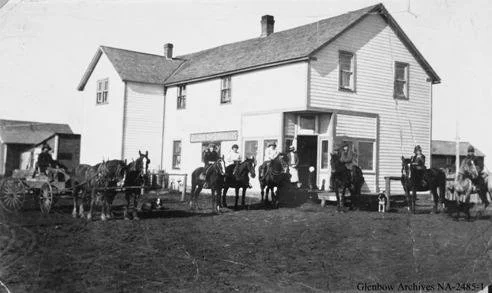



In Sault Ste. Marie, Ontario, Halloween night in 1917 brought snow, disguises and an ultimatum at the front door.