
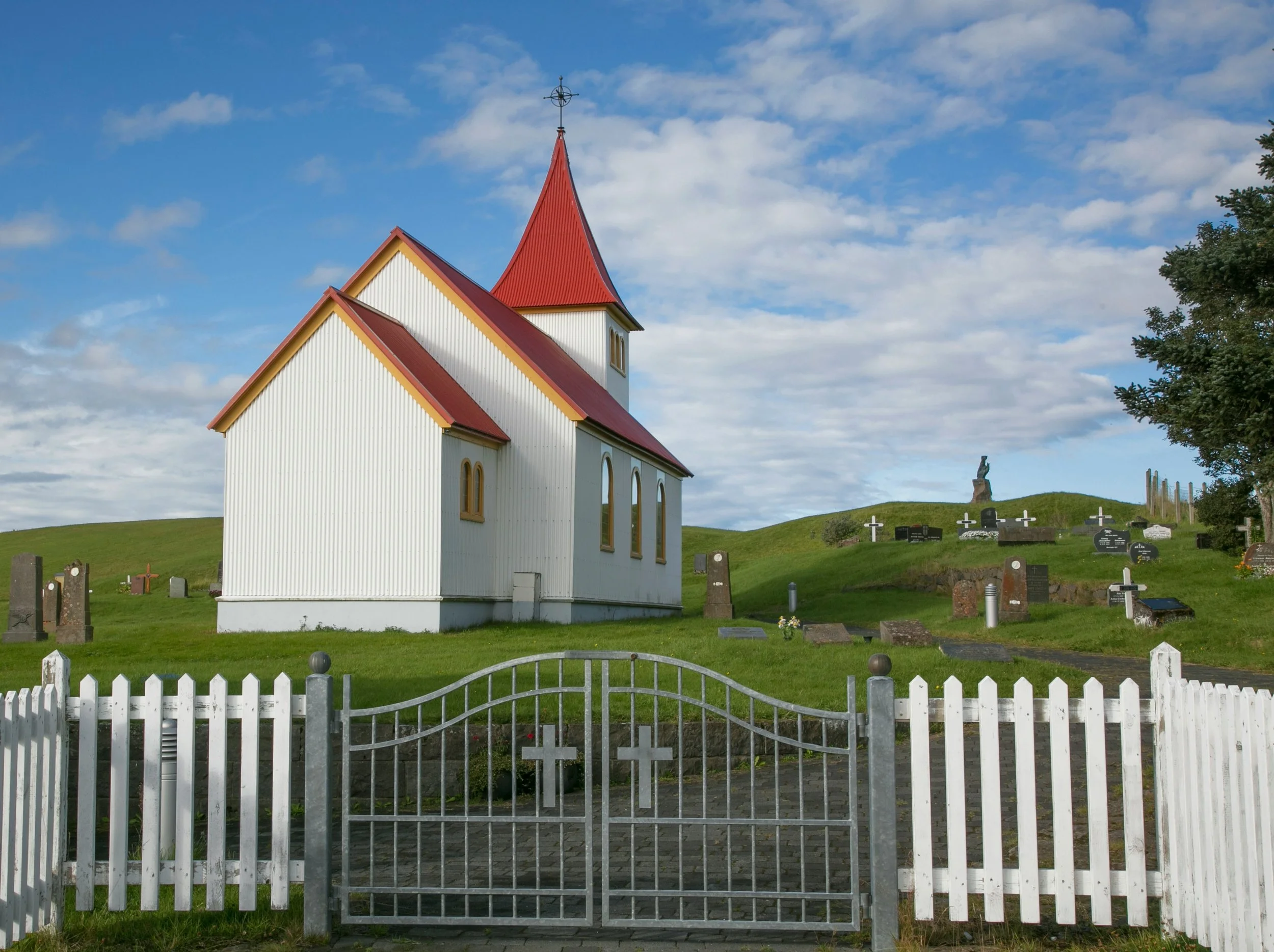
A rural Icelandic church and graveyard. The photograph is illustrative; the precise location of the ghost story is unknown.
Photo credit: elvira Butler
An Icelandic ghost story recorded in nineteenth-century Canada begins with a hired man who insists he will take his employer's daughter to Christmas mass. She has always remained at the farm while the rest of the household attends church, and tells him so. He refuses to accept her answer.
By autumn the man has drowned in a pond and been buried in the churchyard. At Christmas, the ghost returns for her. Before joining him on horseback, the young woman fetches an old cape belonging to her father and fastens it loosely around her neck.
The tale takes place in Iceland. In Canada, Sigríður Pétursdóttir told it to the writer Torfhildur Þorsteinsdóttir Hólm, who recorded it.
Their names appear in a piece of folklore research published in March 2026. In Scottish Studies, folklorist Rósa Þorsteinsdóttir examines seven Icelandic versions of a tale known internationally as The Dead Bridegroom. One was preserved by Torfhildur in Canada after 1876.
A writer in New Iceland
Torfhildur arrived in Canada in 1876, the year after the death of her husband, Jakob Holm. Born in Iceland in 1845, the daughter of a Lutheran minister, she had studied in Reykjavík and Copenhagen and worked as a teacher. Her journey west was made in the company of Rannveig Briem, who was joining her husband, Sigtryggur Jónasson, in the recently established Icelandic settlement along Lake Winnipeg.
New Iceland lay outside Manitoba's provincial boundaries when the first Icelandic settlers arrived in 1875. The federal government had reserved a large tract on Lake Winnipeg's western shore for Icelandic colonization, then administered as part of the North-West Territories. In October 1876, the area became part of the new District of Keewatin. It entered Manitoba when the province's boundaries expanded in 1881.
Before New Iceland was created, Cree and Anishinaabe communities lived and worked along Lake Winnipeg's western shore. Fisher River Cree Nation records that in 1874 a group led by Chief David Rundle asked to relocate to Grassy Narrows and the White Mud River, where they had relatives and fishing grounds. The government rejected their request in 1875, reserving that land for Icelandic settlers, and offered Fisher River instead.
The Sandy Bar band had a separate claim nearby. Historian Ryan Eyford documents its unsuccessful reserve request and an 1876 confrontation between John Ramsay and Icelandic settler Ólafur Ólafsson, known through a settler's reminiscence written in 1919. That recollection describes a local arrangement after a Dominion Indian agent upheld the settler's building claim; it did not resolve the wider question of Indigenous land rights. Eyford also links the 1876–77 smallpox epidemic and government quarantine measures to Sandy Bar's displacement.
Torfhildur entered a community dealing with disease, land claims, uncertain livelihoods and the work of establishing local institutions. Icelandic-language newspapers and other forms of communication helped connect settlers whose homes were spread along the shore. How much of this experience directly influenced her decisions as a folklore collector is not recorded.
According to the Dictionary of Canadian Biography, she spent much of her first two years in Canada recording oral tales from Icelandic immigrants. In August 1879, her short story “Tárablómið” appeared in Framfari, the settlement's Icelandic-language newspaper. Her historical novel Brynjólfur Sveinsson biskup was published in Reykjavík in 1882. After spending her early Canadian years in and around New Iceland, she moved to Winnipeg in 1885 and supported herself through teaching and writing until she returned to Iceland in 1889.
Among the people whose stories she recorded was Sigríður Pétursdóttir, born in 1841. Rósa identifies Sigríður as a woman from eastern Iceland who emigrated in 1876 and lived in Winnipeg. Torfhildur attributed twenty-four accounts to her, including a tale titled “Draugur vitjar konuefnis,” translated in Rósa's study as “A ghost visits his intended wife.”
We do not know precisely when or where Sigríður told Torfhildur this particular story. The defensible recording window is 1876 to 1889, the period of Torfhildur's Canadian residence.
The girl who expected the ghost
The girl does not appear to mistake the rider for a living man. Rósa notes her apparent foreknowledge, a feature absent from some of the other Icelandic versions. The old cape is essential to her escape.
On the ride, the ghost repeatedly asks her to look at the back of his neck. She avoids doing so. At the church, he asks her to wait while he attends to the horse, but she runs for the doors. He seizes her cape; it slips away, and she escapes inside.
Afterwards the young woman tells the others what happened. The priest's horse is found dead outside the churchyard, its bones broken, while the cape lies on the hired man's grave.
Rósa recounts these details from Torfhildur's collection, Þjóðsögur og sagnir, edited by Finnur Sigmundsson and published in Reykjavík in 1962. Her 2026 study compares the account with other Icelandic tellings.
A different version of the Deacon of Myrká
Many Icelandic readers would recognize the outline from The Deacon of Myrká, the country's famous story of a dead lover returning on horseback at Christmas. In one early recorded version, the deacon dies while crossing a swollen river. His beloved does not realize he is dead when he arrives to collect her. As they ride, his words and the wound at the back of his head betray him. Church bells eventually save her.
The German scholar Konrad Maurer recorded a version of the deacon story during his 1858 visit to Iceland and published it in 1860. Jón Árnason's landmark folklore collection, beginning in 1862, brought other tellings into print. Some accounts give the dead man a different occupation, change the woman's knowledge of his death or allow her to escape without the help of bells.
In the seven versions Rósa compares, the woman survives every time. The means of escape varies. In some, ringing bells sends the ghost away. In others, a loose garment is left in his grasp. Elsewhere the woman leaps from the horse.
The relationship between the characters also changes. The deacon and the serving girl have unequal social standing; in several versions from eastern Iceland, including Sigríður's, the dead suitor is a hired man and the woman is a farmer's daughter. In another, both are servants.
These distinctions are central to Rósa's reconsideration of the tale. She questions readings that treat its most elaborate version as evidence of a direct survival from pagan Scandinavian belief. Many of the other tellings, she notes, concern a woman refusing the attentions of a man who then returns to pursue her after death. The pattern resembles stories of retaliation by the dead as much as romantic tales about lovers reunited.
The Dead Bridegroom is an international folktale type, numbered ATU 365 by folklorists. Rósa also examines parallels with the English ballad The Suffolk Miracle, sometimes called The Holland Handkerchief. She suggests that contact between English traders and Icelanders could have brought forms of the story to Iceland centuries before nineteenth-century collectors wrote them down. It is a possible route of transmission, not a demonstrated account of this particular tale's origin.
Features distinguishing Sigríður's telling also appear in accounts collected in eastern Iceland. The surviving evidence gives no basis for attributing this version's differences to immigration to Canada.
The women behind the collected tales
In her 2023 University of Iceland doctoral thesis, folklorist Júlíana Þóra Magnúsdóttir examines the traditions of Icelandic women and the collecting practices through which those traditions entered written archives. Her analysis finds that roughly two-thirds of the named narrators in Torfhildur's collection were women. That makes the surviving names useful evidence of whose voices a particular collector considered worth preserving, though it tells us less about how representative those voices were of the whole immigrant community.
Torfhildur herself occupied a difficult position in Icelandic literary life. After returning home in 1889, she continued publishing novels, short fiction and periodicals. In 1891 the Icelandic government granted her a writer's pension, an unusual recognition for a woman author at the time. The award prompted criticism and political argument, and its amount was subsequently reduced.
Dagrún Ósk Jónsdóttir, writing in 2025 about Torfhildur and the emergence of the female author in Iceland, describes a writer who attracted readers while facing reviewers inclined to judge her intellect and ambition through her sex. Dagrún also cautions against assuming that books or tales written and collected by women necessarily challenged the gender expectations of their time. Some of Torfhildur's writing upheld conventional ideas about religion, marriage and women's roles.
Sigríður's ghost story should be read with that complexity intact. The farmer's daughter finds a way to protect herself, but the narrative also belongs to a rural world in which a male worker's claim upon a woman becomes a threat. We cannot know what Sigríður intended her listeners to take from it. Her telling is available because her name was attached to a recorded account, a detail that is often missing when folktales are reproduced as anonymous national traditions.
What the Canadian record preserves
The collected story retains its Icelandic setting of farm work, Christmas mass and churchyards. Its entry into Torfhildur's collection is undated, and the evidence cannot show how widely it circulated among Icelandic Canadians.
Torfhildur died in 1918, two years after Sigríður. When Finnur Sigmundsson published Þjóðsögur og sagnir in 1962, he grouped twenty-four accounts under Sigríður's name. “Draugur vitjar konuefnis” appears there on pages 68–69.




An Icelandic ghost story recorded in nineteenth-century Canada begins with a hired man who insists he will take his employer's daughter to Christmas mass.