
From Norwegian Folklore to Alberta Ballet: The Long Life of Peer Gynt
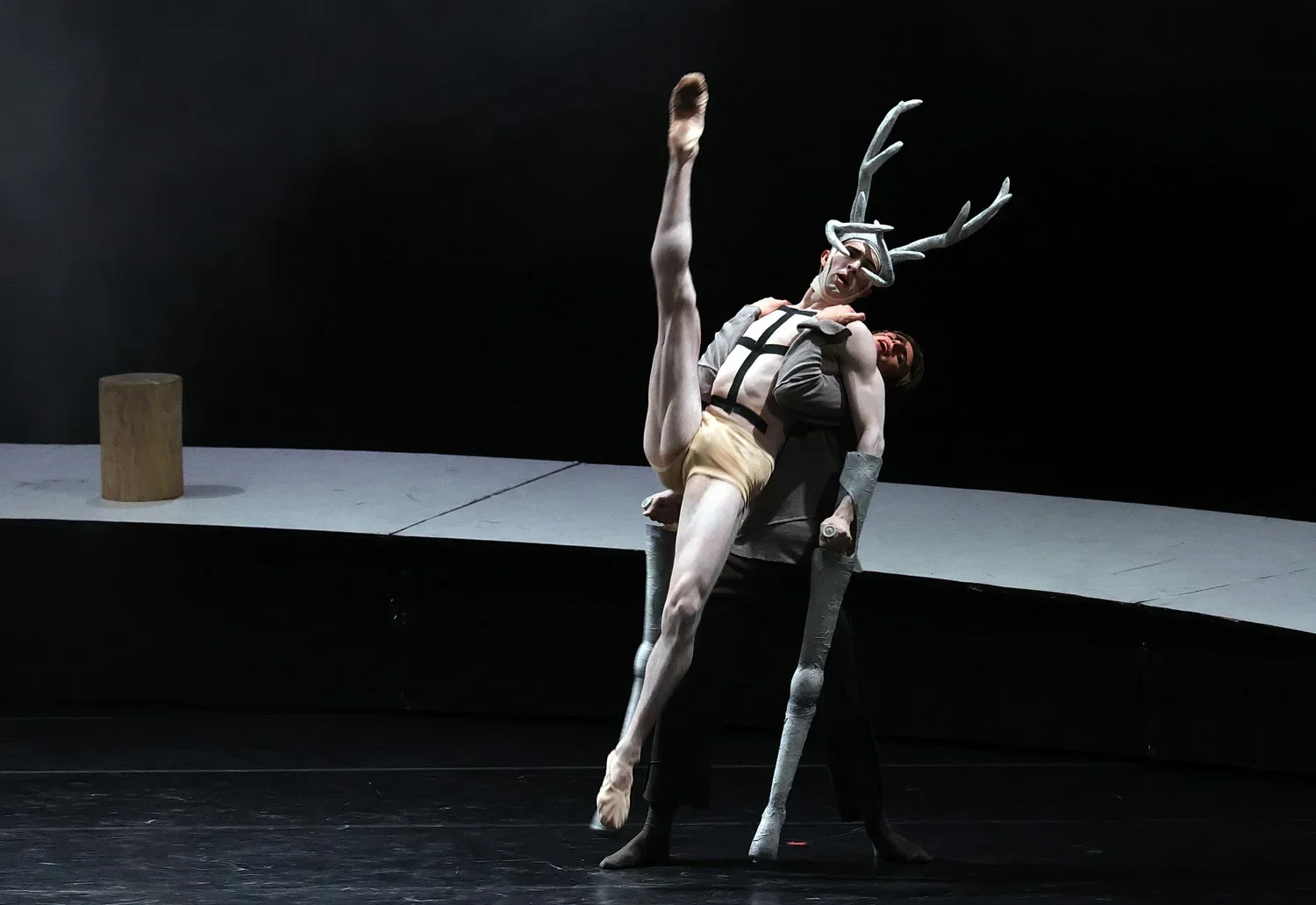
Navrin Turnbull as Peer Gynt supports Emanuele Cazzato as the Deer in Edward Clug's Peer Gynt at Teatro alla Scala in Milan.
Photo credit: Brescia e Amisano / © Teatro alla Scala
When Henrik Ibsen published Peer Gynt in 1867, he gave Norway a protagonist who was difficult to admire. Peer was a boastful, self-serving young man with an extraordinary imagination, a talent for avoiding responsibility and an appetite for adventures that rarely turned out as he expected.
Writing in Norsk Folkeblad on November 23, 1867, Norwegian author Bjørnstjerne Bjørnson praised its satire of Norwegian self-interest and complacency, although he thought the five acts excessively long. Danish critics Clemens Petersen and Georg Brandes subsequently challenged aspects of the poem, provoking an especially angry response from Ibsen.
Nearly 160 years later, Peer Gynt remains one of Norway's best-known literary works. It has been performed in theatres around the world, adapted into music and dance, and celebrated in the Norwegian region where its legendary protagonist originated.
In October 2026, the story reached Alberta Ballet as a contemporary production by choreographer Edward Clug. I attended its Edmonton performance on October 24 and found it imaginative, entertaining and thoroughly enjoyable. I knew surprisingly little about the original story, even though I recognized several pieces of its famous music.
The legendary Per Gynt of Gudbrandsdalen
The original Per Gynt belonged to the oral storytelling traditions of Gudbrandsdalen, a mountainous valley region of central Norway.
In August 1842, Norwegian folklore collector Peter Christen Asbjørnsen met fifteen-year-old Engebret Hougen in Sel and recorded stories that included Per Gynt's adventures. Asbjørnsen incorporated the material into his account of a mountain journey, published in the second collection of Norske Huldre-Eventyr og Folkesagn in 1848.
The legendary Per Gynt was a hunter associated with the mountains around Gudbrandsdalen. His adventures included encounters with supernatural beings, among them trolls and the mysterious Bøyg, a creature that obstructed his passage through the mountains.
Asbjørnsen was part of a larger nineteenth-century movement to document Norwegian oral traditions. Working with fellow collector Jørgen Moe, he helped preserve stories that became central to Norway's emerging national literature. Their collections began appearing in 1841, during a period of growing interest in Norwegian language, history and cultural identity.
Ibsen travelled through Gudbrandsdalen in 1862 while collecting folklore, but scholars have found no written evidence that he heard a Per Gynt story on that journey. Asbjørnsen's published account provides a documented connection between the legends and Ibsen's poem.
In an August 1867 letter to his publisher, Ibsen described Per Gynt as a person he believed had actually lived. A written reference to a figure named Peder Jynt survives from 1831, but the evidence does not establish that one identifiable man was behind all the later legends.
Ibsen took considerable liberties with the character. His Peer retained the hunter's extraordinary adventures and encounters with mountain creatures, but became a vehicle for examining Norwegian society and the human tendency toward self-deception.
Henrik Ibsen: Norway's troublesome playwright
Henrik Ibsen was born in Skien, Norway, on March 20, 1828. His family experienced financial difficulties during his childhood, and at fifteen he moved to Grimstad, where he became an apprentice pharmacist.
He began writing plays as a young man and subsequently worked in the theatre, first in Bergen and later in Christiania, the city now known as Oslo. His practical experience included directing, writing and managing productions, although his early theatrical career was marked by professional and financial difficulties.
In 1864, Ibsen left Norway for Italy. He would spend the next 27 years living abroad, principally in Italy and Germany.
His 1866 dramatic poem Brand, about a religious idealist whose uncompromising principles bring suffering to himself and those around him, established his literary reputation across Scandinavia. Peer Gynt, published the following year, offered an almost opposite personality: a man whose determination to evade obligations allows him to drift through an extraordinary assortment of identities.
A Doll's House (1879) examined marriage and women's independence through the character of Nora Helmer, whose decision to leave her husband and children provoked considerable controversy. Ghosts (1881) confronted inherited disease, sexual morality and family hypocrisy. An Enemy of the People (1882) explored the conflict between public opinion and an individual determined to expose an uncomfortable truth.
His later psychological dramas, including The Wild Duck (1884) and Hedda Gabler (1890), helped establish his place among the most influential playwrights in modern theatre.
Ibsen returned to Norway in 1891 and spent his final years in Christiania, where he died in 1906.
Today, his former apartment is preserved as part of the Ibsen Museum in Oslo, while Norwegian academic institutions continue to study his writings, correspondence and theatrical history.
What happens in Peer Gynt?
Ibsen's story follows Peer from his youth in Gudbrandsdalen through a series of adventures that carry him far beyond Norway.
At the beginning, he is living with his mother, Åse, who has little patience for his boasting. Peer tells elaborate stories about his exploits, including a spectacular ride on a reindeer buck. His mother recognizes that he has borrowed the tale from another hunter.
His behaviour grows increasingly reckless. He disrupts a wedding, runs away with the bride and eventually encounters the trolls of the mountain kingdom.
There he meets Dovregubben, the Mountain King, who offers him a place among the trolls if he will accept their peculiar understanding of identity and self-interest.
The encounter draws on Norwegian folklore, although Ibsen transforms the supernatural creatures into participants in a philosophical argument about what it means to remain true to oneself.
Peer's other encounters include the Bøyg, a strange obstacle that urges him to avoid confrontation by going around difficulties. Its advice is particularly appropriate for a man who spends so much of his life evading decisions.
The later acts carry Peer to North Africa, where he pursues wealth, status and further adventures. His fortunes repeatedly collapse, yet his ability to reinvent himself remains almost inexhaustible.
Eventually, an aging Peer returns to Norway and faces the possibility that his life has amounted to very little.
In one of the play's most memorable passages, he peels an onion, searching for its centre, only to discover layer after layer without finding a core. It is an unsettling metaphor for a man who has adopted so many different identities that he struggles to identify his own.
The mysterious Button-Moulder, who proposes melting down Peer's soul, becomes another challenge to the old man's understanding of his existence.
The conclusion brings Peer back to Solveig, the woman who has waited for him throughout his long absence. Whether their reunion represents spiritual redemption, consolation or another unresolved question remains open to interpretation.
The Norwegians, Danes and Swedes who brought Peer Gynt to the stage
Ibsen wrote Peer Gynt while living in Italy, and his publisher, Frederik Hegel of Gyldendalske Boghandel, was based in Copenhagen.
The book appeared on November 14, 1867. Its initial printing of 1,250 copies was nearly sold out before publication, and a further 2,000 copies were ready on November 28. The success of Ibsen's previous poem, Brand, had helped build the demand.
Clemens Petersen, writing in the Copenhagen newspaper Fædrelandet on November 30, questioned whether the work succeeded as poetry. Georg Brandes, reviewing it in the Danish newspaper Dagbladet on December 16, also raised objections, although his appreciation of Ibsen's poem grew in later assessments.
In a December 9, 1867 letter to Bjørnson, Ibsen responded angrily to Petersen's review; he continued debating the work's artistic principles with Brandes in correspondence two years later.
The original Peer Gynt was intended primarily as a dramatic poem for reading, rather than a conventional stage play. Its numerous locations, supernatural encounters and abrupt movements through time presented considerable challenges for nineteenth-century theatre.
By January 1874, Ibsen was working to bring the poem to the stage. From Dresden on January 23, he asked Norwegian composer Edvard Grieg to write music for a shortened theatrical version.
On February 6, Ibsen wrote to Ludvig Josephson, the Swedish director of Christiania Theatre, about presenting it as a musical drama. Josephson directed the eventual production, with Henrik Klausen in the title role.
The production premiered on February 24, 1876, nearly nine years after the poem's publication.
A review in Aftenposten the following day praised the scenery and credited Ibsen, Grieg, Josephson and Klausen with the production's success. The poem had finally become a theatrical work, with its supernatural scenes made visible to an audience.
Edvard Grieg and the music everyone knows
Edvard Grieg was born in Bergen in 1843 and became one of Norway's most celebrated composers.
His career was closely connected to the nineteenth-century development of a distinctly Norwegian musical identity. He drew inspiration from Norwegian folk melodies and dance traditions, incorporating their characteristics into works written for concert audiences.
Grieg had already achieved considerable recognition by the time Ibsen approached him in 1874.
His Piano Concerto in A minor, begun in 1868, premiered in Copenhagen on April 3, 1869, with pianist Edmund Neupert as soloist. The concerto later became one of Grieg's most widely performed works. He also wrote the Lyric Pieces for piano, songs, chamber music and the Holberg Suite, composed in honour of the writer Ludvig Holberg.
Grieg initially welcomed the commission but found the sprawling drama demanding to score. He wrote incidental music for the 1876 premiere and subsequently revised and expanded the material for later productions. The numbering of individual pieces varies among versions and editions.
In the Hall of the Mountain King accompanies Peer's encounter with the trolls, its accelerating rhythm creating an increasingly threatening atmosphere. Morning Mood, frequently associated today with peaceful landscapes and sunrise, was originally written for a scene set in North Africa.
Solveig's Song and The Death of Åse provide some of the score's most affecting passages.
Grieg later arranged selections from the theatrical music into two orchestral suites, allowing the compositions to circulate independently of Ibsen's play.
How Norway remembers Peer Gynt today
The Peer Gynt festival traces its outdoor performances at Gålå, beside Lake Gålåvatnet, back to 1989. The stage sits within the Gudbrandsdalen landscape associated with the original legends.
In 2026, Norwegian actor Thorbjørn Harr took the title role in the summer production, directed by Peer Perez Øian.
In Oslo, the National Theatre revived its Ibsen Festival in autumn 2026 after several years on hiatus. The programme includes a visiting Peer Gynt production directed by Thorleifur Örn Arnarsson, alongside productions of The Wild Duck, Hedda Gabler and The Lady from the Sea.
Peer Gynt comes to Alberta
Choreographed by Edward Clug, who was born in Romania and built his career with the Slovenian National Theatre in Maribor, the ballet premiered there on November 6, 2015. Clug also choreographed Radio & Juliet (2005), set to music by Radiohead, and a staging of Stravinsky's The Rite of Spring (2012).
The Alberta performances form part of the company's sixtieth-anniversary season, with performances in Edmonton on October 23 and 24 and Calgary scheduled for October 29–31.
Clug's adaptation retains the Norwegian literary foundation and Grieg's music while approaching the story through contemporary dance, surreal imagery and theatrical humour.
Clug expands the reindeer from Peer's opening boast into a recurring character, a deer that appears to watch over him. A personification of Death also follows Peer across the ballet. Death's continuing presence is Clug's invention; Ibsen approaches mortality through other figures and encounters, including the Button-Moulder.
In the second act, a tiny, old-fashioned aeroplane drew laughter from the Edmonton audience, one of Clug's more absurd theatrical inventions.
In the ballet, Death accompanies Åse's body on a wheeled bed around the stage's white oval walkway as Peer responds without speaking. Ibsen had written a farewell between Peer and his mother in the third act; Clug gives that scene a new visual form.
This feature expands on reporting from Alberta Ballet's October 24, 2026, Edmonton performance. An earlier review by Shara Cooper, “Review: Death steals the show in Alberta Ballet's surreal Peer Gynt,” appeared in Scene 49 on October 26, 2026.
Original review: https://www.scene49.ca/entertainment/alberta-ballet-peer-gynt-review-kelley-mckinlay





In the spring of 1893, Martin Finseth, Nels Jevning, Andrew Malmberg and John Wallerbeck travelled north from Minnesota to inspect Canadian farmland.