
The Huldra: The Beautiful Stranger in the Norwegian Forest
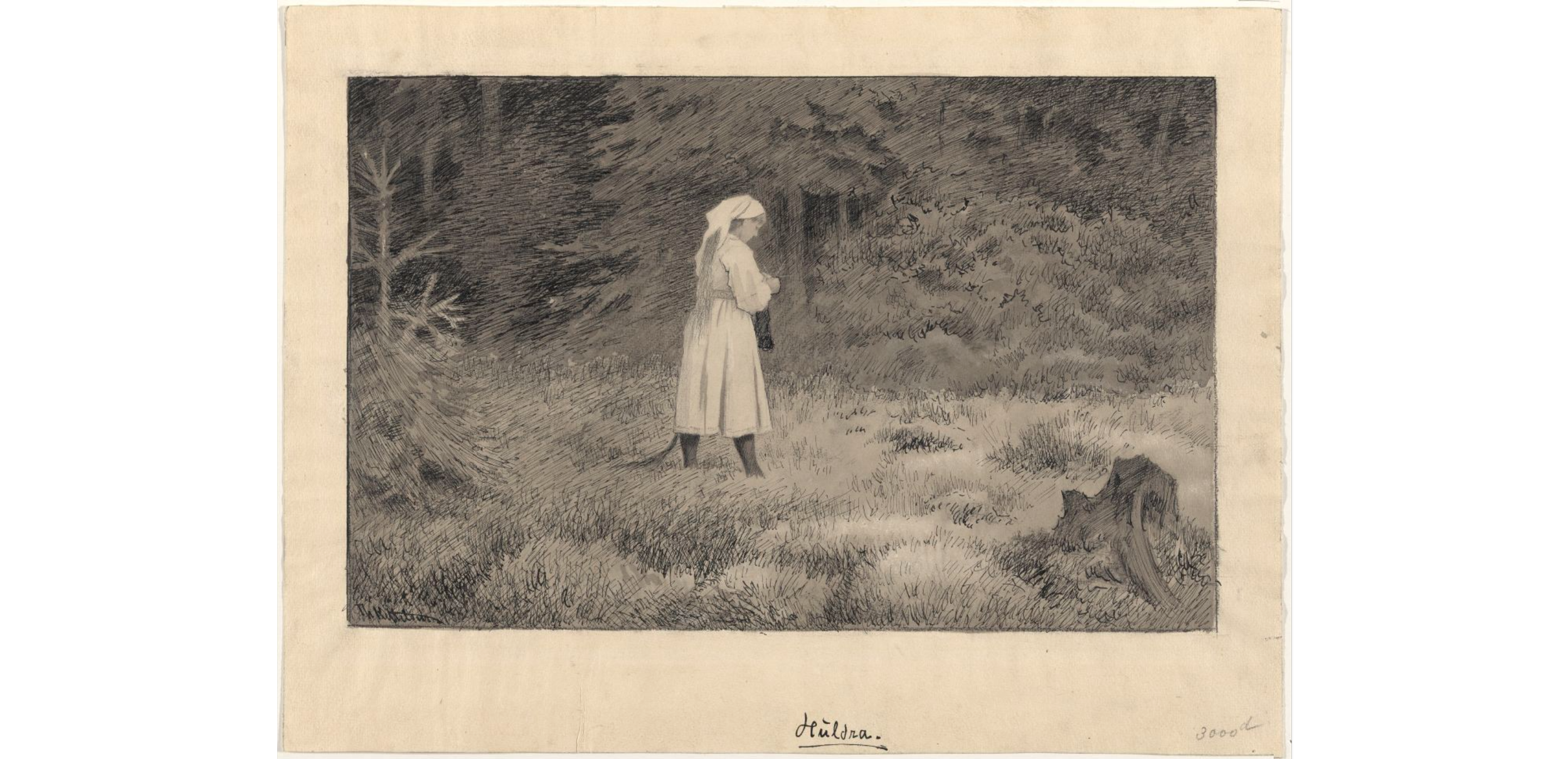
In Huldra (1891–1892), Theodor Kittelsen depicted a solitary supernatural woman standing in the woods. His drawing is a nineteenth-century interpretation of Norwegian folklore, not an illustration of any particular encounter described in this article.
Photo credit
Theodor Kittelsen / Nasjonalmuseet; digital photograph: Andreas Harvik
In a legend published by the Norwegian collector Andreas Faye in 1833, a beautiful stranger arrives at a dance. Everyone wants a turn with her. One young man gets his chance, then notices something beneath her clothes: a long tail. He knows at once whom he is dancing with. Frightened, he nevertheless manages to finish the dance without exposing her. When the music stops, he offers what sounds like an ordinary warning: “Beautiful maiden, you’re losing your garter.” The stranger vanishes. Later, according to the tale, she rewards his discretion with gifts and prosperous livestock.
Faye gives neither the dancer’s name nor the location of the gathering in his book, Norske Sagn. He is recording a legend, not documenting an eyewitness encounter. Yet the detail that matters is unmistakable. The young man recognizes the huldra, a supernatural woman of Norwegian forests and mountains, and decides to protect her secret.
The woman Faye describes generally wears a blue skirt and white head covering. Her tail gives her away, although she tries to conceal it when visiting human settlements or summer pastures. Other Norwegian accounts differ. Faye himself cautions that people across the country did not describe the same being in quite the same way. In some places her tail resembles a cow’s; elsewhere she is beautiful from the front but hollow behind, as though her back were the inside of a trough. He also records different clothing and related forest figures.
The other herd on the mountain
Many accounts place her around the seter, the mountain summer pasture where people took livestock to graze and made use of milk during the warmer months. Herds moved up from settled farms, and the work demanded long days from the people looking after them. The hidden neighbours in these stories had animals and work of their own.
In Peter Christen Asbjørnsen’s 1845 collection Norske Huldreeventyr og Folkesagn, a dairy worker named Brit tells of carrying food to her father at a mountain mill when she stopped to rest in the shade. She heard a dog bark, bells ring and a distant herding call. Soon a procession appeared: packhorses loaded with dairy equipment, splendid cattle with silver bells and a tall woman calling the animals by names Brit had never heard before. As the herd passed, Brit caught sight of a blue skirt and what she thought was a cow’s tail beneath it. Then the woman disappeared behind the small fir trees.
Brit's second encounter is almost domestic. Years later, while working at a summer pasture, she stayed out dancing until nearly morning and slept through the time she should have milked the cows. A beautiful voice outside called to “Spillevika,” her nickname, to get up and tend her animals: the singer’s cows were already on the hillside, while Brit’s were still in their stalls. When Brit hurried outside, she glimpsed the huldra at the edge of the woods.
Here the visitor neither steals a person nor demands a bargain. She points out that the work is overdue. The cattle, the milk and the timing of a day’s labour belong to both the human pasture and the hidden one.
Other tales reveal a less accommodating neighbour. Faye records a legend from Brodsjø in Gjerstad, southern Norway, where a huldra is seen leaving a newly discovered farm as an older, grey-clad woman carrying a milking pail and leading her cattle. Before she goes, she curses the finder, declaring that the person will have no luck living there until the farm has burned three times.
An invitation that could become a trap
The huldra sometimes appears alone, but Norwegian traditions also speak of huldrefolk or underjordiske, hidden people with households and livestock. Being invited into their company could be dangerous. Another story in Asbjørnsen’s “Fra Fjeldet og Sæteren” concerns Ole, a young man said to have vanished while minding cattle in Hallingdal. Searchers looked for him and rang church bells, but he was held among the hidden people.
A huldra named Gyri Ørnehovd had become attached to Ole. She treated him kindly and taught him to play the jaw harp with extraordinary skill, yet he longed to go home and recoiled from her cow’s tail. When he invoked Jesus’ name, the hidden people had to release him. Gyri warned him to keep to one side of the doorway as he left. He forgot, and a blazing bundle of brush struck him. The story says he never recovered his health, and that he continued to see Gyri long after others could no longer see her.
Asbjørnsen presented such stories within carefully composed literary scenes. The folklorist Olav Solberg has shown how his narrative frames brought orally transmitted material into the world of nineteenth-century literature. Brit and Ole should therefore be encountered as people in published storytelling, without treating every scene and exchange as a verbatim interview.
Marriage was another possibility. In Asbjørnsen’s “Huldreæt,” a young man deliberately stays behind at a summer pasture after his family leaves. Two women from the hidden community arrive. He shares his cream porridge with them and eventually marries the younger one, who is baptized. Her mother promises a substantial dowry if he treats her well. One night, after he has been unkind to his wife, the farmyard fills with cattle, horses and equipment. Later, she asks him to fell a large pine for a chopping trough, but he refuses, saying the tree is too valuable and too heavy to haul home. She fells it herself and carries the trunk home on her back. The story ends with her husband so frightened by her strength that he never dares contradict her again.
Christian signs and language appear repeatedly in the collected stories, sometimes protecting people or permitting an escape. The outcomes vary: one huldra vanishes after a discreet warning, another marries after baptism, and Gyri must let Ole go when he speaks Jesus’ name.
The Norwegian huldra also belongs to a wider landscape of northern European forest and hidden-people traditions. Sweden's skogsrå shares motifs such as the beautiful woman with a hollow back, while Icelandic huldufólk are generally described as hidden people associated with hills or rocks. Some characteristics overlap, but these traditions have their own histories. Even within Norway, the lake-dwelling nøkken belongs to a different group of encounters, though music and the danger of being lured away may sound familiar.
The old stories are unusually attentive to how people behave when they meet the unexpected. Faye’s dancer is rewarded for keeping his discovery to himself. Brit receives a reminder to milk her cows. At Brodsjø, a woman departing with her herd leaves a curse behind.



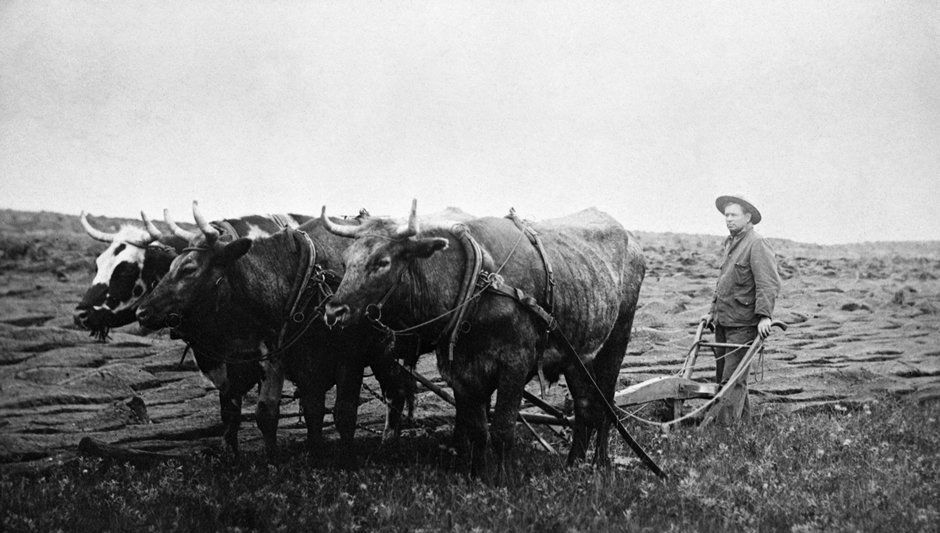


In the spring of 1893, Martin Finseth, Nels Jevning, Andrew Malmberg and John Wallerbeck travelled north from Minnesota to inspect Canadian farmland.