
The Mechanics of the Homestead
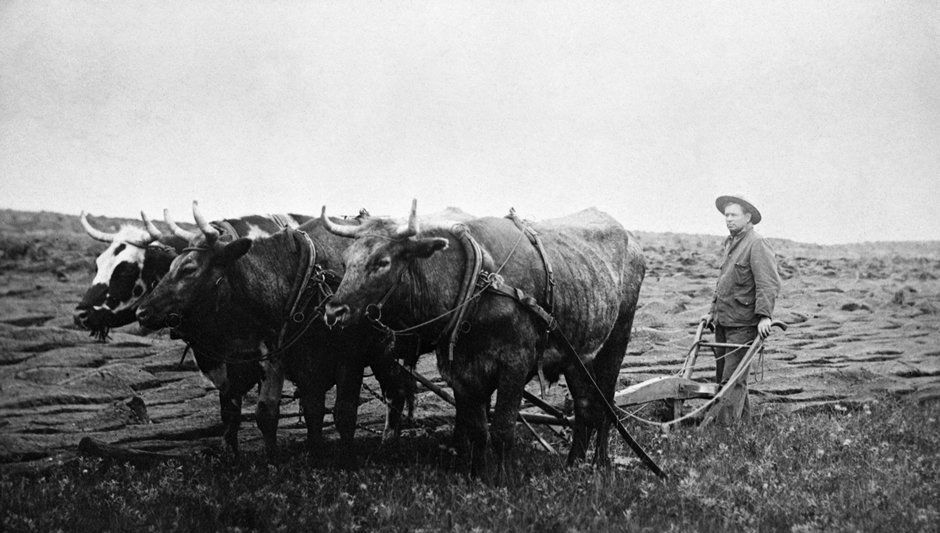
Ploughing with oxen near Coronation, Alberta, circa 1907–1908. Animal power remained essential to Prairie farming during the early settlement period.
Photo credit
Glenbow Archives, NA-474-8.
When Michael Leeb applied for the patent to his Alberta homestead in 1905, the paperwork described a log house measuring 24 by 32 feet, valued at $250. Leeb had come from Minnesota to the Norwegian farming district of Bardo, southeast of present-day Camrose. In May 1901, at 34, he entered the northeast quarter of section 24, township 45, west of the Fourth Meridian. He had a wife and six children. The provincial heritage record dates his patent to February 1905, nearly four years after his homestead entry.
For immigrant families, the offer of a 160-acre homestead was an opportunity to establish a farm without buying the land at market prices. Entry ordinarily cost $10.
The land on the map
Dominion surveyors laid a grid over much of the western country. Townships were six miles square, each with 36 sections of about 640 acres. A quarter-section measured 160 acres and had a legal description identifying its position, section, township, range and meridian.
A newcomer looking for land had to understand which quarters were available. School lands occupied sections 11 and 29. The remaining odd-numbered sections were generally reserved for railway grants. Under the ordinary allocation the Hudson's Bay Company received all of section 8 and three-quarters of section 26; in every fifth township it received all of section 26. The remaining even-numbered land was generally assigned to homesteading, although earlier entries, reserves and other dispositions could close individual quarters.
That allocation formed part of Canada's wider administration of land already occupied and used by First Nations and Métis peoples. Canada acquired Rupert's Land and the North-Western Territory in 1870 and extended surveying and settlement policy across them. Treaties 1 through 7 were negotiated between 1871 and 1877, but the circumstances and priorities of the participating First Nations differed. In April 1871, Hudson's Bay Company official W. J. Christie reported that Cree chiefs from the country between Edmonton and Fort Carlton had asked whether their lands had been sold and expressed concern about declining bison herds and the prospect of starvation. Treaty Six was negotiated in 1876. The Treaty Relations Commission of Manitoba records Elders' understanding of the numbered treaties as agreements to share land, in contrast to the Crown's written language of surrender. The meaning of those agreements and the fulfilment of their promises remain contested.
Métis communities also held longstanding connections to the land. The federal government issued land and money scrip under a policy intended to extinguish Métis land title and open western districts to settlement. Scrip frequently passed into the hands of speculators, leaving many Métis families without a secure land base. Métis Nation–Saskatchewan continues to dispute that scrip extinguished Métis rights. A map showing a quarter as open for homestead entry reflected these colonial decisions, not an absence of prior inhabitants or land use.
The Dominion Lands Act of 1872 established the homestead system, though Parliament and the government altered its conditions over subsequent decades. A federal guide issued in 1914 described entry at the Dominion Lands office for the district, a $10 fee and an entry certificate permitting the settler to occupy the claim while completing its requirements. Settlers who arrived in the 1880s or 1890s encountered earlier versions of the rules.
Water, hay and a railway station
According to a community history assembled by the Wadena & District Museum, Ingimundur Eiriksson and Christjan J. Helgason travelled west from the Thingvalla Icelandic settlement in 1891 to the Fishing Lake and Foam Lake district of present-day Saskatchewan, looking for water and hay. Dry years had put pressure on livestock raising at Thingvalla. The men found substantial grass near Fishing Lake, and relatives followed into the district the next year.
The museum's account records an October 1892 land entry by Groa Asbjornadottir. On the quarter chosen by her family, several related households occupied a log house just 14 by 18 feet, with a sod roof. As additional families arrived, part of a stable was divided into living quarters. These particulars come from a community reconstruction published more than a century after settlement, rather than from a surviving contemporary household diary.
The same account describes the trouble the settlers had getting enough hay. A fire destroyed much of the hay cut during their first autumn. Later, while they were cutting more, their only mower broke. Gisli Bildfell went to Saltcoats for parts; the others continued cutting with scythes and using homemade rakes.
Swedish settlers established New Stockholm in the 1880s, north of the Canadian Pacific Railway line across southeastern Saskatchewan. An 1888 federal immigration report placed the colony about 15 miles north of the railway station at Whitewood.
A house, animals and the first acres
In the wooded parkland, settlers could cut logs or poplar; in districts where timber was scarce, sod and other local materials were used. Dominion regulations allowed homesteaders without adequate timber on their own quarters to obtain permits for certain building, fencing and fuel needs.
The government's own settlement literature suggested that someone reaching the land early enough might plant potatoes or oats in the first year. A later arrival might have to concentrate on shelter and winter feed. Water for people and animals had to be found or hauled regardless of the planting schedule.
Breaking ground required animals, harness and a plough. On grassland the plough cut through established sod. In parkland, trees and brush first had to be cleared or worked around. A wagon was needed for hauling, while seeders, harrows, mowers and harvesting equipment became more useful as acreage increased. Horses and oxen had to be fed through the same months when the new holding produced little.
The federal government promoted the low entry price, but its estimates for a beginning farm included hundreds of dollars for animals and implements. A more fully equipped operation could cost over a thousand dollars. Those published sums represented suggested budgets, not accounts of what every Scandinavian family spent.
Neighbours sometimes shared equipment and labour, and relatives could provide somewhere to stay until a house was ready. Other settlers worked for wages on farms or railway construction to pay for supplies. That created a difficulty under a law that required residence on the homestead: time spent earning money elsewhere might not count toward the days needed to obtain title.
Labour within the household was less visible in the legal documents. Homestead applications generally named adult men, with specific exceptions for widows who headed families. Women tended gardens and animals, prepared and preserved food, raised children and at times worked in the fields. Children took on work too. The division of tasks differed between families, and the name on a patent rarely identifies everyone whose labour supported the claim.
From entry to patent
To receive title, a settler had to satisfy the residence and cultivation rules applicable to the entry and submit proof to the Dominion Lands administration. Officials could examine statements about the home, the time spent on the land and the acreage cultivated. Requirements changed through the years: earlier orders generally called for 15 acres broken and 10 cropped, while regulations issued in 1908 raised the ordinary requirement for entrants living on their claims to 30 acres broken and 20 cropped. Transitional provisions distinguished entries made before June 1, 1908, from those made on or after that date but before the newer regulations took effect.
Leeb sold the farm to William Webster in 1908. The Websters lived for a time in the log cabin Leeb had built, before a larger house was erected around 1914. When Alberta heritage researchers recorded the property in 2003, Leeb's original homestead house was still standing beside the newer building.





In the spring of 1893, Martin Finseth, Nels Jevning, Andrew Malmberg and John Wallerbeck travelled north from Minnesota to inspect Canadian farmland.