
Nøkken: The Terrifying Spirit of Nordic Lakes and Rivers
Theodor Kittelsen’s Nøkken (1887) depicts a root-like water spirit with luminous eyes among the lilies of a pond. The drawing is an artist’s interpretation of folklore, rather than an illustration of the Sundfossen legend.
Photo credit
Theodor Kittelsen / Nasjonalmuseet; digital photograph: Andreas Harvik
In a legend published in 1844, a priest is travelling with four sturdy men when they reach Sundfossen in Gjerrestad, southern Norway. Twice they try to pull their boat up the falls, and twice the water pushes them back. On their third attempt, the priest reaches into the torrent and draws out something that looks like a small black dog.
The thing he has caught is nøkken, a spirit said to inhabit the water. The priest holds it between his feet until the boat reaches a rocky place farther upstream, where he confines it. According to the legend, accidents at Sundfossen stop. Near the place where the priest confines the spirit, two people are said to have drowned, and cries of distress are heard.
Norwegian folklore collector Andreas Faye included the account in his 1844 edition of Norske Folke-Sagn. He named no witness or date for the supposed events. The drownings belong to the legend rather than a verified accident record.
A creature that changed its shape
The Norwegian nøkk, known in Old Norse as nykr, inhabited rivers, lakes, ponds and sometimes wells. It could lure people to their deaths, but its appearance changed from story to story. Faye wrote of a creature resembling part of a boat, a horse at the water’s edge, or something valuable waiting to be picked up. Touching an apparently harmless object could put a person within its power.
Some Norwegian traditions described the creature crying out before a drowning, making sounds like someone in terrible distress. Such cries were called varskrik, warnings of approaching misfortune. Faye also reported that the spirit was considered especially dangerous after sunset and could be repelled by a spoken formula invoking Christian protection.
Across the border, Swedish tales of näcken shared characteristics with Norwegian accounts, although neither the names nor the stories were uniform. Sweden’s Institute for Language and Folklore records appearances as an old man in grey clothing and a red cap, a horse, a fish, a white or black dog, or an ordinary object. In southern and western Sweden, stories of the bäckahäst, a mysterious water horse that carried riders into the depths, occupied related ground.
In a recollection preserved by Sweden’s Institute for Language and Folklore, Lena Klasson of Frillesås in Halland, born in 1860, remembered seeing a white dog walking beside a stream when she was a child. It disappeared where the stream ended. Her father identified it as näcken.
The fiddler by the stream
Swedish näcken had a musical reputation. According to traditions documented by the Swedish folklore institute, an aspiring fiddler might seek instruction from the spirit by visiting a brook or river on three Thursday nights and making an offering. An unusually skilled musician could acquire a reputation for having learned from him.
In other stories, it was the näck himself who played. His music enchanted listeners, and dancers could not stop until sunrise.
Related Norwegian traditions sometimes associated musical instruction with the nøkk or another water being, the fossegrim. Faye gave the fossegrim a separate section in his collection.
Warnings at the water’s edge
Stories about näcken and nøkken could explain a disappearance or give children a reason to avoid dangerous water. Swedish accounts located the threat beneath bridges, near mills and along places where people washed clothes or bathed. Water lilies, sometimes said to belong to näcken, were another reason for keeping away from particular stretches.
Protection might involve naming the spirit, using a Christian phrase or performing a ritual before swimming. In an account recorded in 1930 at Håbol in Dalsland, bathers were supposed to throw small pieces of stone in a high arc so they fell almost vertically into the water. A popping sound, likened to a cork being pulled from a bottle, supposedly meant näcken had been bound and swimming was safe.
An account from Steninge in Halland describes a mother warning her child away from an unguarded marl pit by invoking the märgelgubben, a different local figure.
By the late nineteenth century, artists were giving older traditions new faces. Theodor Kittelsen’s drawing Nøkken, dated 1887 by Norway’s National Museum, shows a dark, root-like head and two luminous eyes emerging from a pond among water lilies.
At Sundfossen, the priest’s plan succeeds. Faye’s legend leaves the creature among the stones near Tvet, where the cries and reported drownings begin.


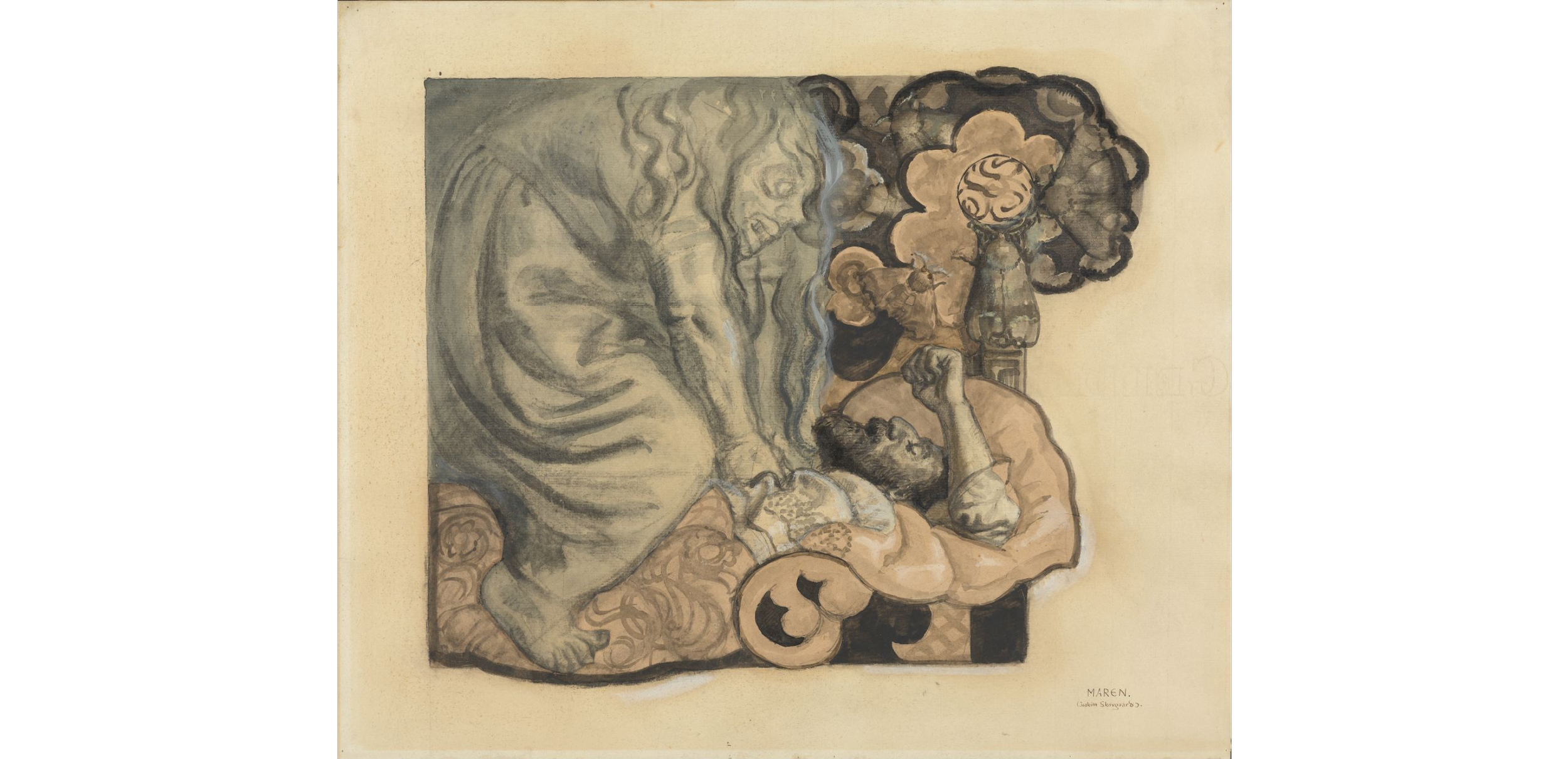



In a Norwegian folktale, a bridegroom has promised his closest friend a place at his wedding. There is one complication: his friend is dead.