
Marketing the Last Best West
Long before Canada advertised the “Last Best West,” officials were recruiting Scandinavian emigrants. Surviving advertisements, newspapers and parliamentary records show what was promised—and what the promise of Prairie land left out.
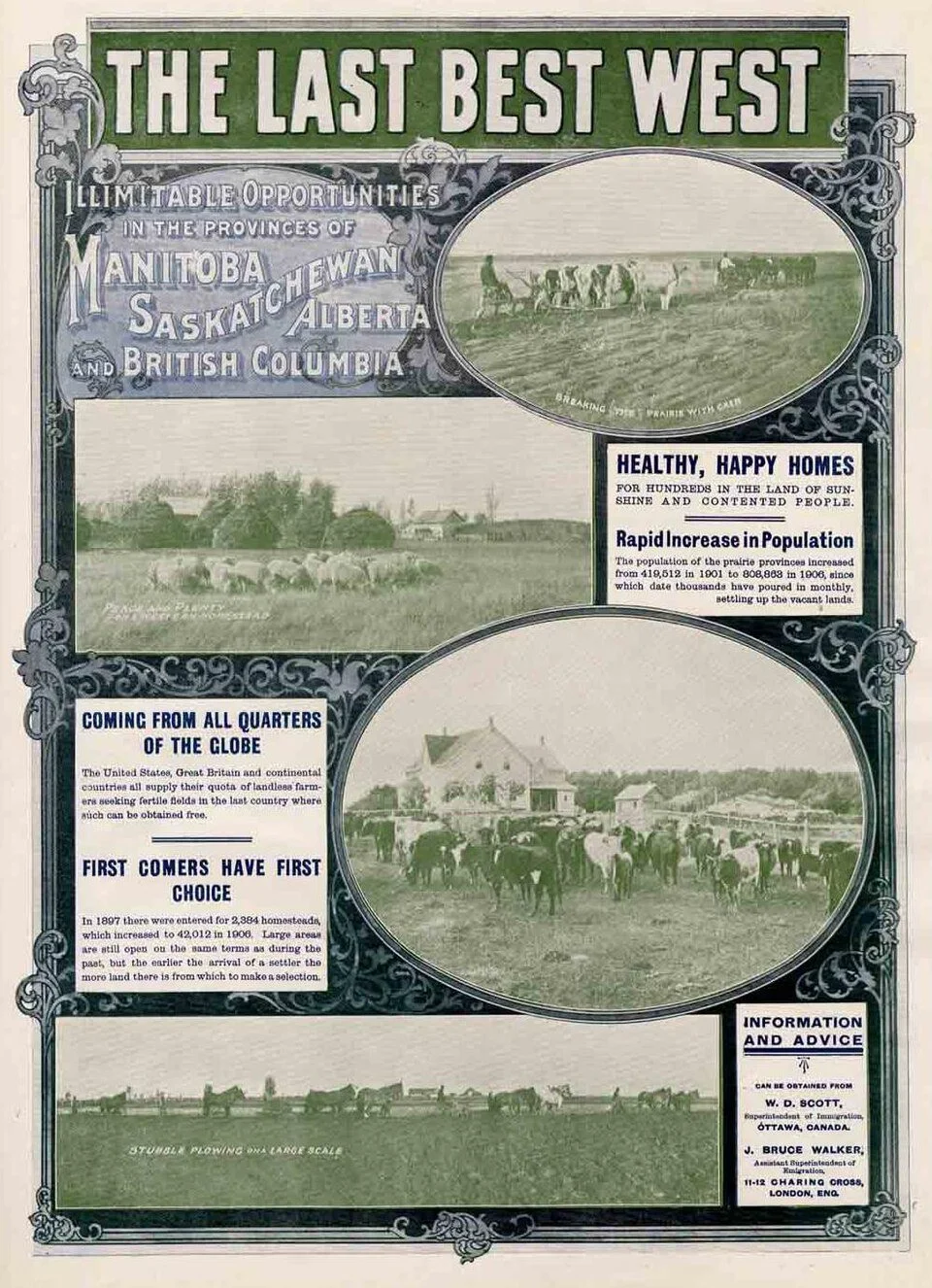
A Canadian government advertisement published in the Christmas 1907 edition of Toronto's The Globe promoted western Canada as “The Last Best West,” illustrating its promises with photographs of Prairie farmland and livestock.
Photo credit
The Globe (Toronto), 1907 / Library and Archives Canada
In a Canadian advertisement reproduced from the Christmas 1907 edition of the Toronto Globe, the Prairies appear beneath the words “The Last Best West.” Grain fields, farm buildings and cattle accompany promises of “illimitable opportunities” and “healthy happy homes.” The page offered an image of a farm already flourishing. It said less about the government's authority to offer that land, the terms attached to it or the people whose claims preceded the survey.
By then western immigration promotion had been underway for decades. Ottawa's officials, provincial boosters, railway companies, steamship agents and newspapers had all helped make western Canada visible to prospective emigrants. The surviving records show how the sales effort operated, including attempts to reach Scandinavian-language readers. They do not, by themselves, tell us which family believed a particular advertisement or what happened after arrival.
The promise before the slogan
Ottawa's campaign did not begin with the Laurier government or Clifford Sifton. Canada assumed control of Rupert's Land and the North-Western Territory in 1870, and federal surveyors began dividing much of the region into a grid. The Dominion Lands Act of 1872 established the legal framework for homesteading. An eligible applicant could seek a 160-acre quarter-section of designated Dominion land, subject to conditions before ownership was secured.
That promise gave immigration advertising a persuasive figure: 160 acres. It also concealed an important qualification. The land had to be surveyed and open to homestead entry. Other parcels were reserved for schools, the Hudson's Bay Company and railway companies; some were sold rather than offered as homesteads. An advertisement could give an acreage without telling its reader which quarter-sections remained available, how far they were from a railway or what establishing a farm would cost.
Federal recruitment was organized well before the slogan. A departmental immigration report to Parliament for 1883 lists John Dyke among Canada's emigration agents in Britain, based in Liverpool. A separate Library and Archives Canada finding aid identifies an 1883 file titled “John Dyke's Report on Trip to Norway, Denmark & Sweden.” It establishes a documented Scandinavian assignment, although the finding aid cannot tell us what he promised or how many migrants his work brought to Canada. Another departmental file concerns Dyke and a passenger list for Manitoba.
Provincial promoters were making their own appeals. A Manitoba Department of Agriculture and Immigration pamphlet from 1892, reproduced by Parks Canada and credited to the Provincial Archives of Manitoba, proclaimed “Fruitful Manitoba” and “homes for millions.” Its illustrated wheat fields and grazing claims belong to Manitoba's promotional efforts; they should not be mistaken for a specific federal campaign. Ottawa's overseas agents and provincial advertising nonetheless worked toward a common objective: attracting people who might otherwise settle elsewhere.
A Swedish-language window on Canada
A Scandinavian-language newspaper offers a different kind of evidence. The first issue of Den Skandinaviske Canadiensaren appeared in Winnipeg on September 30, 1887. Canadiana preserves scans of the publication and identifies Emanuel Öhlén, an immigration agent, as its publisher. Later surviving issues appeared into the 1890s. This was a newspaper produced in Swedish for readers interested in Canada, not an English-language government poster.
The newspaper is evidence of a Swedish-language information channel on the Prairies. Its surviving catalogue and issues do not establish how widely individual editions circulated overseas or prove that every issue carried immigration advertisements. Those questions require examination of the actual pages. Still, the publication places a named immigration agent and a Nordic-language press operation in the same Winnipeg milieu as the expanding western settlement campaign.
An advertisement provides a more direct example. The Canadian Museum of Immigration at Pier 21 reproduces a Swedish immigration advertisement card, identifying its archival source as Library and Archives Canada image C-089542. It is specific evidence that Canadian immigration publicity was produced for Swedish-language readers. The museum's caption does not establish where the card was handed out, how many copies circulated or which emigrants acted on it. The distinction matters: Swedish-, Norwegian-, Danish-, Finnish- and Icelandic-speaking migrants had different existing communities and routes of information. An archival card cannot stand for all of them.
Sifton expands the sales force
The government's promotional effort accelerated after Wilfrid Laurier's 1896 election. Clifford Sifton, minister of the interior from 1896 to 1905, pursued farmers and farm labourers through expanded overseas publicity and immigration administration. Agents worked alongside transportation interests; pamphlets appeared in European languages, and Canadian exhibits reached fairs and other public displays. Sifton did not invent the effort. His department enlarged a recruitment apparatus that was already active when Dyke travelled to Scandinavia in 1883.
The North Atlantic Trading Company, established in 1899, linked federal recruitment with steamship booking agents in Europe. Payments for immigrants who met the government's conditions gave the trade in passages a direct recruiting incentive. Library and Archives Canada preserves small promotional cards circulated between 1900 and 1905. A French version offered 160 acres of free land, with sea routes on the reverse; a German-language version offered a comparable promise. Archival descriptions record large-scale mailing of such cards. Each is a surviving example of a wider system, rather than evidence that a particular Scandinavian household received one.
The French and German cards cannot themselves establish Scandinavian-language advertising. The Swedish card reproduced by Pier 21 is a separate archival object, and no record examined here connects it to the North Atlantic Trading Company's distribution. But the company did have a Scandinavian recruitment mandate. On December 15, 1909, Interior Minister Frank Oliver told the House of Commons that the government's agreement had directed booking agents to recruit immigrants in Switzerland, Germany and Scandinavia. He said the government later cancelled the contract because it considered the company's efforts inadequate. His testimony identifies where Ottawa intended those agents to work; it does not prove how many Scandinavian migrants they persuaded.
The arrangements could be politically contentious. In June 1905, members of Parliament questioned the government over its agreement with the North Atlantic Trading Company, including a contract dated November 28, 1904. What appeared to migrants as an invitation to a farm could also represent a payment to a booking agent and a dispute in Ottawa over the use of public funds.
Railways had land to sell
The Canadian Pacific Railway had a direct interest in the same movement. Its construction had been supported by a federal grant of 25 million acres, and railway companies held land that could be marketed to settlers. More farmers meant potential customers for railway land and continuing business in passengers, equipment, supplies and grain freight. Steamship companies benefited from ocean passages. The federal government wanted agricultural production and population; private companies expected commercial returns.
The interests of Ottawa and the transport companies overlapped, but the offers differed. A Dominion homestead was a conditional federal land grant. Railway companies held land for sale, and an advertised quarter-section was not necessarily a vacant parcel available on the reader's arrival. Some promotional material blurred these differences by showing productive farms without explaining tenure, location or cost. Immigration policy also selected among prospective newcomers: officials actively sought particular European agricultural immigrants while restricting or discouraging others.
Sifton left the interior portfolio in 1905 and was succeeded by Frank Oliver. The 1907 Globe advertisement therefore belongs to an ongoing government campaign, not simply to Sifton's years in office. Promotional publications were still using the language of free land and inexpensive living in 1910; a surviving Canada West issue, described in Canada's History, shows the slogan continuing after the change of minister. The evidence establishes a durable advertising effort without proving when the phrase “Last Best West” was first coined.
Whose land was being advertised?
The word “free” concealed the most consequential part of the transaction. The Prairies were already homelands of First Nations and Métis communities, with farms, trade networks, political relationships and long-established ways of using the land. Beginning in 1871 the federal government negotiated numbered treaties and asserted authority over territories it then surveyed and allocated, while accepting continuing treaty obligations. The meaning and implementation of those agreements were contested. The advertisements did not explain the existing Indigenous rights, the treaty promises or the displacement bound up with opening land to settlers.
The government survey itself could conflict with existing Métis settlement patterns. James Isbister and Margaret Bear had established a farm near present-day Prince Albert in 1862. When federal surveyors later laid out square 160-acre homesteads across the region, the grid encroached on Métis river-lot holdings. Isbister helped organize petitions over land, surveys and scrip in the 1870s and 1880s. This was happening during the decades in which officials and promoters presented surveyed western land as a national resource available to newcomers.
Métis scrip, intended by the government to settle certain land claims through certificates for land or money, created another set of disputes. Speculation, fraudulent dealing and administrative practices undermined Métis land security. In Manitoba, Parks Canada's account of the period after 1870 describes the government's failure to uphold land protections contained in the Manitoba Act as newcomers and surveyors arrived. These histories are central to understanding how land could be legally offered by Ottawa while its status remained contested by people already living there.
For an immigrant who obtained a quarter-section, the land could support a new livelihood. But its availability rested on federal surveys, reservations, treaty administration and decisions about existing Métis claims. Those processes were underway before the would-be settler encountered an advertisement, and they shaped what could actually be offered.
What the advertisements could not answer
The records preserve an extensive campaign of posters, pamphlets, newspapers and cards. They establish what governments and companies wanted emigrants to see: land, harvests, rail connections and the prospect of a farm. A Swedish card and Dyke's Scandinavian assignment show that Nordic recruitment had identifiable channels. Neither the existence of those channels nor the volume of printed material tells us how many people chose Canada because of a particular advertisement.
The printed offer also left practical questions unanswered. Was the advertised land open to homestead entry, reserved for a railway or already occupied? How far was it from a station or a market? The acreage figure did not account for the equipment, labour and money needed to begin farming. Those matters belong to the land and settlement record rather than to a recruitment card. A claim about a migrant family's eventual success or disappointment would require that family's own documented experience.
That is the gap visible in the 1907 Globe advertisement. Its farm photographs make the promised destination appear settled and prosperous; they do not show the legal conditions or the land claims behind the offer. The government could promote a quarter-section across the Atlantic because it had already established a system for surveying and distributing western land. The Swedish card and Dyke's 1883 Scandinavian assignment reveal who some of that promotion was meant to reach. The land and treaty records explain what the invitation left unsaid.
Further Reading
Chandler, Graham. “Selling the Prairie Good Life.” Canada’s History, 7 Sept. 2016, https://www.canadashistory.ca/explore/settlement-immigration/selling-the-prairie-good-life.
Den Skandinaviske Canadiensaren. No. 1, 30 Sept. 1887. Canadiana, https://www.canadiana.ca/view/oocihm.N_00719_18870930.
Gagnon, Erica. “Settling the West: Immigration to the Prairies from 1867 to 1914.” Canadian Museum of Immigration at Pier 21, updated 28 Jan. 2022, https://pier21.ca/research/immigration-history/settling-west-immigration-to-prairies.
Manitoba. Department of Agriculture and Immigration. Fruitful Manitoba. 1892. Rearview, Archives of Manitoba, https://www.gov.mb.ca/rearview/averill/journal/rr-immigration_pamphlet.html.
“North Atlantic Trading Company.” House of Commons Debates, 15 Dec. 1909. LiPaD: Linked Parliamentary Data, https://www.lipad.ca/full/1909/12/15/6/.
“160 acres de terre libre.” 1900–1905. Library and Archives Canada, RG 76, vol. 225, file 113228, pt. 9, item 2945664, https://recherche-collection-search.bac-lac.gc.ca/eng/home/record?app=FonAndCol&idnumber=2945664.
Parks Canada. “James Isbister National Historic Person (1833–1915).” Government of Canada, last modified 22 July 2024, https://parks.canada.ca/culture/designation/personnage-person/james-isbister.
Treaty Relations Commission of Manitoba. “What Is a Treaty?” Treaty Relations Commission of Manitoba, https://trcm.ca/lets-talk-treaties/what-is-a-treaty/. Accessed 22 Oct. 2026.






In the medieval Icelandic Ynglinga saga, King Vanlandi has been asleep only a short time when he cries out that a mara is treading on him.