
The Winter Candle
From Scandinavian farms to Alberta homesteads

Before the candles could be dipped, everyone at Överby parsonage had work to do.
Edvard Ström spent part of his childhood there, on Sweden’s west coast, between 1814 and 1825. In recollections recorded late in the nineteenth century and published by Bohusläns Museum, he remembered the household twisting cotton and tow yarn into wicks while his aunt Anna Lisa prepared for candle making. A tall copper vessel was carried into the servants’ room, wrapped in blankets and mats to retain its heat, more than half-filled with boiling water and topped with melted tallow.
Five or six wicks were fastened to each wooden stick. They were lowered into the fat, withdrawn and hung to cool. The work continued until each candle reached the thickness required for its intended use. The household made candles of several thicknesses, thinner dankar with tow-yarn wicks, and elaborate branched candles for Christmas. The finished supply had to last through winter.
The September equinox arrives on September 22, 2026. It provides a fitting date to consider how people once prepared for the returning dark, although it came earlier than the candle-making described in the Swedish records. That work usually followed autumn slaughter and formed part of the preparations before Christmas.
The surviving sources do not establish a direct line between Scandinavian candle dipping and the tallow lights used in central Alberta. They document the two histories separately. Rural households in Sweden and Denmark, and the large farms described in Ofoten, made candles from tallow. The Swedish and Danish accounts also show that candles were prepared in different sizes for different uses.
In Alberta, settlers continued to use tallow candles and simple fat lamps when coal oil was unavailable or when candles were needed for a Christmas tree. Scandinavian migrants arrived while these older and newer forms of lighting still overlapped.
After the Autumn Slaughter
Swedish household candles were commonly made from tallow saved after autumn slaughter. The fat was cut away, chopped, melted slowly and strained. Once purified, it hardened into cakes that could be stored until candle-making day.
At Överby, the supply came partly from cattle slaughtered at the parsonage and partly from purchased tallow. In Elise Jensen’s Danish childhood home, sheep tallow was especially important because the farm kept many sheep.
Tallow had other uses. It could be needed for cooking or salves, which made candle production an exercise in allocation. Beeswax produced a cleaner light, but Swedish wax candles were associated with churches, monasteries, wealthy households and the royal court. Rural families worked with tallow saved on their farms or bought from other producers.
The same pattern appears in Denmark. In a memoir published and contextualized by historian Merete Bo Thomsen, farm woman Elise Jensen called candle-making day “a great day.” The previous evening, the household prepared wicks from candle yarn purchased in town. Five or six were tied to each stick.
A large amount of tallow was then melted. Jensen remembered sheep fat being used in particular because the farm kept many sheep. Boiling water went into the bottom of a tall container, with the melted tallow floating above it. The wicks were dipped while the fat remained hot, then hung from a ladder laid across two chairs. Children watched as repeated dips made the candles thicker, smoother and more finished.
A 1979 local-history article by Per R. M. Berg described a comparable method on large farms in Ofoten, northern Norway. According to Berg, wicks were suspended from rods, dipped into melted tallow and hung over oars or poles to dry. Across the accounts, the process relied on prepared wick, melted tallow and somewhere to hang the candles between dips.
Scandinavians did not invent the tallow candle. The materials and dipping method belonged to a much wider European technology. Regional practice can be seen in the farm calendar, the household division of work and the particular place candles occupied at Christmas.
Every Candle Had a Job
Elise Jensen’s family did not make every candle to the same dimensions.
Thin candles provided enough light for the kitchen and brewhouse. Burning a thick one there would have been considered wasteful. Better candles were taken into the living rooms. The thickest were saved for travelling tailors, whose close work required more light when they came to sew clothing for the household.
Ström remembered a similar hierarchy at Överby. Cotton wicks were used for the best candles, while tow yarn produced narrower, lower-grade dankar. Candle thickness changed according to purpose. According to Sweden’s heritage inventory, even the remaining tallow could be used: a wick was drawn back and forth through it to make the simplest candles.
Light also had to be managed by the hour. Berg described families on the large farms of Ofoten eating near windows while daylight remained. They then observed skjømming, waiting through the dim interval before someone finally lit a petroleum lamp or candles. Once a flame was burning, work and leisure gathered around it. Reading aloud and music could be shared by the same light.
Christmas altered the calculation.
Swedish households made their thickest candles for the holiday. Some prepared grenljus, branched candles whose three wicks were said to represent the Trinity. Ström described a more elaborate kronljus, or crown candle, with between four and ten branches. Making one required steady dipping so that the branches did not break.
He also remembered an early nineteenth-century Lucia morning when one of his sisters entered the sleeping household dressed in white, carrying coffee while burning candles sat in a green wreath on her head. On Christmas Eve, his father was given the task of lighting the household’s best candles.
Candlelight marked the difference between ordinary work and a feast day. The distinction depended on the quality of the wick, the thickness of the candle and the amount of stored fat a household could afford to burn.
Stearin and Coal Oil
The candle economy began changing well before large numbers of Scandinavian settlers reached Alberta.
Stearin candles were developed in France around 1825. Swedish newspaper publisher Lars Johan Hierta encountered them in London and worked with chemist Johan Michaëlson to establish Liljeholmens stearin factory in 1839. Stearin burned more evenly than tallow and produced less smoke, although its cost initially kept it beyond many households.
Kerosene brought another change. During the 1860s, kerosene lamps gradually replaced other forms of domestic lighting in Canada. By the 1870s, coal oil had become the standard household illuminant in many communities. In rural and remote parts of the country, kerosene lamps survived for decades. Historian Loris S. Russell found that Prairie farmers remained largely within the kerosene era until the 1920s.
That chronology matters when considering Scandinavian Alberta.
Swedish colonies were established at Edna, New Sweden and Olds in 1892, followed by Swea near Red Deer in 1893. Norwegian families developed New Norway southwest of Camrose during the same decade. A Library and Archives Canada historical summary reports 304 Norwegians in the Alberta district of the North-West Territories in 1901. By 1911, the province of Alberta had 5,761 residents born in Norway.
Many Scandinavian settlers came north from Minnesota, Nebraska and the Dakotas, bringing livestock, equipment and household goods acquired during years in the United States. Others arrived directly from Sweden, Norway or Denmark.
These migrants entered Alberta after stearin production and kerosene lighting were well established. Store-bought candles and coal oil were already part of the settler economy. For many households, annual tallow dipping no longer had to provide every light.
The records reveal technological overlap rather than a documented cultural lineage. Scandinavian migrants came from communities familiar with tallow candles, while Alberta households still used the same basic combination of fat and wick when coal oil failed or a particular occasion called for candles. The surviving accounts do not show whether Scandinavian settlers regarded those practices as inherited customs.
Light in Central Alberta
Local histories from central Alberta show how several lighting systems could exist in the same household.
Dora Muller arrived with her family in the Heather Brae district, southeast of Wetaskiwin, in November 1894. Their first home was built partly into the bank of Dried Meat Creek. It had log walls, a sod floor, one window and a door made from canvas and blankets.
When their coal-oil supply ran out, Muller remembered floating a cloth wick in a dish of wild-animal fat and lighting it as a makeshift source of light.
Another account came from Mrs. Harry Owre, who recalled the first community Christmas tree east of Spring Lake. The gathering took place at the Weymouth home after the family arrived from South Dakota in 1903. Mrs. Weymouth made tallow candles for the spruce tree. Popcorn was strung across its branches, and apples brought in for the occasion became the day’s main attraction.
Neither recollection assigns candle making to a particular ethnic tradition. The accounts establish that tallow candles and fat lamps remained useful in a central Alberta region where Swedish and Norwegian communities were growing. They also show why an old household technology could survive alongside coal oil.
Available records do not trace a particular candle mould, dipping vessel or family practice from Scandinavia to an Alberta farm. Many settlers had spent years or even a generation in the American Midwest before moving north. Their household practices had already passed through another rural society.
The Scandinavian and Alberta records therefore document parallel knowledge rather than a proven line of transmission. In both places, animal fat and a prepared wick could provide light when other sources were expensive, unavailable or reserved for a different purpose.
Final Thoughts
In the Swedish and Danish accounts, candle making formed part of the farm’s seasonal workload. It followed slaughter, required several hands and produced a carefully graded winter supply. The best candles went into family rooms or appeared at Christmas. Lesser ones provided enough light to work.
Scandinavian settlers reached Alberta while that system was being replaced. Coal oil illuminated ordinary evenings. Manufactured candles could be purchased. Electricity eventually removed flame from the centre of household lighting.
No surviving source connects the two households. What connects them is the technology itself: a wick, animal fat and the need for light when another source was unavailable.
At Överby, Anna Lisa stood beside a copper vessel wrapped in blankets while rows of fresh candles cooled. Eight decades later, in a dugout beside Dried Meat Creek, a cloth wick floated in a dish of animal fat. The coal oil was gone, and the room had light again.
Further Reading
Edvard Ström, Minnen från en lång lefnad, excerpted by Bohusläns Museum. A museum transcription and presentation of Ström’s late nineteenth-century recollection of his childhood at Överby parsonage, including household slaughter, candle dipping, Lucia and Christmas.
Merete Bo Thomsen, “Landbokvinden Elises Jensens erindringer,” Landbohistorisk Tidsskrift 2013:1. Thomsen introduces, contextualizes and publishes Elise Jensen’s retrospective account of Danish farm work, women’s labour and the production of candles in different sizes for specific household tasks.
“Ljusstöpning,” Sweden’s Inventory of Living Cultural Heritage. An official heritage entry describing Swedish dipping methods, tallow preparation, wick materials, Christmas candles and the present-day continuation of the craft.
Loris S. Russell, A Heritage of Light: Lamps and Lighting in the Early Canadian Home. A material history of candles, grease lamps, kerosene and electric lighting in Canada, first published by University of Toronto Press in 1968.
William C. Wonders, “Mot Kanadas Nordväst: Pioneer Settlement by Scandinavians in Central Alberta,” Geografiska Annaler: Series B, Human Geography 65, no. 2 (1983): 129–152. An academic study of Scandinavian migration patterns and settlement concentrations in central Alberta.
The Golden Trail. A 1955 community history containing retrospective recollections from residents of the Camrose district, including accounts of housing, lighting, Christmas gatherings and daily life.

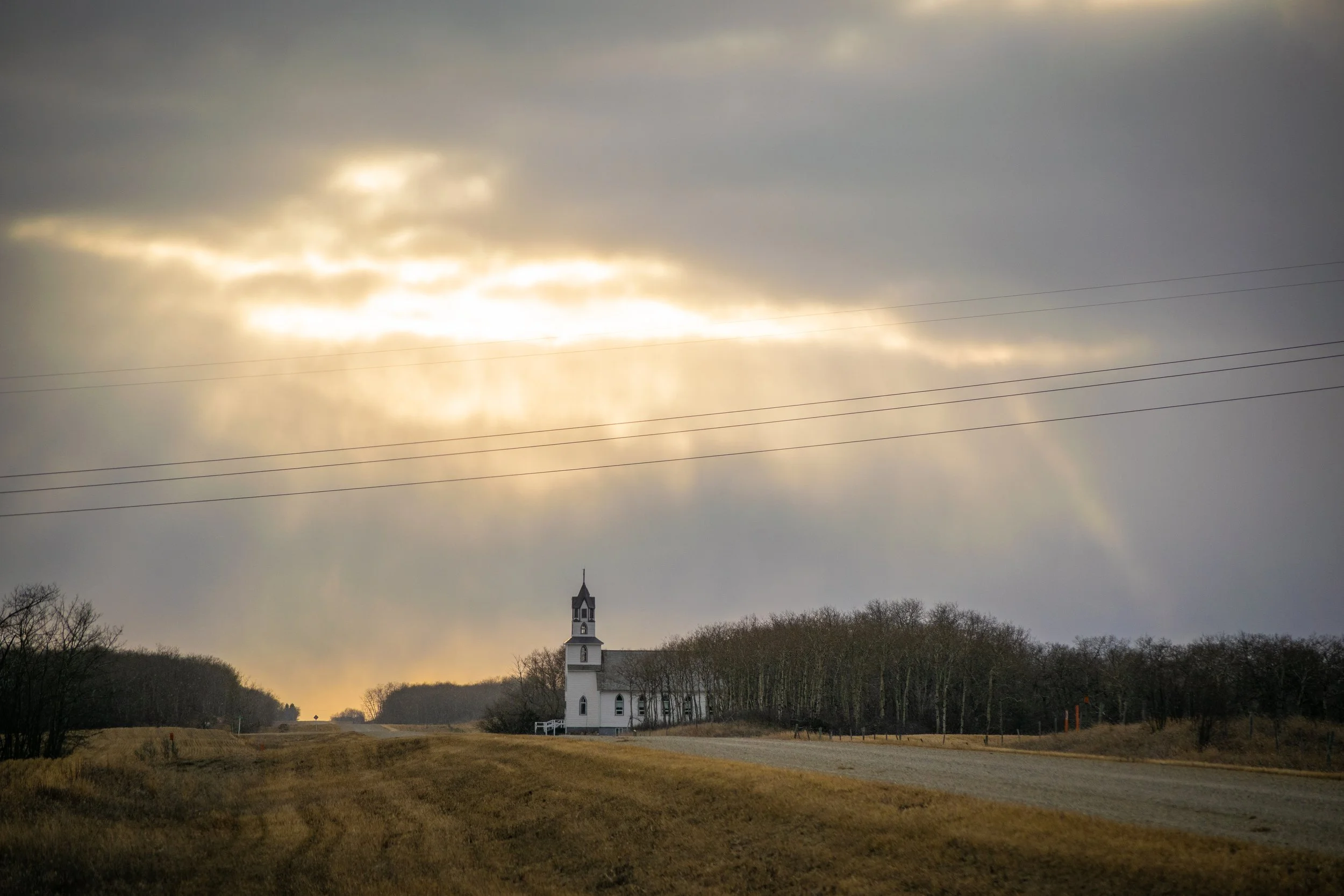

Before the candles could be dipped, everyone at Överby parsonage had work to do.
Edvard Ström spent part of his childhood there, on Sweden’s west coast, between 1814 and 1825. In recollections recorded late in the nineteenth century and published by Bohusläns Museum, he remembered the household twisting cotton and tow yarn into wicks while his aunt Anna Lisa prepared for candle making. A tall copper vessel was carried into the servants’ room, wrapped in blankets and mats to retain its heat, more than half-filled with boiling water and topped with melted tallow.