
The Red Finns of King George
Politics, Repression and Soviet Karelia
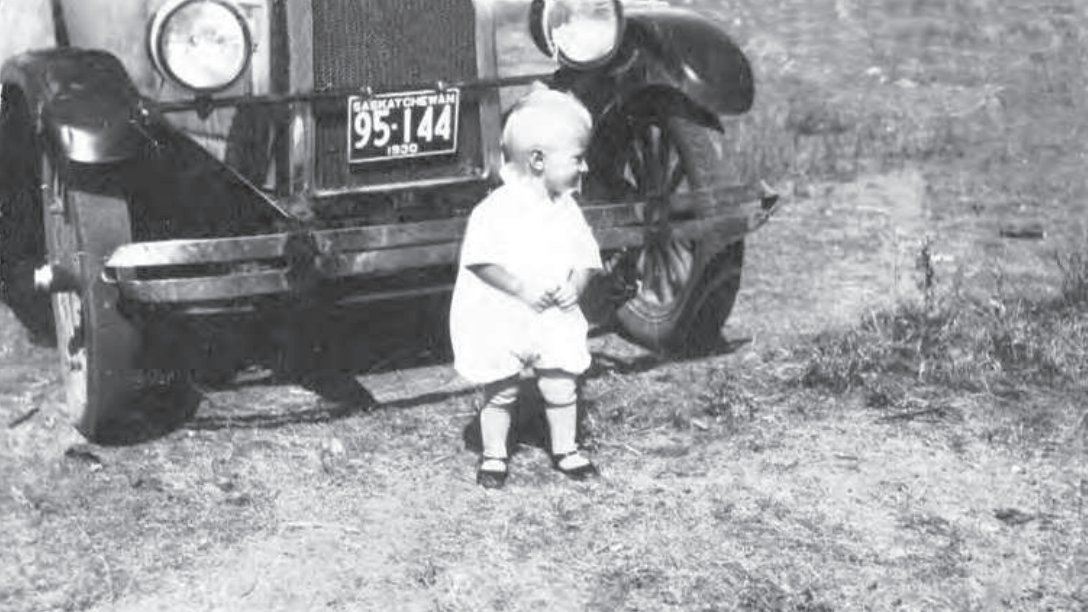
One-year-old Aare Lekander, child of Saskatchewan residents Valter and Aune Lekander, several months before the family emigrated to Soviet Karelia.
Photo credit to the Lekander family; reproduced in Golubev and Takala, The Search for a Socialist El Dorado (2014).
In August 1924, the Finnish-language newspaper Canadan Uutiset carried a report from Strongfield, Saskatchewan, about a dispute over a library. Conservative and socialist Finns had been fighting for control of the local Finnish collection, and the conservatives had prevailed. Under the new policy, books considered violently revolutionary, anti-government or profaning religion were not to be admitted.
The disagreement belonged to a much larger political division within Finnish immigrant communities. Archaeologist Verna Gallén, who reconstructed the history of Saskatchewan’s Finnish settlements using archaeological evidence, newspapers, documentary records, local histories and oral sources, found that some Finns around Strongfield and Loreburn later sold their farms and moved west across the South Saskatchewan River. She suggests that, for at least some of them, the political climate may have contributed to that decision. It is an interpretation rather than a documented motive that can be assigned to every family, although the political landscape west of the river can be traced more directly through the organizations Finns established there.
Three locals of the Finnish Organization of Canada operated in the surrounding country at Lake Coteau, Coteau Hill and Dunblane/Macrorie. A 1925 report in the Finnish-language newspaper Vapaus, cited by Gallén, indicated that the organization hoped its Saskatchewan branches could influence the development of a broader left-wing farm movement. Later histories of the district would describe this western concentration of politically active settlers as the “Red Finns.”
A Finnish Settlement Spread Across the Coteau
Finnish settlement in this part of Saskatchewan developed during the first decade of the twentieth century, although the sources use somewhat different starting points depending on the district they are describing. Gallén places Finns around Loreburn and Dunblane by about 1904, while historian Arnold Alanen dates Finnish settlement around Elbow, Rock Point and Outlook to about 1905. Alan Anderson’s Encyclopedia of Saskatchewan entry dates the Rock Point concentration itself to about 1910. These dates concern overlapping but differently defined parts of a dispersed farming settlement and should not be treated as a single founding date for the whole district.
The Finnish country stretched through a broad section of the Coteau and the land around the South Saskatchewan River rather than forming a single compact village. Anderson identifies a religious concentration of Laestadian Finns around Rock Point toward the eastern side of the settlement and a stronger left-wing concentration toward King George in the west. King George itself was the Rural Municipality of King George No. 256 rather than a Finnish town, and important centres of Finnish political and community life also lay at Dunblane, Macrorie, Lake Coteau and Coteau Hill.
That east-west distinction describes a broad pattern rather than a firm boundary. Finnish families lived throughout the district, and the political and religious affiliations represented within the settlement were more complicated than two neatly separated communities.
Some settlers had already travelled a long way before reaching Saskatchewan. Alanen notes that several Finns who settled around Dunblane and Dinsmore had been radicalized while living in Minnesota’s Mesabi Range mining country. Larry Warwaruk’s 1984 local history, Red Finns on the Coteau, also describes settlers who had previously lived and worked in Minnesota and Michigan before moving north to Canadian farms.
They brought with them institutions already familiar in Finnish North American working-class communities. Finnish-language newspapers circulated through the settlements, halls provided space for meetings and cultural events, and political organizing developed alongside the everyday work of farming. The Finnish Civil War of 1918 also sharpened Red-White divisions within Finnish communities in Canada and the United States, although those labels never captured the full range of political identities represented on the Saskatchewan Coteau.
More Than One Kind of Red
“Red Finn” cannot safely be treated as a synonym for Communist Party member. Gallén’s work shows that Finnish halls and secular organizations drew people from several parts of the political left, including socialists, social democrats, Communists, co-operators, syndicalists associated with the Industrial Workers of the World and anarchists. Participation in a hall or Finnish Organization local did not by itself establish membership in a particular political party.
On Saskatchewan farms, political and agricultural organizations could also overlap. Warwaruk described the Farmers Union, Saskatchewan Wheat Pool, Communist Party and Finnish Organization as closely intertwined on the Coteau, with some residents belonging to several of them. That description comes from his later local history rather than from an independent reconstruction of surviving membership rolls, so it is best understood as Warwaruk’s account of political life in the district rather than a precise census of affiliation.
The Finnish Organization of Canada grew out of the Finnish Socialist Organization of Canada, founded in 1911. Library and Archives Canada records that the FOC was federally incorporated in 1923 and operated through a national office, district committees and local branches. Surviving archival inventories confirm Saskatchewan locals at Coteau Hill, Dunblane and Lake Coteau, although the records for individual locals are incomplete.
The Strongfield library dispute provides a glimpse of how these political divisions could enter ordinary community institutions. Conservative and religious Finns were also deciding what kinds of newspapers, books and organizations would shape Finnish life in Saskatchewan. Political differences affected the institutions people built and the material they read, while movement between different parts of the settlement could place families among neighbours with a different political outlook.
Police Attention at Dunblane
RCMP records provide an independent documentary trail of federal police interest in political activity at Dunblane during the 1920s and 1930s. A Royal Canadian Mounted Police subject-file register includes a January 1926 file referring specifically to Communist Party activity at Dunblane.
The existence of that file establishes that the RCMP considered political organization there worth monitoring. It does not establish that everyone attending a Finnish hall was a Communist, nor does the appearance of a person or organization in a police record prove criminal conduct.
Dunblane appeared again in an RCMP intelligence summary in August 1934. According to the report, a Communist Party conference had agreed to establish a sub-district bureau in Saskatoon and section committees in several Saskatchewan communities, including Dunblane. The RCMP also reported that anti-war demonstrations were expected in a number of farming communities on August 5, with Dunblane among the places named. These are police intelligence records and should be read as documentation of what the RCMP reported and monitored rather than independent proof that every planned activity occurred exactly as described.
Later local history preserves more personal accounts of that surveillance. Thomas DuBois, citing Warwaruk’s Red Finns on the Coteau, reports that RCMP officers entered Finn Hall dances, recorded names and directed residents to remove portraits of Karl Marx and Vladimir Lenin. The surviving police records independently establish RCMP attention to left-wing activity at Dunblane, but the specific dance-hall incidents presently reach us through Warwaruk as cited by DuBois. Without the underlying evidence Warwaruk used for that passage, the incidents cannot be given the same documentary status as the surviving RCMP files.
The national legal climate gave police surveillance additional weight. In 1931, Canadian authorities prosecuted eight Communist Party of Canada leaders under Section 98 of the Criminal Code, and the party was driven underground until the provision was repealed in 1936. For Finns who were active Communists, state repression was therefore more than hostile public opinion. Other people on the Finnish left could live within the same surveillance environment even when their own politics fell outside the Communist Party.
Soviet Karelia Looks West
During the same period, Soviet Karelia was seeking Finnish workers from North America. Under a leadership in which Finnish Communist Edvard Gylling played an important role, Karelia had developed Finnish-language institutions while Soviet authorities pursued rapid economic development in a region rich in forests and short of experienced labour.
North American Finns were attractive recruits because some had extensive experience in logging, sawmills, machinery, construction and other skilled work. They could also bring equipment, technical knowledge and money that were difficult to obtain within the Soviet economy.
The organized recruitment campaign is securely documented from 1931. According to Alexey Golubev and Irina Takala’s archival study of the migration, a Soviet decision of March 5, 1931 authorized Karelia to recruit as many as 2,000 qualified forest workers from Canada. The recruitment program soon expanded to include Finns from the United States as well.
The Karelian Technical Aid Committee was established in New York on May 1, 1931, while a Canadian operation functioned in Toronto under Jussi, or John, Latva. Recruitment proceeded through Finnish workers’ organizations and left-wing networks. Applicants supplied information about their professional experience and political backgrounds, obtained recommendations, and moved through a selection process involving the technical-aid organization and Soviet authorities.
Migrants also contributed more than their labour. Golubev and Takala document efforts to collect machinery, tools and money for Karelia, where North American equipment and expertise were expected to assist industrial development.
The campaign took place during the Great Depression, when workers and farmers across North America were facing unemployment, low commodity prices and economic insecurity. Soviet Karelia was presented through Finnish-language political networks as a place where skilled workers could find employment while participating in the construction of a socialist society in which Finnish culture still occupied a substantial institutional place.
Historians generally estimate that roughly 6,000 to 6,500 Finnish Canadians and Finnish Americans migrated to Soviet Karelia during the early 1930s. Golubev and Takala were able to establish the country of origin for 5,309 migrants in their archival database. Of those, 2,211 had come from Canada and 3,098 from the United States. Their database covered most, but not all, of the North American migration.
Saskatchewan Finns were part of that movement.
Leaving the Coteau
The number of people who left the Saskatchewan settlement for Karelia is more difficult to establish precisely. Gallén, drawing on Warwaruk’s local research, estimates that nearly 100 people, mostly young adults with families, left the Elbow region, with smaller numbers departing from elsewhere in Saskatchewan.
The chronology in the secondary literature is inconsistent. Gallén describes the nearly 100 departures as occurring in the 1930s. Thomas DuBois, also drawing on Warwaruk, describes about a hundred members of the Coteau community leaving for Soviet Karelia beginning in the late 1920s and notes that some had returned by 1932. The large organized North American recruitment campaign is firmly documented from 1931. The published sources do not presently allow the earlier Saskatchewan departure date to be reconciled securely with Gallén’s chronology, and it is better to leave that disagreement visible.
The reasons for leaving also resist a single explanation. The Encyclopedia of Saskatchewan links the movement partly to repression of Communists in Canada, while Gallén describes Saskatchewan Reds confronting crop failures, low farm incomes, ethnic discrimination and political repression. Broader studies of the Karelia migration add the pressures of the Depression, political commitment, Finnish identity, the promise of employment and an active Soviet recruitment campaign.
Those conditions provide context rather than a set of motives that can be assigned to every Saskatchewan family. The Saskatchewan migration emerged from a community that included committed Communists as well as people belonging to a broader Finnish socialist culture, while the wider North American movement also included migrants drawn by employment, economic security and the prospect of participating in a Finnish-oriented socialist society.
Life in Soviet Karelia
Many of the North American Finns who arrived during the organized recruitment campaign came as recruited workers, often with their families, and Soviet authorities placed considerable value on the skills, machinery and resources the newcomers brought. Their familiarity with logging, sawmill operations, mechanical work and other industrial processes made them useful to an economy undergoing rapid development, while Finnish-language schools, publications and cultural institutions gave Karelia a particular attraction for migrants who hoped to combine Finnish culture with socialist political life.
Conditions proved considerably more difficult than many recruits had expected. Golubev and Takala document inadequate housing, shortages, problems with work assignments and disputes over payments and promised conditions. Some migrants returned to Canada or the United States, and accounts from returnees contributed to the decline of further recruitment.
At the same time, Soviet policy toward Karelia was changing. During the later 1930s, Finnish cultural and political institutions came under increasing suspicion, and Finnish-language education and public institutions were progressively dismantled. Ethnic Finns, including immigrants from Canada and the United States, were among those caught in Stalinist repression during the Great Terror.
The exact number of North American Finnish victims differs slightly between published studies. Golubev and Takala’s 2014 study identified 739 North American Finns repressed in 1937 and 1938, including 323 who had come from Canada and 416 from the United States. Later research by Irina Takala, reported by Samira Saramo, gives 741 arrests, again including 323 from Canada but 418 from the United States. The publications do not resolve the two-person difference, and neither list should be treated as complete.
“Repressed” does not mean that every person included in those figures was executed. The category encompasses arrests and different forms of Soviet punishment. Saramo reports Takala’s finding that approximately 84 per cent of the Canadians in the later dataset were executed. Those who were not executed could still face imprisonment, labour camps and other forms of Soviet repression.
Those Canadian figures cannot be converted into a reliable number for Saskatchewan. Soviet records frequently identify migrants only as having come from Canada, without preserving the Canadian town, district or farm from which they departed. Gallén states that some Saskatchewan emigrants were killed, but the available evidence does not establish how many migrants from King George, Dunblane or the wider Coteau settlement were arrested, imprisoned or executed.
The archival trail becomes much thinner when individual Saskatchewan families reach Karelia. Finnish Organization records preserve fragments of their political world in Canada, RCMP files document official attention to Dunblane, local history preserves names and incidents that do not always appear in government records, and Soviet archives document the larger migration and repression. Until Saskatchewan names can be matched reliably with individual Soviet records, the fate of much of the Coteau group remains only partly recoverable.
Further Reading
Larry Warwaruk, Red Finns on the Coteau. Saskatoon, Saskatchewan: Core Communications, 1984.
This locally published history is the foundational study of the Coteau’s left-wing Finnish community and is repeatedly cited by later scholars. Verna Gallén describes it as a non-academic work based on extensive primary research. It remains especially valuable for local organizations, people and events that are difficult to recover elsewhere, although individual claims should be checked against archival evidence and later scholarship where possible.
Verna Gallén, In Silence We Remember: The Historical Archaeology of Finnish Cemeteries in Saskatchewan. MA thesis, University of Saskatchewan, 2012.
Gallén combines archaeological evidence with newspapers, documentary records, local histories and oral sources to reconstruct Finnish settlement and identity in Saskatchewan. The thesis is especially useful for the geography of the communities, their political divisions, the Finnish Organization locals and Saskatchewan migration to Soviet Karelia. Its principal subject is cemetery archaeology, so the political history appears within a broader examination of Finnish community life.
Thomas A. DuBois, “Little Steamship on the Prairie: Grass-Roots Preservation and Artistic Interpretation in the Construction of Ethnic, Local, and National Identities.” Scandinavian-Canadian Studies / Études scandinaves au Canada 30 (2023): 1–29.
DuBois focuses primarily on Tom Sukanen and the ways his life and ship were later interpreted, rather than offering a comprehensive history of Saskatchewan’s Red Finns. His discussion of the Coteau community is nevertheless useful because it engages closely with Warwaruk and provides an accessible scholarly source for several claims concerning political organization, migration to Karelia and RCMP activity.
Alexey Golubev and Irina Takala, The Search for a Socialist El Dorado: Finnish Immigration to Soviet Karelia from the United States and Canada in the 1930s. Michigan State University Press, 2014.
Based extensively on archival research in Russia, this is one of the principal English-language studies of Finnish North American migration to Soviet Karelia. It covers recruitment, the Karelian Technical Aid Committee, migrant labour, return migration and Stalinist repression. Its scope is North American and Soviet rather than Saskatchewan-specific, and Soviet records often preserve only a migrant’s country of origin rather than the community from which the person came.
Samira Saramo, Building That Bright Future: Soviet Karelia in the Life Writing of Finnish North Americans. University of Toronto Press, 2022.
Saramo examines letters and memoirs written by Finnish North Americans who moved to Soviet Karelia, concentrating on how migrants themselves described work, family life, ideology and everyday conditions. These personal sources do not represent every migrant experience, and Saramo treats their perspective, circumstances and limitations as part of the historical analysis.
Library and Archives Canada, Finnish Organization of Canada collection, R5279-0-1-E, former archival reference MG28-V46.
The collection spans 1881–1983 and contains records of the national office, district committees, local branches and related Finnish Canadian organizations. It is particularly useful for tracing the institutional history of secular and left-wing Finnish organizations in Canada. Library and Archives Canada notes that the surviving records for most individual locals are fragmentary.
Alan Anderson, “Finnish Settlements,” in The Encyclopedia of Saskatchewan. Regina: Canadian Plains Research Center, 2005; online edition.
Anderson provides a concise overview of Finnish settlement in Saskatchewan and describes the broad contrast between the Laestadian concentration around Rock Point and the stronger left-wing presence toward King George. Because the entry compresses a dispersed settlement into a short overview, its chronology and geography are best read alongside Gallén and the more detailed Saskatchewan scholarship.





In August 1924, the Finnish-language newspaper Canadan Uutiset carried a report from Strongfield, Saskatchewan, about a dispute over a library.