
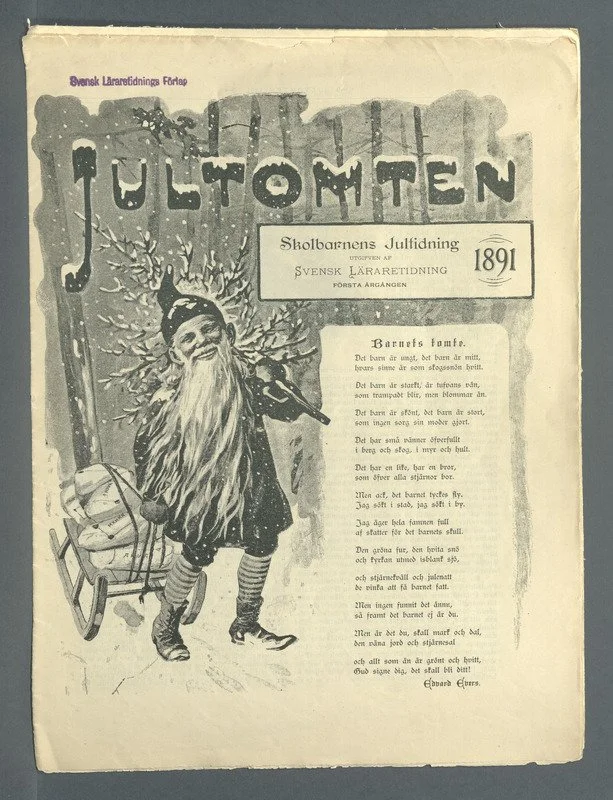
Jenny Nyström illustrated the cover of the first annual volume of Jultomten, a Swedish children’s Christmas publication, in 1891.
Illustration: Jenny Nyström / Svenska Barnboksinstitutet, via Saga (University of Gothenburg). Public Domain Mark 1.0.
The bearded man on the cover of a Danish Christmas book in 1866 had no presents to hand out. In Krohn's verses, Den gamle Jul—Old Christmas—visited homes to make the Christmas trees shine for children who had behaved well. His figure formed the outline of the booklet itself: the pages of Peters Jul were cut around a cloaked old man, with colour illustrations by Pietro Krohn and Otto Haslund.
The author, Johan Krohn, had little affection for the first edition. He and the illustrators tried to prevent its sale after seeing the printing. In a letter to a friend, Krohn suggested she put her copy in the stove or at the bottom of a drawer. The book reached shops in December 1866 nonetheless. Only a few copies survive.
Today, julemanden may arrive at a Danish home with Christmas presents. Jultomten in Sweden and julenissen in Norway may hand children their Christmas presents; Finland's joulupukki, whose name means “Christmas goat,” may visit in person. In Iceland, thirteen jólasveinar, or Yule Lads, may leave small gifts in shoes on successive December nights. Families in all five countries commonly open their main presents on December 24, though the gifts do not always come from a visitor at the door.
The Christmas knock
In Swedish, a Christmas present is a julklapp. The klapp is a knock. Nordiska museet describes a Christmas Eve custom of knocking on someone's door and throwing in a piece of wood or a carved doll as a playful gift. Christmas rhymes also became part of the exchange. Giving presents became increasingly common in prosperous Swedish households during the nineteenth century.
In seventeenth- and eighteenth-century Sweden, presents could also arrive with the julbock, a person dressed as a Yule Goat. The farm's gårdstomte had another role. People left Christmas porridge for this guardian, believed to protect the farm and its animals. In Norwegian folklore, the nisse helped with farm work if given food and drink, and could punish those who neglected him.
Finnish kekripukki and nuuttipukki visitors also expected hospitality, although their rounds fell on seasonal dates other than Christmas Eve. An account from Uusikirkko, recorded in 1924 and preserved by the Finnish Literature Society, describes masked callers whose singing woke a household. When the door opened, they came inside and kept singing. Their hosts offered coffee and a drink; the visitors thanked them and went on to the next house.
A Christmas face on paper
Jenny Nyström brought the Swedish tomte into children's books, illustrating Viktor Rydberg’s Lille Viggs äfventyr på julafton in 1875 and Tomten in 1881. On an 1883 Norwegian Christmas card, Wilhelm Larsen pictured a nisse in grey clothes and a red cap throwing snowballs at a fence until they spelled “Glædelig Jul.” Nyström's illustrations also appeared in the children's annual Jultomten. She drew its first cover in 1891; that copy survives in the Swedish Children’s Book Institute’s collection.
Stories of Saint Nicholas, remembered for his generosity to children, fed into the Dutch Sinterklaas tradition, whose name contributed to the American Santa Claus. In a 1923 White Rock Ginger Ale advertisement in Life, Santa was already round, bearded and dressed in red. Haddon Sundblom began painting him for Coca-Cola in 1931.
In Denmark, accounts from around the First World War describe adults dressing as julemanden at home. A department store offered another encounter with the costumed visitor: in 1932, Carl Dauw appeared as julemand at Magasin du Nord on Copenhagen’s Kongens Nytorv.
When the presents are handed over
In Denmark, Christmas Eve presents commonly wait until after dinner. Family members join hands, circle the tree and sing carols before unwrapping them. Some families have a costumed julemanden distribute the gifts; others pass them around themselves. In Norway, parcels may sit beneath the tree until after the evening meal, or julenissen may arrive carrying gifts in a sack.
At three in the afternoon, many Swedish families gather for Kalle Anka och hans vänner önskar God Jul, a Christmas Eve television programme broadcast at that hour since 1960. Later, jultomten may appear with a sack of gifts. Visit Sweden describes a family ruse: an adult announces a trip outside to fetch the newspaper and returns dressed as the bearded visitor.
Finland's joulupukki commonly enters the home on Christmas Eve, asks whether any well-behaved children are present and distributes the gifts. The Finnish Literature Society describes him talking with the children before continuing on his rounds. His helpers, the joulutontut, watch children in Christmas stories to see how they have behaved.
In a 1927 radio broadcast, Finnish presenter Markus Rautio described where joulupukki and his helpers lived: Korvatunturi, a fell in eastern Lapland. He told children they could send their wishes there and that the gift-bringer would set out in a reindeer-drawn sleigh. Linguist Osmo Ikola later recalled hearing of Korvatunturi as Santa's home earlier in the 1920s.
Thirteen visits before Christmas
Some Icelandic children put a shoe in the window on December 11. The first jólasveinn arrives on December 12, followed by another Yule Lad each day until Christmas Eve. By morning, a child may find a sweet or small present in the shoe. A child who has misbehaved might find a raw potato instead.
The Yule Lads of older stories were more interested in causing trouble than delivering gifts. Their names still describe their particular habits: Spoon Licker, Door Slammer and Skyr Gobbler are among them. At Dimmuborgir, among the lava formations near Lake Mývatn, families can also meet costumed Yule Lads during the Christmas season.
The thirteenth visitor arrives on December 24, when many Icelandic families gather for their main Christmas celebration. Wrapped presents are commonly opened after dinner, quite apart from the small gifts left in shoes. Books are a popular choice, with Icelandic publishers releasing many new titles ahead of Christmas.
Christmas visitors on the Prairies
In 2016, a contributor to the Icelandic Festival of Manitoba wrote that their family in Canada had always celebrated Christmas together on December 24. Only later did the contributor learn that Icelandic families generally gathered for dinner and opened gifts on Christmas Eve. In New Iceland, their family's Christmas table included rullupylsa (cured lamb), vinarterta (layer cake) and pönnukökur (rolled pancakes).
Southwest of Sylvan Lake, the Finnish farming district of Kuusamo took its name, according to the 1977 local history Along the Burnt Lake Trail, from settler Peter Wetelainen’s birthplace in Finland. The same history, cited in Nordic Prairie Life’s earlier reporting, describes Christmas programs at the district school or Elspeth Hall almost every year after about 1913. Between 1925 and 1935, the gatherings could draw approximately 300 people. The programs included music, folk dances, dialogues and tableaux, along with a visit from Santa. Lunch and a dance followed.


The bearded man on the cover of a Danish Christmas book in 1866 had no presents to hand out.