
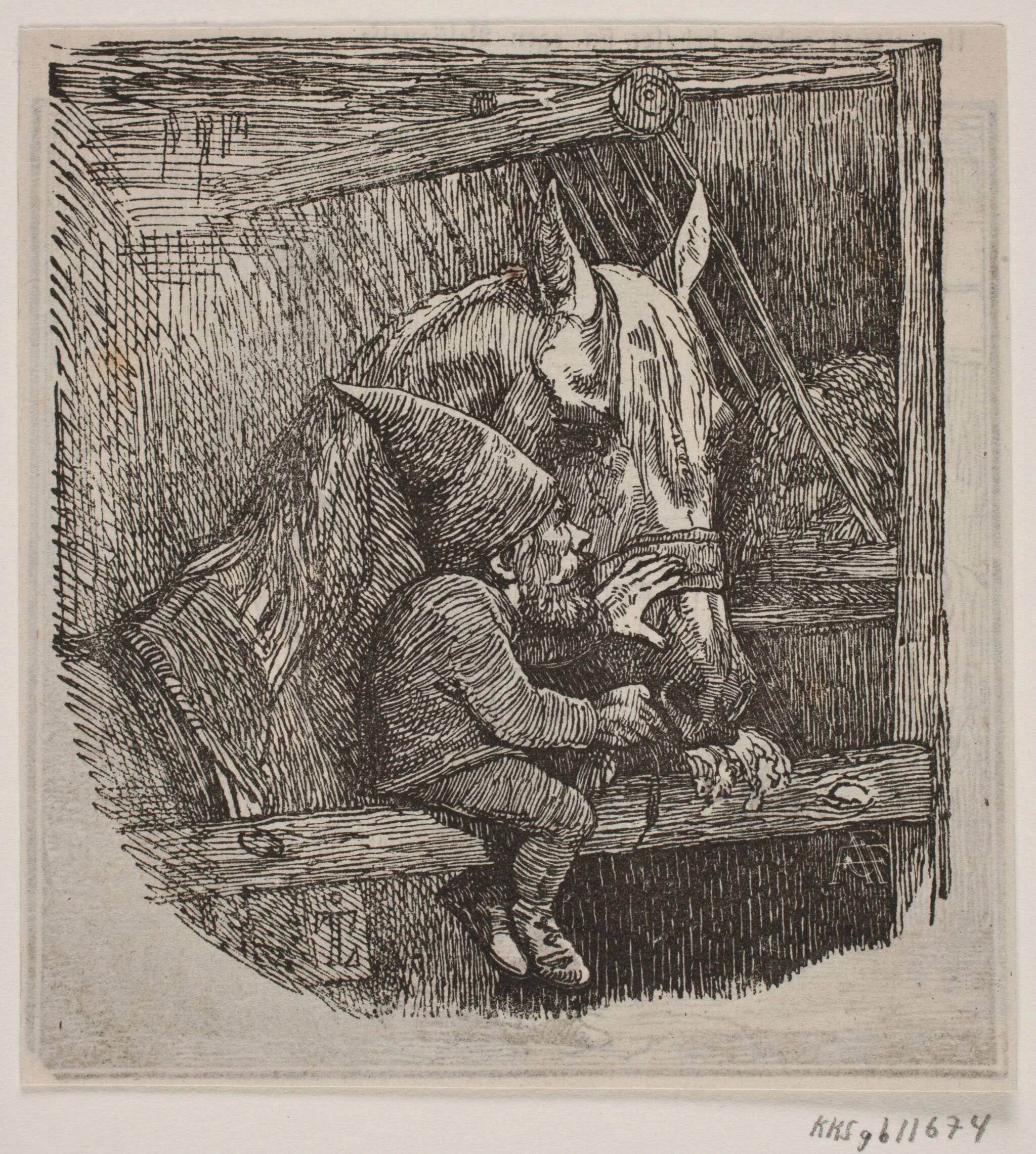
A nisse feeds a white mare in an 1842 Danish woodcut made by Andreas Flinch after Johan Thomas Lundbye for an almanac.
Photo credit: Andreas Flinch, after Johan Thomas Lundbye / Statens Museum for Kunst
On Christmas Eve in 1836, Martinus Rørbye doubted he could manage the cooking. The Danish painter was in Rome with fellow artists, and a fever had come on after a day of running about. He stood over a strong fire preparing porridge and the other dishes, later writing that the heat seemed to drive his illness away. The meal, he reported, earned praise from all sides.
The company gathered in rooms belonging to fellow painter Constantin Hansen. The artists had decorated them with greenery, especially ivy, and Hansen had painted what Rørbye called Christmas amusements with nisser in Pompeian style. Rørbye asked to have the work afterward and congratulated himself in his diary on having made the request in time.
His diary, preserved in Denmark's Royal Library, is an unusually early dated record of nisser appearing in a Christmas celebration. He does not describe how they looked or suggest that they were handing out presents.
The nisse already had a place in Danish farm tales published earlier that century. In stories collected by Just Mathias Thiele between 1819 and 1823, he protected the household and worked around the farm, provided the farmer supplied his porridge. Rørbye had cooked it for his fellow artists; in those stories, it was payment for the guardian's labour. Neglecting that payment could bring trouble.
Hammering After Dark
Mor Kerstin of Nytomta in Kortlanda told of a tomte who objected to hammering after dusk. If people on the farm carried on making noise, she said, he answered with his own pounding far into the night. She was 79 when a Swedish folklore record repeated her story in 1929. Another woman also called mor Kerstin, 70 and born in Håvilsrud in Eda, supplied a different example. Her account described a tomte who disliked card games and pulled chairs from beneath the players, sending them to the floor.
The narrator described tomtar as feared, though not found on every farm. In many stories they were invisible; those said to be seen appeared as little old men in rough working clothes, sometimes with caps. Their jobs included sweeping, carrying straw and tending animals, often at night. In Norwegian folklore, the related fjøsnisse belonged especially around cowsheds and outbuildings.
In another episode from the 1929 record, a cow calved overnight when nobody was there to attend it. By morning, the calf was in its pen and the door fastened. The teller credited the tomte with having done the work.
At a croft in Älgå Finnskogen, two charcoal carters were said to have horses the tomte treated very differently. Their black horse was well cared for, and if a farmhand drove her too hard, the story said, the tomte slapped him. The teller suggested that such spirits could favour particular colours: black horses had their manes groomed and braided and hay kept ready. The brown horse at the croft was sometimes led out of its stable and found standing in the yard the following morning.
The Butter at the Bottom
A guardian who looked after a farm's animals expected the household to look after him. In 1930, a person in Lenhovda parish, Småland, told a folklore collector of a farm where the housewife set out porridge and milk for the tomte every Thursday evening. The food went into the threshing barn. The same account described him carrying straw between the barn and cowshed and climbing into the loft each autumn to count the cheeses.
The published record preserves the teller's claim, rather than independent evidence that the housewife followed this routine. Some Swedish stories describe porridge being left for him every evening. Danish farm tales place the offering on Saturday evenings and feast days, with a knob of butter added to the bowl.
The butter was a sign that the tomte's work was appreciated. In some Swedish versions of a legend, that small gesture causes a disastrous misunderstanding. The tomte finds his porridge without any butter visible on top and takes offence. His anger falls on one of the farmer's cows, which he kills.
Only after eating does he discover what happened. The butter had sunk to the bottom of the dish. Regretting the killing, the tomte carries the dead cow to a neighbouring farm and exchanges it for a healthy one. He then drags the replacement back to the farm where he was given the porridge.
A Nisse in the Almanac
In 1842, a Danish almanac printed a nisse feeding a white mare at Tirup. Johan Thomas Lundbye designed the scene and Andreas Flinch cut it into wood. The sheet, about ten centimetres high, survives in Denmark’s Statens Museum for Kunst.
Printed illustrations were also giving the tomte a face in Sweden. For a collection of Wilhelm Bäckman’s tales published in 1851, Kilian Zoll drew the guardian in homespun clothes and a red cap.
In 1871, Viktor Rydberg published a Christmas story, Lille Viggs äfventyr på julafton, in a Gothenburg newspaper. Jenny Nyström, still a young art student, drew eight illustrations for it on her own initiative. The newspaper’s editor showed the drawings to Rydberg, who liked them, and they appeared in an illustrated book edition in 1875. In 1881, Nyström’s drawings accompanied Rydberg’s poem Tomten in Ny Illustrerad Tidning. The poem follows a guardian through a winter night as he checks the farm’s locks and visits the sleeping animals. The cows dream of summer, while the horse dreams of a manger full of clover. Between his rounds, the tomte puzzles over the people who have lived and died there. Nothing in the poem says it is Christmas Eve, and he delivers no presents.
Nyström’s earlier tomtar were rougher than the friendly figures she later drew for cards, wrapping paper and Christmas periodicals. Emil and Amalia Hammarlund commissioned writers and artists for the magazine Jultomten. Its 1891 cover, illustrated by Nyström, showed a smiling tomte pulling a wagon of gifts.
A Farmhand's Tomte Mask
In 1982, the Swedish Institute for Language and Folklore collected recollections of the Christmas tomte from older Swedes. Some described visitors in costume, while others recalled no visitor at all.
Stina Eurenius, born in 1899, could not remember anyone mentioning a Christmas tomte during her childhood, even at Christmas. Elsa Andersson, born in 1914, thought she first saw the tomte pictured after starting school in 1921. No costumed visitor came inside her home. Instead, a sack was left outside and the doorbell rang.
Elma Dahl, born in 1899, had grown up on an isolated farm seven kilometres from Stugubyn in Jämtland. She remembered no visitor and no talk of one. But she knew Lina Lundström, born in 1900, from Brynjegård, where a Christmas tomte appeared, often wearing a dogskin coat and a mask.
Einar Carlsson, born in 1915, remembered tomtar in Christmas magazines, books and seasonal posters. Around 1920–22, he recalled, a farmhand in his family's household made a mask using a pattern from the magazine Allers. Einar described it as the first masked Christmas tomte he remembered.






The bearded man on the cover of a Danish Christmas book in 1866 had no presents to hand out.