
For the Glenbow image, once rights are cleared:
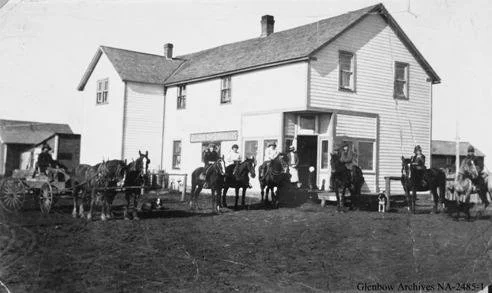
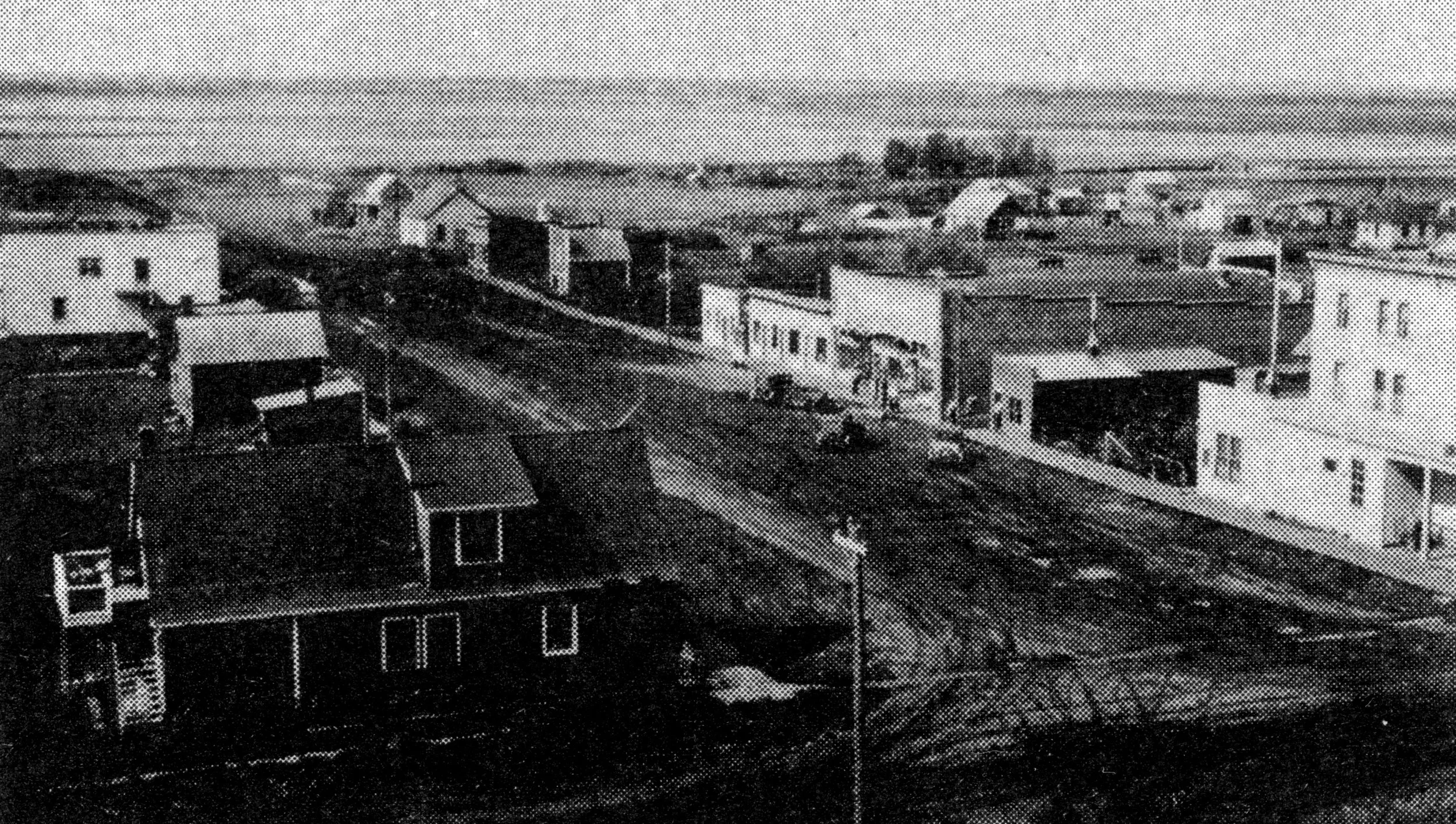
The general store at Dickson, Alberta, circa 1918. Opened in 1909, the business became a commercial centre for the Danish settlement.
Photo credit: Glenbow Archives, NA-2485-1
In the autumn of 1902, Danish immigrants living around Omaha, Nebraska, began discussing a move to the Canadian Prairies. Some had left Denmark during the 1890s and were considering homestead land west of Innisfail, in what is now central Alberta.
By July 1903, Danish settlers were living in tents on land claims west of Innisfail. The Dickson Store Museum’s exhibition connects that migration with a compass associated with an advance scouting journey and a homestead receipt, dated 1903, identified with Henry Larsen.
Historian Frank M. Paulsen, writing in 1974 after fieldwork among Prairie Danish communities, traced the Nebraska group’s interest in Canada to homestead opportunities and railway promotion. The Dickson Store Museum’s later account says a railway agent recommended land near Innisfail. According to the museum, Henry and Jens Larsen were sent north to inspect the district; they returned with a favourable report, and the prospective settlers prepared to leave Nebraska.
The museum places the proposed district about 22 miles west of Innisfail and recounts a government agent setting aside land for the Danish settlers. No corresponding Dominion Lands document has been identified that would establish a legally reserved tract.
The Dickson Store Museum counts seventeen adults and children in the new settlement by the second week of July 1903. Alberta’s provincial historic-place statement instead describes Carl Christiansen and seventeen Danish compatriots settling west of Innisfail that year. Because the two retrospective accounts describe the group differently, an exact founding headcount remains uncertain.
A homestead entry recognized a claim under the Dominion Lands system; it did not provide the shelter, tools, seed or labour required to cultivate a farm. The museum’s community history describes neighbours helping one another as they established their homesteads. In the first two years, according to Frank M. Paulsen’s account, Dickson settlers went to nearby Markerville, an Icelandic community about twelve miles northwest, for basic supplies. Markerville’s creamery, established in 1897, also bought their cream.
Whose land could be claimed?
Dickson’s homesteads were entered through a Canadian land system imposed on a region with much older Indigenous histories. The community lies north of the Red Deer River, the side that Red Deer County today identifies as Treaty 6 territory; the county identifies land south of the river as Treaty 7. Those geographical descriptions provide essential regional context, although the original Dickson quarter-sections still need to be checked against contemporary survey and land records. Long before Danish homesteading, the wider central Alberta region was a place of travel, gathering, ceremony and trade for Cree, Blackfoot and Métis peoples. During the nineteenth century, Métis families maintained wintering communities at Buffalo Lake and Tail Creek, northeast of present-day Red Deer.
Treaty 6, negotiated in 1876, appears in the Crown’s written record as a surrender of land. Historians working with the treaty record and First Nations accounts have also documented Indigenous understandings of treaty as a continuing relationship involving the sharing of land and promises made by the Crown. By 1903, federal officials were administering homestead entry in the Prairie West under Dominion Lands rules. Those records explain how immigrants could acquire recognized claims within Canadian law; they do not settle the differing understandings of land rights created by the treaty process.
A homestead receipt documented a settler’s claim under the Dominion government’s land system. It did not record the histories of Indigenous peoples who had occupied and used the region before the surveys.
Church and commerce in Dickson
The Danish settlers established a Lutheran congregation in 1903, according to a Central Alberta Historical Society account of Dickson’s churches. That retrospective account dates the first church building to 1910. The community’s later religious history was not confined to one institutional name: Wilfrid Laurier University Archives holds separate files for Pella Danish Lutheran Church and Bethany Lutheran Church in Dickson, although the available descriptions chiefly cover later decades.
Carl and Laura Christiansen opened Dickson’s general store in 1909, with family living quarters upstairs. According to the provincial historic-place record, Carl also served as postmaster and was active in the Danish Lutheran church. During the interwar period, the same record identifies him as a contact for newly arriving Danish immigrants.
The store bought and sold locally produced eggs, butter and meat, as well as selling household goods and lumber. According to the Dickson Store Museum, customers short of cash could barter or use credit accounts, while the Christiansens’ own suppliers required payment. The store also offered postal and telephone services and, later, access to radio broadcasts.
The district beyond the first homesteads
Dickson’s general store expanded with the agricultural district around it. Alberta’s provincial heritage record dates three additions to the premises between 1911 and 1930. An ice cooler acquired in 1919 made the store a local distribution point for products from the nearby Markerville Creamery, while a lumber-storage shed was added in 1928. Rural freezer lockers and a processed-meat plant followed in 1947. The Dickson Store Museum credits Carl Christiansen’s sons with helping expand the family enterprise.
The Danish Canadian National Museum records that Dickson’s Verbena Dormitory was built in 1933 to accommodate students attending the district’s high school. It had room for up to twenty girls in five bedrooms, with a matron overseeing the residence. Boys also attended the school and sometimes ate at the dormitory, but usually boarded with nearby farm families, often exchanging labour for room and board. Two rooms on the dormitory’s main floor initially served as classrooms until a separate high-school building was built in 1938. The dormitory later housed both girls and boys and remained open until 1959, when a centralized school in Spruce View and bus transportation made the boarding arrangement unnecessary.
Some heritage accounts describe Dickson as the first Danish settlement in Western Canada. BC Parks documents an earlier Danish colony at Cape Scott on Vancouver Island beginning in 1897. The Federation of Danish Associations in Canada calls Dickson the oldest Danish community on the Canadian Prairies, a narrower description also used by Frank M. Paulsen.
The Christiansen family store remained in business until 1980. Local heritage accounts date its reopening as a museum to 1991, during a visit by Queen Margrethe II of Denmark. The provincial heritage register identifies original shop equipment still preserved inside, including an accounts register and coffee grinder, along with an upstairs residence containing some of the family’s belongings.



In Sault Ste. Marie, Ontario, Halloween night in 1917 brought snow, disguises and an ultimatum at the front door.