
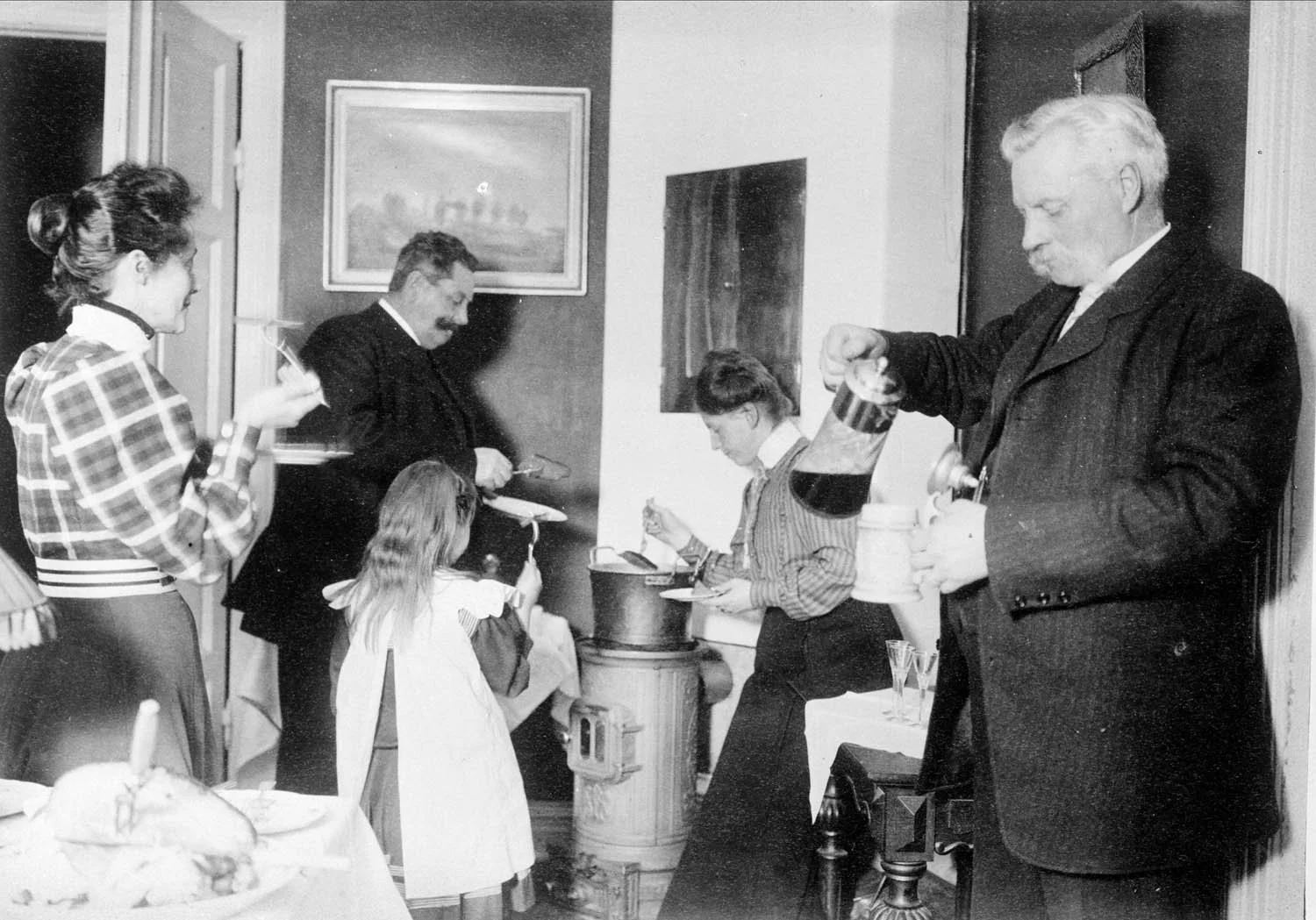
A family in Småland, Sweden, dips bread into ham broth during a Christmas gathering in 1910. At right, a man pours mumma, a traditional festive drink.
Photo credit: Erik Åkerhielm / Nordiska museet
On Christmas Eve in 1834, Danish parish priest Johan Frederik Biering had a song prepared for his family at Tåderup rectory. Presents hung from the branches of a Christmas tree, and the verses called relatives forward by name to collect their gifts. Lise was teased for always wanting more. Biering's son Christian Henrik, who studied natural sciences, was instructed to share rather than grab everything for himself, as the song joked he had done with the turkey.
Another verse addressed someone who was forever complaining about needing clothes. A hat was promised, along with trousers in some future year. By the final verse, the tree had been stripped of its presents, and Biering wished everyone, young and old, a happy Christmas.
Den Gamle By, the museum in Aarhus that published the song, notes that Christmas trees were still relatively unusual in Denmark. In 1847, Peter Faber wrote the much better-known Christmas song Højt fra træets grønne top, which also assigned gifts to named recipients around a tree. A researcher at Den Gamle By has proposed that Faber might have known Biering's earlier verses through the priest's son, although no surviving document establishes the connection.
Christmas Day remained December 25, but the day did not always begin at midnight. In Sweden, as in much of medieval Europe, people traditionally reckoned the beginning of a new day from the evening. By that understanding, a celebration associated with Christmas Day could begin on what modern calendars call December 24. Nordiska museet identifies this older way of counting the day as one reason Christmas Eve remains central to Nordic Christmas celebrations.
Religious observance also gave the preceding evening significance. The Christian vigil was associated with preparation, prayer and, in older traditions, fasting. Norwegian farming customs preserve a detailed account of how those observances became part of the family's Christmas Eve.
Before Christmas Presents
In older Norwegian farming communities, church bells rang at five on Christmas Eve. The household was supposed to have finished its preparations by then. Firewood had been chopped and brought inside, tools put away, and the animals fed earlier than usual so everyone could gather for the evening. Where the bells could not be heard, people sometimes announced Christmas by firing a gun.
Anne Kristin Moe, a former curator at Norsk Folkemuseum, describes an evening that could include two meals, with several hours between them. The first was associated with the older Christian fast: porridge, gruel or fish. People might rest, read or play games afterward, waiting until the family gathered again, sometimes close to midnight, for meat.
For farming households, that later meal brought food rarely eaten in such abundance during the rest of the year. Pork or mutton might be served, and before the iron cooking stove became common in the nineteenth century, the meat was generally boiled. The head of the household read the Christmas Gospel, a hymn was sung, and a bowl of beer passed around the table.
Some families left the Christmas table laid throughout the night because they believed deceased relatives might return to eat. In parts of Norway, the ancestors were also expected to use the household beds. The living slept on straw spread across the floor, a practice Moe records as surviving in many districts into the nineteenth century.
Christmas Day had different expectations. Animals still needed feeding and milking, but unnecessary work was set aside. People went to church, while social visits were discouraged. A man who ignored the restriction could be called a julegris, or Christmas pig; a woman might be called a juleskjor. The round of visiting between farms generally began on December 26, when neighbours gathered for food, drink and company.
Moe found relatively little evidence of Christmas or New Year's presents in the older farming communities. Servants sometimes received clothing, cloth or wool, although these provisions could form part of their compensation.
When Gifts Joined the Celebration
The Swedish word for Christmas present, julklapp, recalls a rather less elaborate exchange. Someone knocked on a door and tossed inside a piece of wood or a small carved doll. The offering was meant as a joke, and humorous verses became associated with the custom, allowing people to tease the recipients of their gifts.
Where presents were distributed in wealthy Swedish households during the eighteenth century, the person handing them out might arrive dressed as a Christmas goat. Nordiska museet describes the julbock as a potentially frightening figure, with historical associations that could make it a symbol of both good and evil.
The farm tomte belonged to a different tradition. In Swedish folklore, this guardian watched over the farm buildings and animals, expecting the livestock to be treated properly. Anyone who neglected the creatures might receive a slap from the unseen guardian. At Christmas, the household could leave him a bowl of porridge.
Gift delivery wasn't originally his responsibility. During the nineteenth century, however, the farm guardian's appearance and character became associated with European traditions of Saint Nicholas, producing the jultomte familiar in Swedish Christmas celebrations. Artist Jenny Nyström drew inspiration from the older farm figure for her Christmas illustrations, helping establish the appearance of the modern gift-bringer.
In Sweden, Christmas trees appeared in noble households during the seventeenth century, influenced by German customs, and reached a broader population during the nineteenth century. Nordiska museet dates their greatest expansion to the decades after the Second World War.
The Christmas Eve Clock
At noon on December 24, the bells of Turku Cathedral ring as Finland prepares to hear the Declaration of Christmas Peace. A city official reads the proclamation in Finnish and Swedish from the balcony of Brinkkala House, overlooking the Old Great Square. The reading is broadcast across Finland, and for many households it marks the beginning of their Christmas celebrations. The proclamation announces that the feast of Christ's birth is tomorrow.
The ceremony reaches back to the Middle Ages, when Christmas peace was a legally protected period and offences committed during it could attract harsher punishments. The wording from the earliest centuries has been lost. The oldest surviving copy found in Turku dates from 1834, when the text was recorded from memory after older records were destroyed in the city's great fire of 1827. The declaration has been read from the Brinkkala balcony since 1886, and its present ceremonial format dates from 1903.
For Petri Karkola's family, the noon broadcast also determines when to begin heating the Christmas sauna. He told thisisFINLAND that ordinary chores can continue beforehand, but the sauna marks the transition into the family's holiday. A birch whisk saved from summer is soaked and prepared for the occasion.
Many Finns also visit cemeteries on Christmas Eve, placing candles beside relatives' graves or at memorials for people buried elsewhere. Risto Lehto, who managed six Helsinki cemeteries, explained that the practice of placing candles on graves became widespread only in the 1920s, when candles grew affordable.
Since 1960, Swedish television has broadcast Kalle Anka och hans vänner önskar God Jul, the Donald Duck Christmas programme, at three o'clock on December 24. Many families eat Christmas lunch before gathering around the television, with the jultomte arriving later to distribute presents.
In Denmark, a Christmas Eve meal may include roast duck, pork or goose, followed by risalamande, a rice dessert served with cherry sauce. One whole almond is hidden in the bowl, and whoever finds it wins a small prize. Families often sing around the Christmas tree before opening gifts.
Norwegian Christmas Eve menus vary by region and household, with roast pork belly and pinnekjøtt, salted and dried lamb ribs, among the familiar dishes. Meat remains important to the celebration, although the earlier custom of dividing Christmas Eve into a fasting meal and a later feast is no longer universal.
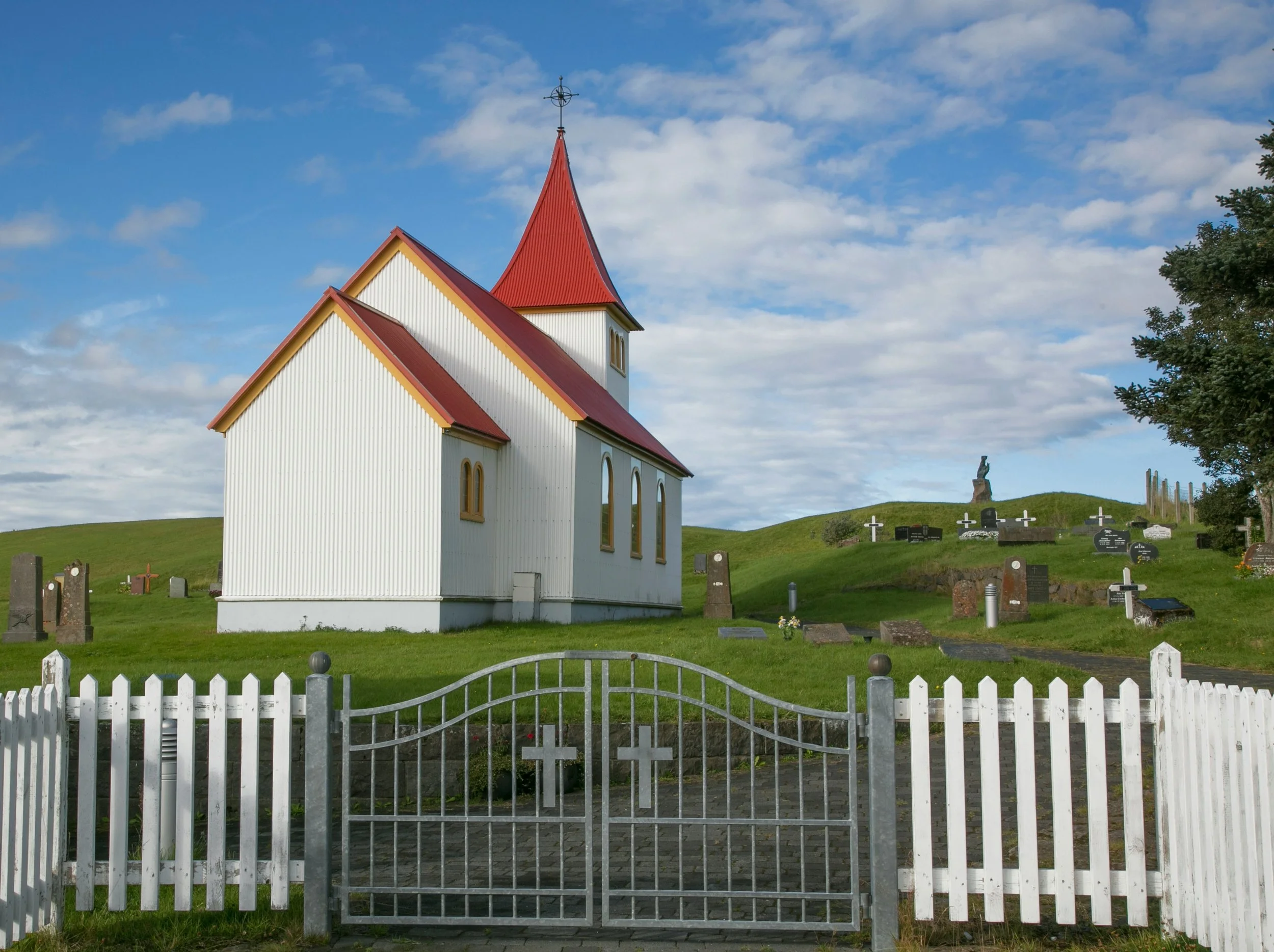
In Iceland, Christmas is rung in at six in the evening on December 24. Families commonly gather for dinner before opening their presents. The preceding day, St. Thorlac's Day, has its own traditions, including a meal of fermented skate in some households.
Christmas Eve on the Prairies
In Gimli, Manitoba, Christmas Eve in 1878 included a magic-lantern show. John Taylor, a missionary and government agent who had helped bring Icelandic settlers to the Lake Winnipeg region, showed slides of people, places and animals at a community concert. The following year, he was one of four speakers at another concert held on December 24. The Icelandic colony was established in 1875 on land the Canadian government reserved for Icelandic immigrants despite existing Cree, Ojibwe and Métis claims to the area.
Historian Wilhelm Kristjanson recorded these events in a paper published by the Manitoba Historical Society in 1975–76, almost a century after they occurred. His account describes the concerts and Taylor's participation, although it tells us nothing about the families' Christmas dinners or when they exchanged presents.
A more personal account appeared in 2016, when a contributor to the Icelandic Festival of Manitoba described Christmas in their Canadian family. Their holiday foods included rullupylsa, cured lamb; vínarterta, a layered cake; and pönnukökur, thin rolled pancakes.
Christmas Eve had always been the family's day for gathering, but the reason for that timing had puzzled the contributor for years. Only later did they learn that families in Iceland also celebrated with Christmas dinner and presents on December 24.



In a poem attributed to the Norwegian poet Þorbjǫrn hornklofi, King Harald has already grown tired of sitting beside a fire.