
Kekri: When Finland’s Farming Year Came to an End
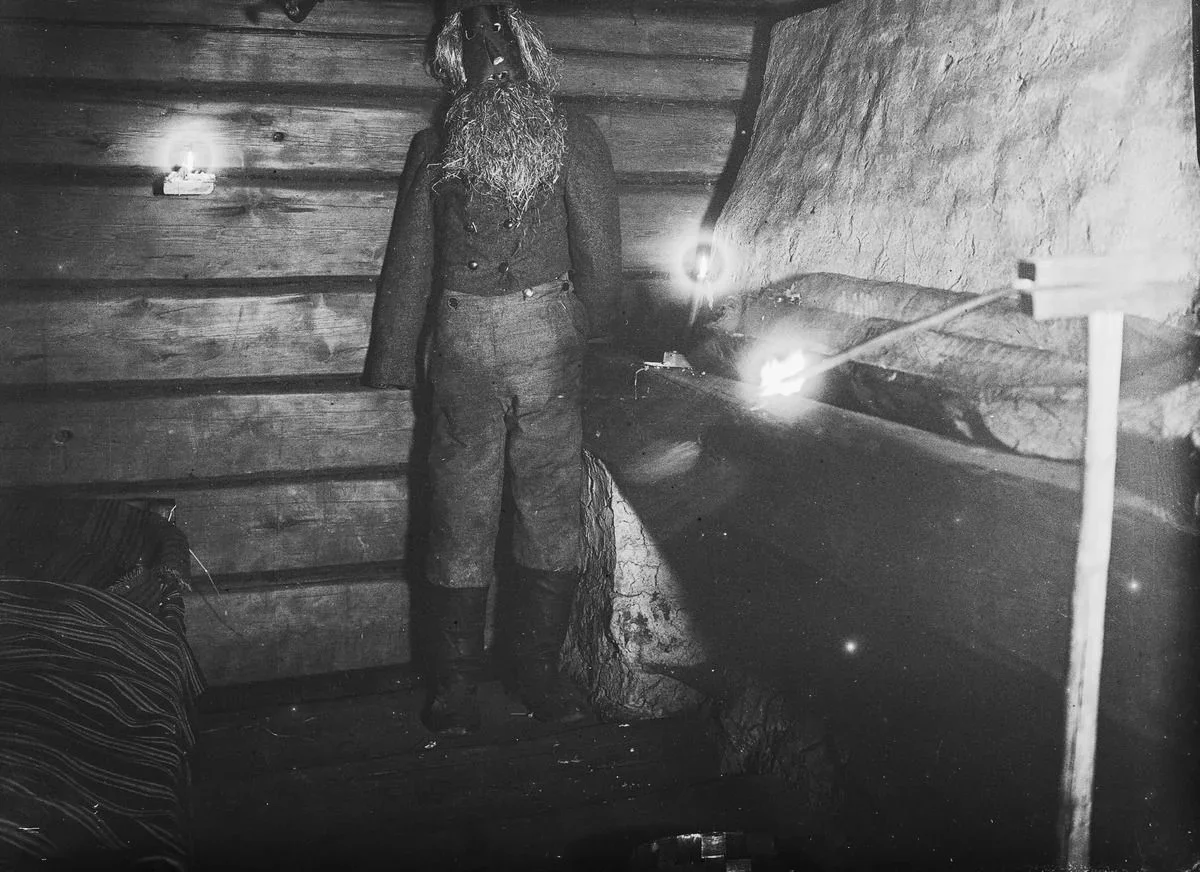
A Kekri figure beside the stove in the Niemelä croft exhibit at Seurasaari Open-Air Museum in Helsinki.
Photo credit
Finnish Heritage Agency (Museovirasto), Kansatieteen kuvakokoelma / Seurasaaren kuvakokoelma, CC BY 4.0.
“Köyriä vai uunia?” — “Kekri or the stove?” That was the question visitors might put to a farm household in the Kuopio countryside when the autumn festival came around. According to a local recollection collected in 1936, they expected food or drink and threatened a broken stove if their hosts refused.
The same account describes preparations beginning around one in the morning, when a sheep was slaughtered. Lamb soup and leppärieskä, a regional bread made with blood, were ready for breakfast. The rooms were cleaned before the servants’ “year’s end.” That evening, farewell porridge was made and portions set out for the “holy men,” invited to eat before the household went to the sauna. Afterwards, the family listened at the door.
Lyyli Karhu collected the recollection in 1936; it is preserved by the Finnish Literature Society. She recorded what people remembered as customary in the Kuopio area, rather than reporting a celebration she had just witnessed. Other collectors gathered accounts of Kekri from across Finland, often describing quite different practices.
The servants’ year-end
On farms, Kekri came when the autumn work was finished. Crops had been gathered and stored, livestock brought in from pasture, and slaughtering done for the colder months. The date could vary even between neighbouring households. The Finnish Rural Culture Foundation places the wider season between Michaelmas on September 29 and the old All Saints observances in early November.
By 1897, when folklorist Vihtori Alava wrote about Kekri in the journal Virittäjä, he found that most regions observed it on November 1 and the following days. In some places it had become closely associated with farm servants moving between employers. Kekri also went by names including keyri, keuri and köyri.
For servants employed by the year, the occasion brought an end to one household arrangement and sometimes the beginning of another. Recollections collected in Karttula, Lieto and Ruovesi describe farewell meals and a short break before the next position began. The free days had local names, including kissaviikko and römppäviikko. People could visit family, rest or look for another place to work.
A Leppävirta account collected in 1937 recorded the meal in two short lines: “Köyrin aattona keitettiin velli, köyriaamuna lammassoppa.” Thin porridge was cooked on Kekri eve, lamb soup on Kekri morning. Other recollections mention meat, fresh bread, talkkuna and drinks prepared for the occasion.
In Hyrynsalmi, Samuli Paulaharju recorded a saying in 1917: “Talonpojilla kekri, herrain joulu” — “Kekri for peasants, Christmas for the gentry.” Eating well was also associated in some folklore with the hope that the following agricultural year would be generous.
Kekri could also be a time for predicting the next year. A Sulkava account linked the sex of the first visitors with the prospect of ram or ewe lambs. In Rääkkylä, a recollection collected in 1902 said clear weather at keyri foretold an early spring thaw. Other collectors recorded tin-casting and attempts to read the shapes left behind.
Kekripukki and the “old ones”
Costumed callers were among Kekri’s more conspicuous visitors. In certain regions, young people dressed as kekripukki, the Kekri buck, or kekritär, also known as köyriätär. A buck might wear a fur coat turned inside out and a birch-bark mask, while the female figure could be dressed in white. Men sometimes wore women’s clothes, and women men’s, as they went from house to house seeking hospitality.
A recollection collected in Sulkava in 1939 tells of callers threatening to overturn the stove unless they were given coffee.
There is a resemblance to trick-or-treating, although the callers in these accounts were often young adults asking for food and drink rather than children collecting sweets. The similarity offers no documented line of descent from the Irish festival of Samhain.
Some households also prepared for visitors they would not see. In Hirvensalmi, a 1937 account describes food taken to a threshing barn or sauna for the vanhasille, the “old ones.” Some set it on the sauna stove. The Finnish term belongs to that local account and cannot simply be substituted with a single modern category of ancestor or spirit.
In Sulkava, food and water were left for the haltijat, household guardian spirits, so they might use the sauna after the family. The Kuopio household invited “holy men” to its porridge.
Kekri beyond the farmhouse
Written references to Kekri reach further back than these accounts. In the preface to his Finnish Psalter in 1551, Mikael Agricola included a figure called Käkri in a list of beliefs attributed to Karelians, connecting it with the growth of cattle. The later descriptions of servants’ meals, masked visitors and sauna offerings come from records gathered centuries afterwards. Alava had already described connections between Kekri and All Saints’ Day in 1897.
In November 1911, Helsingin Sanomat reported an “old-fashioned” Kekri celebration at the Niemelä croft in Helsinki’s Seurasaari open-air museum. A figure placed in a corner of the room startled some guests. According to Helsinki’s city history, Kekri events had become established at Seurasaari by 1922.
In 1955, the Finnish Lutheran observance of All Saints was moved to the Saturday between October 31 and November 6. That change concerned the church calendar; farm households had long chosen different days for their autumn celebrations.
As farming and annual service changed, Kekri could no longer mark the same household turning point everywhere. Local observances, museum events and organized celebrations continued in different forms. In 2009, the Finnish Rural Culture Foundation launched its Kekristä kansanjuhla initiative to encourage wider public celebration.
Present-day events may include shared meals, masked visitors, performances and autumn fires. At some events, organizers burn a large constructed straw goat, a recent addition to Kekri festivities.


“Köyriä vai uunia?” — “Kekri or the stove?” That was the question visitors might put to a farm household in the Kuopio countryside when the autumn festival came around. According to a local recollection collected in 1936, they expected food or drink and threatened a broken stove if their hosts refused.