New Finland, Saskatchewan
The Finnish Settlement Northeast of Whitewood
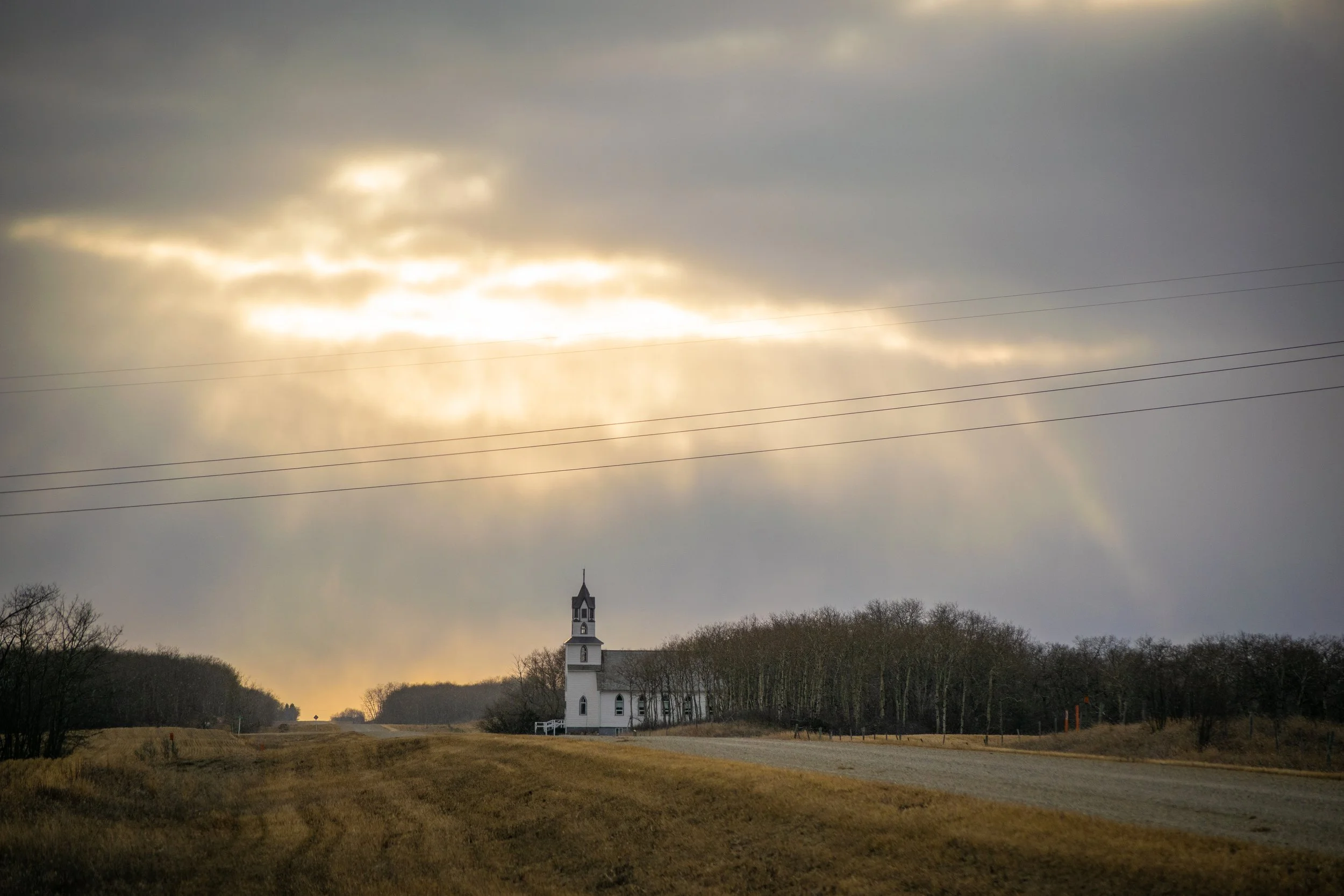
St. John’s Lutheran Church in New Finland, Saskatchewan, photographed in 2020. The church was built in 1907 and moved to its present site in 1934.
Photo: Powerbump/Wikimedia Commons, CC BY-SA 4.0.
In 1888, David — or Taavetti — Kautonen registered a 160-acre quarter-section northeast of Whitewood, in the District of Assiniboia in what was then the North-West Territories. His claim, SW-36-17-1-W2, placed him within the Dominion survey grid that was reshaping the geography of settlement across the Prairies.
The date requires some care. The Encyclopedia of Saskatchewan dates the beginning of New Finland to 1887, as does geographer Arnold Alanen in his work on Finnish settlement on the Great Plains. Outi-Kristiina Hännikäinen, whose doctoral research reconstructs New Finland through land records, community histories, interviews and other sources, begins the settlement in 1888, when Kautonen registered the first documented Finnish homestead. Archaeologist Verna Gallén likewise found the 1888 registration in the homestead record. The evidence firmly places Kautonen on the land that year, although some later histories continue to use 1887 as the settlement's founding date.
The homestead lay within the geographic area covered by Treaty 4, first concluded at Qu'Appelle in 1874. By the time Kautonen filed his claim, the federal government was administering settler homesteads throughout much of the region through the Dominion Lands Act and its survey system. A standard homestead quarter-section contained 160 acres and could be entered for a $10 registration fee, provided the claimant met the residence, cultivation and other requirements necessary to obtain title.
Kautonen's quarter-section became the beginning of a Finnish farming district that eventually carried a name of its own: New Finland, or Uusi Suomi. It did not appear all at once as a planned village or colony. Farms accumulated household by household along the roads and survey lines north and northeast of Whitewood.

Families Followed the First Homestead
The next documented arrival came in 1890, when J.K. Lauttamus settled in the district with his wife, Sanna Liisa, and their four children. Other Finnish families followed during the 1890s, and Hännikäinen's reconstruction of the settlement biographies identifies 1895 as the busiest immigration year, when 24 adults and 16 children arrived.
Those figures are reconstructed rather than official immigration counts. Hännikäinen worked principally from the biographies preserved in New Finland's community histories, checking them against land, census and other historical records where possible. Using those sources, she identified about 250 adults and slightly more than 100 children who moved into New Finland between 1888 and 1933. Local histories also name roughly 50 Finns who spent some period in the district without becoming permanent residents, although in some cases little survives beyond a name.
Immigration slowed considerably after the first years of the twentieth century. After 1915, only a few new settlers generally arrived each year, and Hännikäinen identified just 16 immigrants who came after 1921. By then, much of New Finland's growth came from children born into families already living there.
Men made up about 57 per cent of the adult immigrants in Hännikäinen's reconstruction, a considerably more balanced population than could be found in some Finnish mining and lumber communities elsewhere in North America. Some men travelled first and later sent tickets for wives and children, while other households migrated together. Families were present from the settlement's earliest years, giving New Finland a different demographic shape from communities built primarily around temporary male labour.
Where Finnish places of origin can be identified, the strongest concentration was in South Ostrobothnia. More women came from Kauhava than from any other known locality, while Kauhava, Lapua and Nurmo supplied the largest numbers of men. The surviving record is incomplete, however, and Hännikäinen could establish an origin for only a little more than half of the immigrants. New Finland also included people from other parts of Finland.
Individual motives are harder to establish. Economic hardship, crop failures, population pressure, inheritance practices and political instability all appear in scholarship on the wider Finnish emigration, although New Finland's immigrant biographies rarely preserve enough evidence to assign any one of these explanations confidently to a particular family.
The chronology is especially important when political conditions in Finland are considered. The February Manifesto of 1899, which began the first major period of Russification, is sometimes invoked broadly in accounts of Finnish emigration. New Finland was already well established by then. Kautonen had registered his homestead eleven years earlier, and the settlement's largest recorded influx had occurred in 1895. Political instability formed part of the wider setting in which Finnish emigration continued, although it cannot explain the beginning of this particular settlement.
Finland Was Often Only the First Country in the Story
By the time Finnish families were taking land near Whitewood, Finnish migration to North America already had a history of its own. Finns were settling in Minnesota by the 1860s, and larger Finnish communities subsequently developed around mining, logging and agriculture in Minnesota and Michigan. Between 1870 and 1920, approximately 340,000 Finns immigrated to the United States.
New Finland developed within that continental network.
The 1982 community history Life in the New Finland Woods estimated that about half of New Finland's immigrants had travelled directly from Finland. When Hännikäinen reconstructed individual migration routes from the biographies contained in that history, she arrived at a considerably smaller proportion. Slightly less than one quarter appeared to have come directly from Finland to New Finland. Because the route is unknown for many settlers, she calculated the figure again using only the people whose movements could be traced; even among those cases, fewer than 35 per cent had travelled directly from Finland.
For many families, Saskatchewan was one stage in a longer North American migration. Finnish communities in Michigan and Ontario were especially common intermediate destinations. Settlers could leave Finland, spend time working or living elsewhere in Canada or the United States, and later move west after hearing about farmland near Whitewood through relatives, friends or other Finnish migrants.
Information travelled through letters as well as personal contacts. Life in the New Finland Woods later credited letters from early settlers with attracting 50 people to the district by 1893. Hännikäinen cautions against taking that figure literally, since 50 was also approximately the entire immigrant population of New Finland at that point. The broader evidence for chain migration is much stronger. She identified 29 families or individual migrants who came because relatives were already living in New Finland, along with four families who followed friends.
One arrangement preserved in the community histories involved the Myllymäki family, who were said to have paid the passage of at least five young Finnish men. The men repaid the cost through work on the family farm, and several later married and remained in the district. The story comes through locally compiled biographical material rather than a surviving immigration contract, but it fits the wider documented pattern in which established households helped other Finns reach Saskatchewan.
Immigration Officials Tried to Encourage the Settlement
Canadian immigration officials recognized the value of the Finnish farming district early. In his 1892 annual report from the Whitewood immigration agency, C.K. Hendrickson wrote favourably about Finnish settlers and argued that more Finns should be encouraged to settle in the area.
Government and transportation interests continued pursuing Finnish immigration during the decade. In 1899, the Canadian government brought a Finnish delegation west to inspect settlement opportunities, while another delegation connected with shipping interests also visited New Finland. Railway and immigration promoters were particularly interested in Finns already living in the United States, including communities in Minnesota and the Dakotas.
The major recruiting efforts came after New Finland was already taking shape. Kautonen and Lauttamus were on the land before them, Finnish families had continued arriving throughout the 1890s, and personal networks were already circulating information about the settlement.
Neither Hännikäinen nor historian Maureen Pedersen found a corresponding increase in New Finland immigration after the 1899 delegations. The arrival figures instead support a pattern in which relatives, friends and correspondence remained important mechanisms for bringing new households into the district.
A Finnish Block Without a Finnish Village
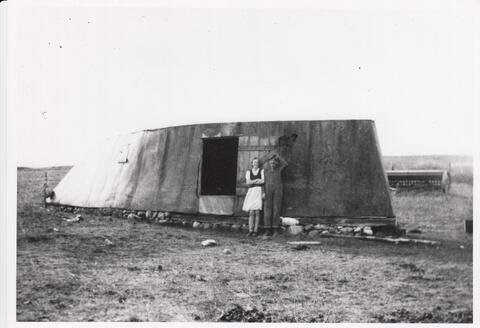
The Dominion land survey shaped the physical form of New Finland. Homesteaders took individual quarter-sections within the survey grid, and the farms spread across enough territory that no compact European-style village appeared. Houses could stand miles apart even when their occupants considered themselves part of the same community.
Finnish settlers nevertheless acquired land close to one another whenever circumstances permitted. By 1900, two scholarly reconstructions produce almost the same picture. Working from the land information contained in Life in the New Finland Woods, Hännikäinen calculated that Finnish settlers had acquired 62 quarter-sections. Pedersen, using Saskatchewan archival land records, counted 61. The difference of one quarter-section does little to alter the underlying pattern: a substantial concentration of Finnish-owned farms had developed on either side of the Second Meridian in Township 17.
The term “block settlement” therefore referred to a concentration of neighbouring Finnish farms rather than a single village. Shared language made cooperation easier in a rural district where neighbours depended on one another for labour, equipment and practical assistance.
Land remained one of the strongest attractions. Hännikäinen identifies the availability of inexpensive homestead land as New Finland's principal pull factor. The district was also more wooded than the open grasslands farther west. Clearing trees demanded considerable labour, although timber supplied building material and sometimes additional income. Hännikäinen also argues that the wooded landscape bore greater resemblance to environments familiar to many Finnish immigrants than the open prairie did.
The settlement eventually developed a recognizable Finnish territorial identity despite never becoming a separate municipality or census unit. That creates problems for anyone trying to calculate its population precisely. Using municipal-level figures from the 1921 census and other records, Hännikäinen estimates that more than 650 people of Finnish background were living within New Finland itself, with approximately 730 in the wider surrounding district.
The Church, School and Hall Gave the District a Centre
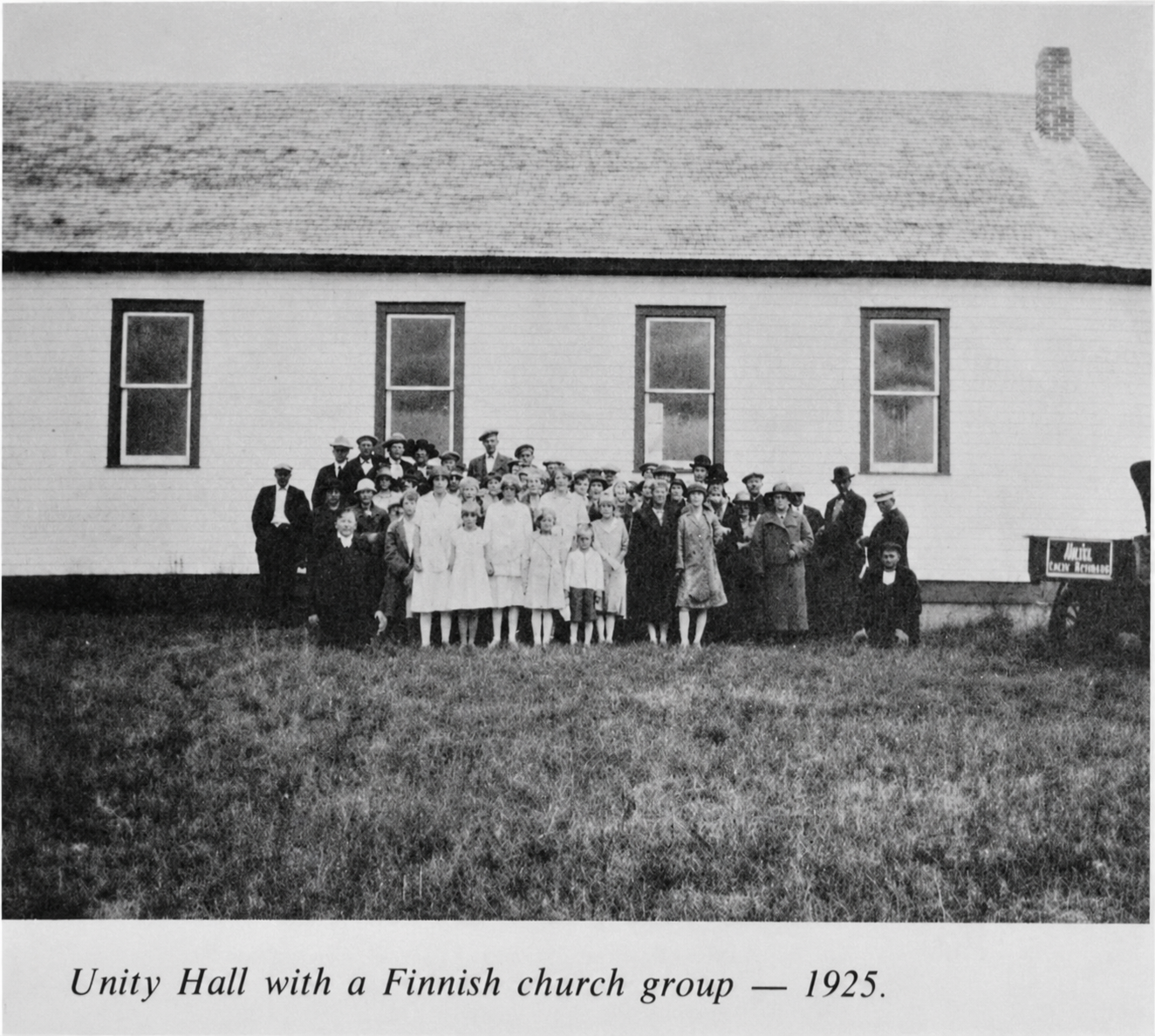
New Finland's institutions appeared within a few years of the first homesteads. St. John's Lutheran congregation was organized in 1893, New Finland School was established in 1896, and the congregation constructed St. John's Lutheran Church in 1907. In 1914, the New Finland Temperance Society built a hall.
These buildings provided gathering places in a settlement whose geography otherwise kept households apart. The school served a heavily Finnish population, while the church became one of the district's most enduring physical landmarks.
Religion was important without making New Finland a uniform Lutheran community. Some later accounts characterize the early settlement as dominated by “Church Finns,” although Hännikäinen traces theological and personal disagreements that eventually produced separate congregational groupings. She also cautions against using the surviving church records to calculate New Finland's total population because not every Finnish resident belonged to the same Evangelical Lutheran congregation.
The geography of worship changed as the settlement itself shifted. By the 1930s, St. John's stood inconveniently far from many members of the congregation, and in 1934 the church was moved south. The building was cut into two sections, transported and reassembled at its present location. Sources disagree on the precise distance: Hännikäinen gives approximately five kilometres, while the Rural Municipality of Willowdale and later church histories give five miles, or roughly eight kilometres.
New Finland and Alberta's Finnish Settlements
New Finland provides a useful comparison with the Finnish agricultural settlement that developed west of Red Deer a little later.
Alberta's Finnish settlement also had an organized recruitment history. A Finnish delegation selected the Red Deer district as a potential settlement area in 1899, and Arnold Alanen records Finns moving into the region about three years later. A cluster of Finnish farming communities developed around Sylvan Lake, Eckville, Kuusamo and neighbouring localities, while smaller Finnish concentrations appeared elsewhere in Alberta, including around Thorhild, Radway, Three Hills, Trochu, Wetaskiwin, Barons and Manyberries.
The resulting geography differed from southeastern Saskatchewan. Central Alberta contained several neighbouring Finnish communities and local centres within a broader settlement zone, while other Finnish populations developed elsewhere in the province. In southeastern Saskatchewan, a concentrated group of Finnish farms became increasingly associated with a single regional name.
The difference should not be overstated. Government and railway interests encouraged Finnish agricultural settlement in both provinces, and settlers in both places relied heavily on family and community networks. New Finland nevertheless developed into an especially recognizable ethnic block whose name came to describe the surrounding countryside as well as its Finnish institutions.
The Rural Municipality of Willowdale still describes New Finland as a Finnish-speaking block settlement. St. John's Lutheran Church, built in 1907 and moved in sections in 1934, remains at its second site, where it was designated a municipal heritage property in 2007.
Further Reading
Hännikäinen, Outi-Kristiina. Identiteettien maisemat Saskatchewanin Uudessa Suomessa: uudisasutuksesta uusidentifikaatioon. Siirtolaisuusinstituutti, 2010.
Pedersen, Maureen A. “‘Wherever Two or Three Are Gathered’: A Study of the Finnish Settlement at New Finland, Saskatchewan, 1888–1945.” M.A. thesis, University of Regina, 2004.
Gallén, Verna Elinor. In Silence We Remember: The Historical Archaeology of Finnish Cemeteries in Saskatchewan. M.A. thesis, University of Saskatchewan, 2012.
Schelstraete, Nancy Mattson, ed., and the New Finland Historical and Heritage Society. Life in the New Finland Woods: A History of New Finland, Saskatchewan. Rocanville, Saskatchewan: New Finland Historical and Heritage Society, 1982.
Alanen, Arnold R. “Little Houses on the Prairie: Continuity and Change in the Finnish Vernacular Architecture and Landscapes of Canada.” Journal of Finnish Studies 9, no. 2, 2005.
Hryniuk, Margaret, and Frank Korvemaker, with photographs by Larry Easton. Legacy of Worship: Sacred Places in Rural Saskatchewan. Coteau Books, 2014.