Unity Hall and the Finnish Young People’s Society Near Sylvan Lake
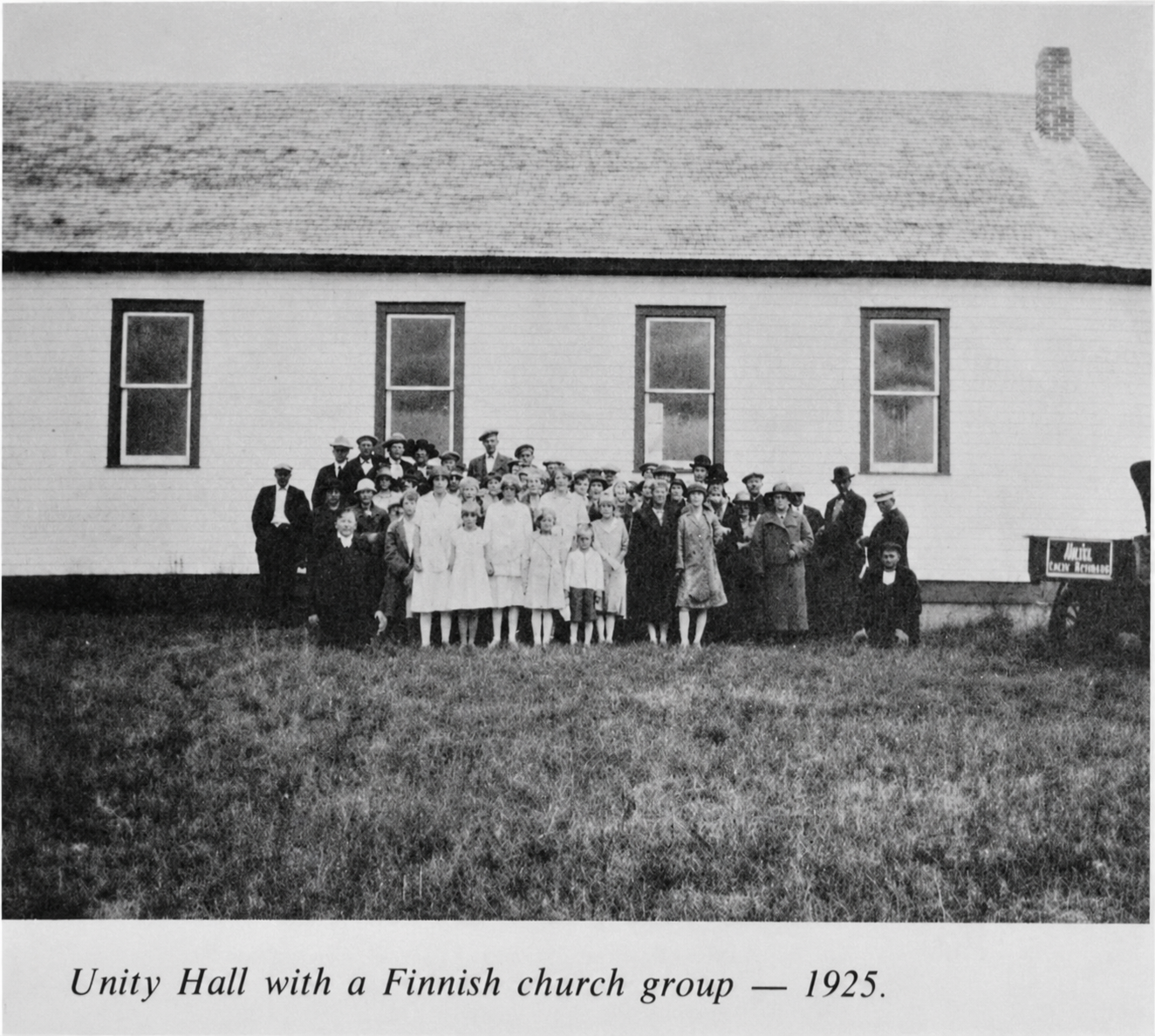
A Finnish church group gathers outside Unity Hall near Sylvan Lake in 1925. Built the previous year for a Finnish young people’s society, the hall also served as a gathering place for church services, dances, plays and community meetings.
Credit: Along the Burnt Lake Trail, Burnt Lake History Society, 1977, p. 491. Image lightly enhanced from the published scan.
A 1925 photograph shows a Finnish church group gathered outside Unity Hall, a white-sided building in the countryside west of Sylvan Lake. The hall was only about a year old when the photograph was taken, but it was already serving several parts of Finnish community life, from church gatherings to dances, meetings and plays.
The fullest account located for this article appears in Along the Burnt Lake Trail, a community history published by the Burnt Lake History Society in 1977. The book drew on land titles, school records, archival material, private collections and family memories. Its editors also cautioned that some details rested on recollections recorded decades after the events.
The section on Unity Hall was written by Mrs. Guy Fitch, born Jennie Sylvia Riekki. She was the daughter of S.A. Riekki, the Finnish farmer who donated the land on which the hall was built, placing her close to many of the people involved in its early history.
A society for Finnish young people
According to Fitch, August Staudinger and Venla Keltikangas felt there was a need for a Finnish young people’s organization in the area around 1923. Keltikangas had recently come from Alajärvi, Finland.
The society was intended to give younger people greater knowledge of the Finnish language and what Fitch described as Finnish “ethics.” The history does not define the term further, but the emphasis on language makes clear that the group was concerned with what younger generations would retain from their Finnish background.
Meetings began in Finnish, but the arrangement did not last. Fitch wrote that too few of the younger members could read and write Finnish well enough to serve as officers. Within about a year, the society switched its meetings to English and became the Young People’s Society.
For a group created partly to strengthen Finnish among the younger generation, the change came early. It also reveals one of the practical challenges facing immigrant communities in Alberta. Finnish remained important within families and community life, but running an organization required enough members who could read, write and conduct its business in the language.
The 1977 history records the society’s Finnish name as “Nuori Seuran Kokous.” That wording is unusual. The standard Finnish term for a youth association is nuorisoseura, while nuorisoseuran kokous refers to a meeting of such an association. Fitch wrote that the society’s own records were no longer available to her, so the name preserved in the community history is best treated cautiously rather than as a confirmed official title.
Another young people’s group appears in the record
Elsewhere in Along the Burnt Lake Trail, the family history of Hilma Kuores describes a group called the Sylvan Lake Young People. It says the organization was formed at Kuores’s home on April 18, 1924, with 34 members and Knut August Staudinger as president.
The date and Staudinger’s involvement make a connection with the Unity Hall society possible, but the book never explicitly says the two groups were the same. The Kuores account also says that the group’s minute book was still being kept for the family by a Mrs. Knight when the local history was prepared in the 1970s.
That surviving reference is especially intriguing because Fitch believed the Young People’s Society records were no longer available. The two accounts may refer to the same organization, or to closely related groups operating among the Finnish families around Sylvan Lake. Without the original minute book, the connection remains uncertain.
Building Unity Hall
In 1924, S.A. Riekki donated one acre of cultivated land at the northeast corner of the northeast quarter of Section 26, Township 38, Range 2, west of the Fifth Meridian. Unity Hall was built there that fall with volunteer labour.
The cooperative construction resembled the Finnish practice of talkoot, in which neighbours joined together to complete work for a household or community. The local history does not use that word for the Unity Hall project, but the method would have been familiar within Finnish rural communities.
The hall measured approximately 36 by 60 feet. It had white-painted siding, cedar shingles and a cement foundation, along with a stage, cloakrooms and a wood-burning box stove. A counter was installed for serving lunches during events.
Its hard-maple floor became one of the building’s remembered features. Fitch wrote that when it was properly waxed, residents considered it one of the best dance floors in central Alberta. That was a community judgment rather than a formal ranking, but it shows what people remembered about the hall decades later.
Unity Hall was also known locally as the Young People’s Hall.
Dances, plays and church services
The building quickly became a social centre. The Young People’s Society used it for dances, plays, meetings and other community events, while the stage gave local performers a place to put on productions.
Religious activity was part of the hall’s early life as well. Fitch wrote that several Finnish denominations used Unity Hall for services, choir gatherings and picnics before it became formally associated with the Finnish Evangelical Lutheran Church. The 1925 photograph of a Finnish church group outside the building fits that account.
The society’s activities also resembled the nuorisoseura tradition that had developed in Finland from the late 19th century. Finland’s first youth association was established in Kauhava in 1881, and the movement became known for volunteer-run cultural and educational activities, including theatre, music, dance and sports.
There is no evidence that the Alberta society was formally affiliated with the Finnish organization. Still, the similarities provide useful context for a group that combined language, cultural activity, performances and community work.
For Finnish farm families scattered west of Sylvan Lake, Unity Hall filled several needs at once. Young people had a place to meet, residents had space to organize events and Finnish congregations had somewhere to gather for worship.
From Young People’s Hall to Lutheran church
Unity Hall stood only about three miles from Sylvan Lake, where three large halls were already available. Fitch wrote that the need for a separate rural hall eventually declined.
The Young People’s Society disbanded and sold the building to the Finnish Evangelical Lutheran Church. After the society’s expenses were paid, its remaining money was donated to the Red Cross. The local history does not give a date for the society’s dissolution or the church’s purchase of the hall.
In 1935, Finnish carpenter Karl Soderlund Sr. built a log manse beside Unity Hall. Finnish Lutheran ministers lived there, and the former Young People’s Hall continued to serve as a church.
The building had already changed considerably from the purpose envisioned for it a decade earlier. A hall created by a youth society concerned with Finnish language and community had become an established place of worship, while remaining part of the same Finnish district that had built it.
Unity Hall moves into Sylvan Lake
The Finnish Evangelical Lutheran Church continued using Unity Hall until 1947. That year, the building was sold to provide additional school space in Sylvan Lake and moved to the school site.
The community history does not identify which classes or school program used it. The building was later moved again, beginning another stage in a life that had already taken it from youth society to church to school.
When Along the Burnt Lake Trail was published in 1977, the former Unity Hall was being used as the town machine shop, across the street south of the Pool elevator. The log manse had also survived in another form and had become part of the Ben Schamber home.
The 1977 account confirms that both structures remained in use long after their original Finnish community roles ended. It does not establish whether either survives today.
A community changing languages
Unity Hall’s story captures a period of transition for Finnish families in central Alberta. The people who organized the society wanted younger residents to know Finnish, but they soon found that conducting the organization entirely in Finnish restricted who could take leadership roles.
Their response was practical. The meetings moved to English, while the society continued organizing dances, plays and gatherings. Finnish congregations continued to worship in the hall, and the building remained useful even as its purpose changed.
That pattern continued after the society disappeared. Unity Hall became a Lutheran church, then school space and eventually the town machine shop. A building erected by volunteers in 1924 continued serving the surrounding community for at least another half-century.
Its history also records the everyday choices that shaped Finnish life in Alberta. Language changed. Organizations came and went. Buildings acquired new purposes. The community did not remain exactly as it had been when the first families arrived, but traces of those earlier institutions remained in the places they built and the stories later generations preserved.
Further reading
Burnt Lake History Society. Along the Burnt Lake Trail: A History of Shady Nook, Burnt Lake, Centerville, Pine Hill, Marianne, Kuusamo and Evarts. 1977.
https://archive.org/details/31221092277271
The Youth Association of Finland. Background on Finland’s nuorisoseura movement and its history.
https://nuorisoseurat.fi/in-english/