Tom Sukanen and the Ship Built on the Saskatchewan Prairie
The Finnish immigrant behind one of Saskatchewan’s strangest landmarks
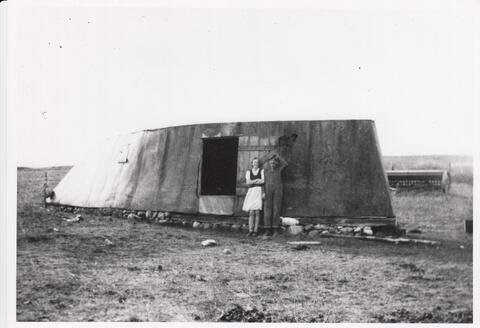
The hull of Tom Sukanen’s ship on the Markula family farm near Macrorie, Saskatchewan, around 1945. Mr. and Mrs. Vic Markula stand in front.
Moose Jaw Public Library Archives / MemorySask. Public domain.
In the fall of 1938, 14-year-old Don Book went with a group of farm kids to see a large boat being built on the prairie near Macrorie, Saskatchewan. Book brought his grandfather’s Kodak box camera, and the photographs he took that day show two substantial sections resting separately on the ground: the hull and keel of a ship being constructed by a Finnish immigrant named Tom Sukanen. Book later recorded the hull as 13.1 metres long.
The South Saskatchewan River was about 26 kilometres away.
According to accounts later collected from Sukanen’s relatives and neighbours, he planned to move the sections to the river and take them downstream through the Saskatchewan and Nelson river systems toward Hudson Bay. The ship would be assembled once he reached deeper water, after which he hoped to continue across the Atlantic to Finland. The hull and keel made it only part of the way to the river, but enough of Sukanen’s boat survived for it to become the centrepiece of a museum south of Moose Jaw decades later.
The physical remains make the broad outline of the story easy enough to believe. The difficulty comes with the details. Sukanen’s life was retold by relatives, neighbours, museum volunteers, journalists, playwrights and filmmakers, and some of those versions contradict one another. Stories about extraordinary strength, homemade machinery, iron teeth and supposed Finnish customs became attached to him alongside better documented evidence. Thomas A. DuBois, a scholar of Scandinavian studies and folklore at the University of Wisconsin-Madison, examined that process in a 2023 article devoted to both Sukanen and the meanings later attached to his ship. His work makes it possible to recover more of the man who lived in Saskatchewan before the ship became the story most people knew about him.
From Finland to Minnesota
Tom Sukanen was born in Finland in 1878, although published sources do not agree on his original name. The traditional museum account calls him Tomi Jannus or Jaanus Alankola, while other records refer to Damianus or Domianus Sukanen. Filmmaker Chrystene Ells later travelled to Finland, interviewed Sukanen relatives and former neighbours and identified him as Damianus Aho Sukanen. DuBois notes the conflict rather than treating one version as definitively established.
Sukanen eventually settled in Biwabik, Minnesota, with Sanna Liisa Rintala. Rick Book dates their marriage to 1906, while Ells’s later family research places the marriage in Finland rather than Minnesota. By 1910 the couple had a son and three daughters. Sukanen appears to have worked in the iron-mining district before turning to farming, part of a much larger Finnish immigrant population that had established itself in northern Minnesota and Michigan around mining and agriculture.
The marriage was in serious trouble by 1911. Book located a March 31 report in the Biwabik Times stating that Sanna Liisa had been ordered by a court to undergo an assessment of her mental condition. The same article reported that Sukanen had recently spent 90 days in jail for failing to support his wife and children and also repeated allegations about his own mental state. The newspaper gives us contemporary evidence of a family crisis, although its language and assumptions about mental illness cannot be treated as a modern diagnosis of either spouse.
Sukanen left Minnesota that year and travelled to Saskatchewan, where his brother Svante was already farming in the Macrorie-Birsay district. Family members later told Book that Sukanen walked roughly 1,400 kilometres and reached his brother’s farm with 28 cents left in his pocket. The walk and the 28 cents belong to family recollection rather than a contemporary travel record, but his move to Saskatchewan in 1911 is well established in the later historical research.
The Finnish Community on the Coteau
Sukanen did not settle among strangers. The Macrorie, Birsay and Rock Point districts formed part of a significant Finnish settlement on the Saskatchewan Coteau, and many of those settlers had followed a route similar to his. Rather than emigrating directly from Finland to Canadian homesteads, they had spent time in Minnesota or Michigan before moving north. Historian Larry Warwaruk traced much of that secondary migration to the years following labour unrest on Minnesota’s Mesabi Iron Range, where Finnish workers had been exposed to union organization, socialism and the Finn Hall system that they later carried into Saskatchewan.
Warwaruk estimated that approximately 1,000 Finns lived in the Rock Point area by 1921. Politics divided the community. Socialist organization was influential, particularly among immigrants with experience in American mining districts, while the settlement also included White sympathizers and a substantial group of Laestadian Lutherans who were not aligned with the socialist movement. The Finnish Civil War, labour disputes and political repression in Canada all became part of local life during the years Sukanen farmed there.
Sukanen himself appears in the political record. Warwaruk found reports in the Finnish-American socialist newspaper Työmies describing a gathering at Isaac Keranen’s home on Jan. 30, 1914, where “Domianus” Sukanen gave a speech before an evening of poems, songs and dancing. At another meeting the following month, held at Svante Sukanen’s home, Domianus was elected to report local news for Työkansa, the Finnish Canadian socialist newspaper.
Those brief newspaper references give us an important view of Sukanen before his later isolation. He attended community gatherings, spoke publicly and took on a role in a Finnish-language political network that connected rural Saskatchewan with Finnish communities elsewhere in Canada and the United States. The image of Sukanen as a solitary man on a farm belongs largely to the later years of his life.
His attempts to reconnect with his Minnesota family are harder to reconstruct. The museum oral history places a return to Minnesota in 1918, when Sukanen learned that his wife had died and his children had been placed with other families. Rick Book gives a somewhat different sequence, describing an earlier attempt to reunite with his wife and children while Sanna Liisa was still alive, followed by another visit after learning that she had died in 1914. Both versions describe an unsuccessful attempt to bring his son to Saskatchewan, but the chronology and border-crossing details come mainly through later family and community recollections.
Sukanen returned to Saskatchewan and continued farming. Later accounts describe him as mechanically gifted, and at least one large handmade tricycle attributed to him survived to become part of the museum collection. Other inventions are more difficult to establish. He was eventually credited with everything from a threshing machine and sewing machine to a violin and a device for puffing wheat, but even Rick Book, who interviewed members of the family, warned that separating Sukanen’s mechanical accomplishments from the stories surrounding them was difficult.
A Journey Remembered, but Not Documented
The next important episode comes from oral history rather than a contemporary record.
According to the museum tradition, Sukanen made an extraordinary journey in 1929, travelling by small boat through the Saskatchewan river system toward Hudson Bay and eventually securing work aboard a ship that carried him to Finland. He later returned to Saskatchewan. The journey appears in several retellings of his life, and DuBois includes it while tracing the account back to the museum’s Together at Last history. Rick Book similarly introduces Sukanen’s exploration of the river route as something “the story goes” he had done. No passenger list, shipping record or other contemporary documentation confirming the complete journey has been identified in the sources used for this article.
The distinction matters because the 1929 trip is often used as a simple explanation for everything that followed: Sukanen had found his route to Finland, returned to Saskatchewan and began building the boat that would take him home. The available evidence does not allow us to reconstruct his thinking that neatly, although it is clear that by the 1930s he had committed himself to a major shipbuilding project.
He named the boat Sontiainen, a Finnish word generally translated as “dung beetle.” The older museum history identifies Sontiainen as the name Sukanen gave the ship and Dontianen, which appears in some later material, as a nickname.
Building a Ship During the Depression
The project took shape during some of the hardest agricultural years Saskatchewan had experienced. Drought had settled over much of the southern Prairies, crops were failing and farm families were trying to survive the combined effects of the Depression and prolonged dry conditions. Against that background, shipments of steel and other materials arriving for Sukanen’s boat were conspicuous enough to become part of local memory.
What he was building was not a small river boat. Book described the hull as 13.1 metres long, three metres high and 2.7 metres across the beam. Sukanen worked with basic equipment that included a forge, anvil, hand drill, saws and hammers, and Book’s reconstruction credits him with fabricating pistons, cylinders, gears, sprockets and lengths of chain by hand. Photographs from Don Book’s 1938 visit provide direct evidence that the major sections of the boat had reached a substantial size by then.
Sukanen also understood that a boat of that size could not simply be pulled intact across 26 kilometres of Saskatchewan farmland. Accounts from his neighbour Victor Markkula describe a design in separate sections, including a keel, a wider section intended for ballast and machinery and upper structures for the deck. Rick Book’s account differs in some of the mechanical details but agrees that Sukanen intended to transport the main components separately rather than move a completed ship overland.
Once in the South Saskatchewan, the pieces were supposed to travel east through the Saskatchewan River system, eventually crossing Lake Winnipeg and continuing down the Nelson River to Hudson Bay. The South and North Saskatchewan rivers meet at the Forks east of Prince Albert, forming the Saskatchewan River, which continues toward Manitoba. The route was therefore connected to Hudson Bay by water, although that geographical fact does not tell us whether Sukanen’s particular plan could have worked in practice.
Near the coast, according to later accounts, he intended to assemble the sections into the finished ship, add ballast and continue toward Finland by sea. Neighbours also remembered plans for both steam and sail power. The proposed Atlantic route varies somewhat in later retellings, which is another reason to avoid presenting a precise itinerary as though Sukanen left us a complete navigation plan.
The boat itself provides firmer evidence than many of the stories around it. Sukanen built large sections of it, fabricated substantial quantities of metalwork and began moving the hull and keel toward the river around 1938. Wilf Markkula, whose father Victor was one of Sukanen’s neighbours, later estimated that the two sections travelled about 4.8 kilometres before the effort stopped.
The Stories That Grew Around the Boat
By the time Don Book visited in 1938, Sukanen was already becoming a local character, and some of the details that survive are difficult to separate from exaggeration. Stories described enormous physical strength and an ability to make almost anything he needed. Book recorded the claim that when Sukanen lost his teeth he made replacements from iron, but he immediately qualified the story rather than presenting it as fact.
The museum’s later oral history added other details, some of which DuBois treats with particular caution. One account says Sukanen coated part of the ship with horse blood and identifies this as an old Finnish method for protecting a hull. DuBois, whose research includes Finnish folklore, notes that this and several other supposedly Finnish traditions in the museum literature do not correspond well with known Finnish practices. Horse blood may have been used somewhere in the construction; describing that treatment as an established Finnish shipbuilding tradition goes beyond the evidence.
A supposed prophecy that Sukanen foresaw the eventual recovery of the boat also appears in the later museum tradition. Without the original letter or another contemporary source, it is better understood as part of the folklore that developed around Sukanen than as evidence for his biography.
The same caution applies to attempts to diagnose him from a distance. Sukanen was eventually taken to the provincial psychiatric hospital at North Battleford, and the surviving accounts describe serious deterioration in both his farm and physical condition during the final years of the project. Rick Book dates the intervention to 1939, while DuBois’s reconstruction from the museum history has Sukanen still working on parts of the project around the river in 1940. Without a contemporary hospital admission record to resolve the difference, the exact year remains uncertain.
Sukanen died at North Battleford on April 23, 1943. Later plays, films and articles have interpreted the ship as evidence of madness, grief, homesickness, stubbornness or some combination of them. The historical record establishes the hospitalization, but it does not give us enough medical evidence to make a retrospective diagnosis or reduce the project to a single psychological explanation.
What Survived
After Sukanen entered hospital, parts of his project were lost, scattered or put to other uses. The surviving hull and keel eventually ended up on the Markkula farm near Macrorie. A photograph catalogued by the Moose Jaw Public Library Archives and MemorySask shows the hull there around 1945, several years before anyone attempted to turn it into a museum artifact.
Later accounts say the surviving sections were used for storage, including grain storage. The boiler had a different fate. DuBois, citing the museum’s own history, reports that the boiler Sukanen had constructed near the South Saskatchewan River was removed and sold for scrap during the work that eventually created Lake Diefenbaker. That account conflicts with the frequently repeated story that the boiler remains underwater in the reservoir, and the museum-based evidence supports the scrap-metal version.
The present museum developed separately from Sukanen’s story. In 1969, after several years of fundraising, the local Antique Automobile Club of Saskatchewan, based in Moose Jaw, purchased ten acres south of the city for a museum site. A building for the club’s antique vehicles went up that year, followed by farm machinery and buildings moved in from surrounding communities. The collection grew into the Prairie Pioneer Village and Museum.
Laurence “Moon” Mullin, a retired farmer involved with the museum project, became interested in the Sukanen story after learning that the remains of the ship were still on the Markkula property. DuBois gives 1972 as the year the surviving pieces arrived at the Moose Jaw museum, while an older museum chronology gives 1973. The difference is minor but unresolved, so the safest conclusion is that the hull and keel were moved to the site in the early 1970s and restoration continued over the next several years.
The ship visitors see today therefore contains surviving portions of Sukanen’s work alongside later reconstruction. His original triangular deck cabins had disappeared, and replacement upper structures were built during the museum restoration. Book, who visited the finished museum display with his father, explicitly describes the Sontiainen as reconstructed.
Initial restoration funding came through the federal New Horizons program for retired Canadians, established in 1972, while volunteers also raised money for materials and equipment. The ship, Sukanen’s grave and the adjoining chapel were formally dedicated on June 19, 1977, with former Alberta lieutenant-governor Grant MacEwan as the guest speaker. The museum says the ship became the focal point of the site that year, and its name was changed to reflect the Sukanen collection.
Sukanen’s remains had been brought from North Battleford and reinterred beside the ship. By then, more than three decades had passed since his death, and the boat that had failed to reach the South Saskatchewan had become a permanent Saskatchewan landmark.
From Finnish Farmer to Prairie Legend
The museum restoration coincided with a wider interest in Sukanen as a subject for Canadian art and literature. Saskatchewan writer Ken Mitchell based his play The Shipbuilder on the story. Stephen Surjik directed a short National Film Board adaptation in 1985 using a script by Mitchell, while Andreas Schroeder’s 1986 novel Dustship Glory fictionalized Sukanen and his ship still further. Chrystene Ells later returned to the Finnish side of his history in Sisu: The Death of Tom Sukanen, drawing on research in Finland and extensive conversations with Sukanen family members and former neighbours.
Those versions are important to the history of the legend, although they cannot substitute for biographical evidence. Even the National Film Board’s description of Shipbuilder places Sukanen’s Saskatchewan homesteading in the 1920s and 1930s, despite the evidence placing him in the Macrorie-Birsay district by 1911.
The museum also gave the ship a meaning larger than Sukanen’s personal story. A plaque installed on the restored Sontiainen calls it a “Monument of Labour” dedicated to Saskatchewan’s early settlers, and MacEwan used the 1977 ceremony to place Sukanen within a broader Prairie settlement story.
That interpretation made sense for a pioneer museum, but it also pushed some of Sukanen’s Finnish Saskatchewan life out of view. The newspaper evidence from 1914 gives us a different picture: a man attending socialist gatherings near Rock Point, making a speech and accepting responsibility for reporting the community’s activities to Työkansa. His neighbours included Finnish immigrants who had travelled through American mining districts, participated in labour politics and established new institutions on Saskatchewan farms.
The later Sukanen is harder to know. We have the photographs Don Book took in 1938, the surviving hull and keel, pieces of handmade machinery and memories recorded by people who knew him. We also have competing accounts of his family, the 1929 journey, his inventions, his health and the exact sequence of events during the final years of the ship project.
The Sontiainen is still there south of Moose Jaw, although what stands at the museum is partly Sukanen’s work and partly the restoration that began decades after his death. That makes it an unusual historical object. It preserves a substantial piece of what Tom Sukanen actually built, while the stories surrounding it show how much was added after he was gone.
Further Reading
Thomas A. DuBois. “Little Steamship on the Prairie: Grass-Roots Preservation and Artistic Interpretation in the Construction of Ethnic, Local, and National Identities.” Scandinavian-Canadian Studies, Vol. 30, 2023, pp. 1–29.
DuBois’s peer-reviewed article is the strongest modern study of both Sukanen and the later interpretation of his life. It draws on the museum history, Larry Warwaruk’s research, Rick Book’s work and the plays, films and novels inspired by Sukanen. The article is published by Scandinavian-Canadian Studies and carries DOI 10.29173/scancan234.
Rick Book. “Dreams in the Dust: The Story of Tom Sukanen.” Canada’s History, Aug. 21, 2014; originally published in the June–July 2013 print issue.
Book’s father, Don Book, visited Sukanen’s boat in 1938 and photographed the hull and keel. Rick Book later interviewed members of the Sukanen and Markkula families. The article contains valuable evidence but also openly incorporates family stories and local recollections, making its own qualifications important when reading it. DuBois independently cites the article in his scholarly bibliography.
Larry Warwaruk. Red Finns on the Coteau. Saskatoon: Core Communications, 1984.
Warwaruk’s study provides the essential background to the Finnish socialist settlement around Rock Point and contains the research from Työmies that places Tom and Svante Sukanen in socialist activity there in 1914. DuBois relies on Warwaruk extensively in reconstructing Sukanen’s Saskatchewan community.
L.T. Mullin, Eldon Owens, Dick Meacher, Erin Lough and Paul Johnson. Together at Last. Sukanen Ship Pioneer Village Museum, 1987.
This museum publication collected oral histories and community memories about Sukanen and the ship. It is an important source for understanding how local people remembered him and how the museum restoration developed, although DuBois identifies several claims in the booklet that should not be treated as reliable descriptions of Finnish culture. The publication is listed in the bibliography of DuBois’s 2023 study.
Sukanen Ship Pioneer Village and Museum. “The Museum” and “Tom Sukanen.”
The museum’s own pages document the history of the institution, including the 1969 land purchase and the 1977 dedication of the ship. Its traditional Sukanen biography is useful as a record of the museum story but should be read alongside DuBois and Book because several details, including Sukanen’s original name and marriage history, are disputed.
Archival Source
Moose Jaw Public Library Archives. “Hull of Tom Sukanen’s Ship, ca. 1945.” MemorySask.
This photograph shows the surviving hull on the Markula family farm near Macrorie a few years after Sukanen’s death. It is one of the clearest surviving pieces of evidence for the condition of the boat before the later museum restoration.
Later Interpretations
Ken Mitchell’s The Shipbuilder, Andreas Schroeder’s Dustship Glory, Stephen Surjik’s 1985 NFB short Shipbuilder and Chrystene Ells’s Sisu: The Death of Tom Sukanen all reinterpret Sukanen for theatre, fiction or film. They are useful for understanding how the Saskatchewan legend developed, but not as substitutes for the documentary sources above. Schroeder’s novel is currently available in a verified edition from Athabasca University Press, which explicitly identifies it as a fictionalization of Sukanen’s story.