
The Mara: The Nordic Creature Behind Your Nightmares
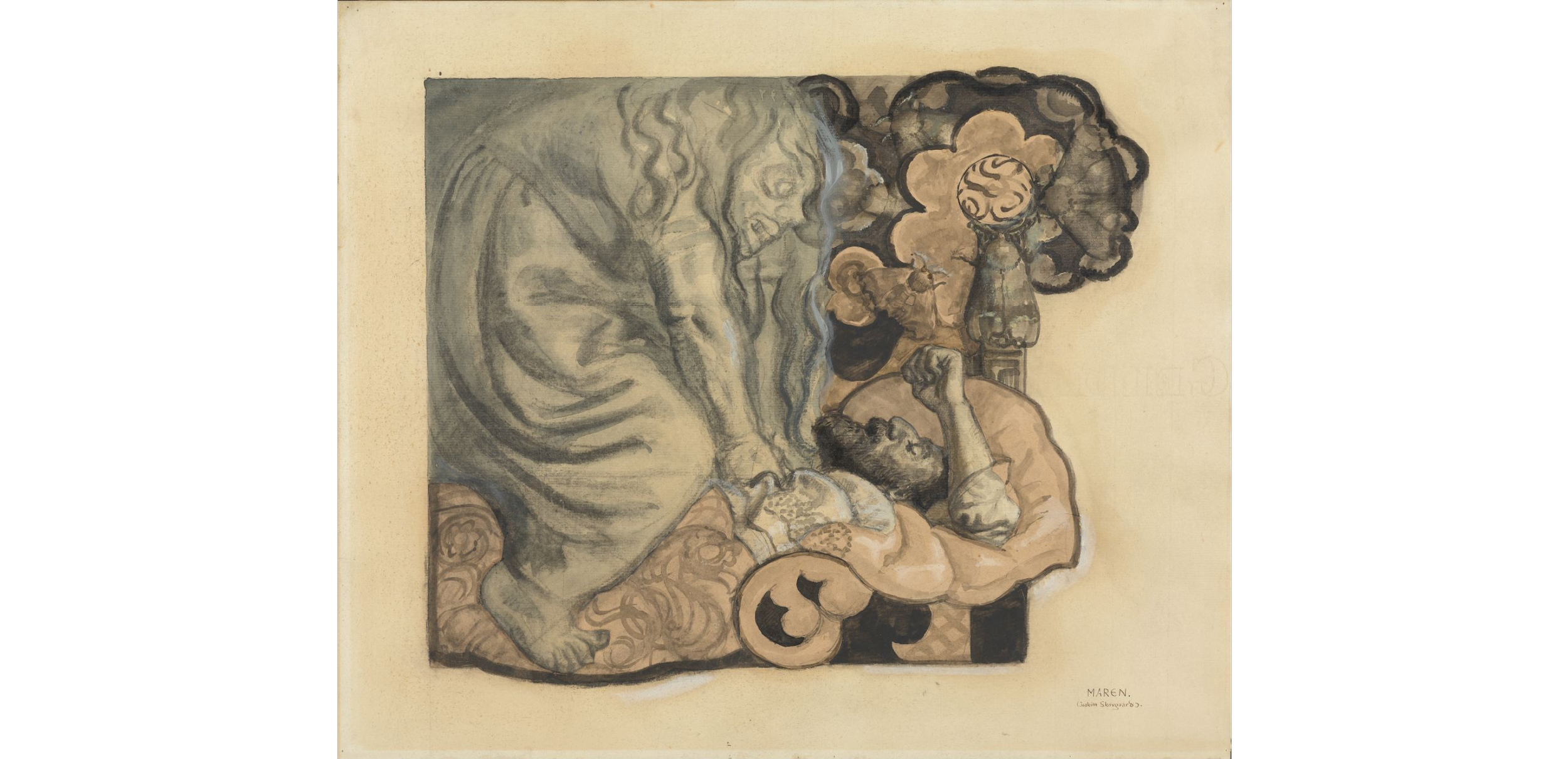
Joakim Skovgaard imagined the mara pressing down on a sleeping man in The Nightmare (Maren), drawn around 1890. The illustration is a nineteenth-century interpretation of Scandinavian folklore.
Photo credit
Joakim Skovgaard / Nasjonalmuseet; photograph: Dag Andre Ivarsøy. Image via Institutet för språk och folkminnen
In the medieval Icelandic Ynglinga saga, King Vanlandi has been asleep only a short time when he cries out that a mara is treading on him. His men rush to help. When they lift him by the head, the unseen assailant bears down on his legs so hard they nearly break. When they take hold of his feet, it presses against his head instead. The saga says he dies there.
The attack follows a curse. Vanlandi has abandoned Drífa, whom he married during a stay in Finland, and she has enlisted a sorceress named Huld to bring him back or kill him. The saga was written down in medieval Iceland and tells of rulers from a much earlier, partly legendary past. It cannot establish how a real king died. It does, however, show how recognizable this kind of nighttime tormentor had become in Scandinavian storytelling.
The being had a name: mara in Old Norse and Swedish, mare in Norwegian and Danish. Across regional traditions, it pressed on sleeping people, robbed them of breath and left them struggling to move. A visit could feel as though something had taken up residence on the sleeper's chest.
When something sat on the bed
Nordiska museet in Stockholm preserves an account from a farmer in Småland who remembered spending a night in an empty cottage at Vitefälle, near Voxtorp. He woke feeling as though something large and heavy were suffocating him. At first he could not move. Eventually he managed to move a toe; the weight seemed to roll up his body, pass over his face and vanish. His companions slept through it. The museum presents the account among historical stories associated with the mara, although the publicly available version does not identify the original recording date.
Such accounts help explain why the mara was feared, but collected descriptions of the being are far from uniform. Some Norwegian storytellers imagined a woman, sometimes one the sleeper recognized. Others described an animal-like presence. In material collected in the Vefsn district of northern Norway and published by folklorist Knut Strompdal, one account likens the visitor to a shaggy creature that settles over a sleeping person. In an account from Bruvik, collected by Andreas Leiro, sufferers sensed hairy fingers in their mouths, counting their teeth.
The mara could also enter the stable. Horses found sweating or with knotted manes might be said to have been ridden through the night. In a 1928 Halland folklore record, a Swedish informant described a stallion believed to have suffered such visits. The tangled hair was treated as a sign of the visitor's activity. No one needed to see a creature arrive for the explanation to take hold.
Keeping the mara away
People who believed they were vulnerable to a mara devised ways to keep it out. These could be strikingly ordinary. In a Småland account, shoes were turned so their toes pointed away from the bed to keep the mara back. In northern Norway, shoes could instead be turned toward the door, to make the mara think the sleeper had already left. Elsewhere a Bible or hymnbook under a pillow, a prayer, or a piece of steel offered protection. The measures varied with the locality and the storyteller; there was no single Nordic instruction manual for dealing with a mara.
Some traditions gave the visitor an unsettling human side. The mara might be a woman who changed shape or wandered at night without knowing it. In one widespread tale type, a man blocks the opening through which a mara enters, trapping her in human form. She becomes his wife, only to disappear when the opening is uncovered again. Such stories made the visitor a figure of household life and human relationships as well as a source of terror.
The word that stayed behind
The mara has endured most conspicuously in language. Swedish has mardröm, Norwegian mareritt and Danish mareridt. The Norwegian term joins mare with ritt, a ride, while Icelandic martröð joins mara with a word connected to treading or trampling. Linguist Guðrún Kvaran points to the Vanlandi episode when explaining the Icelandic compound. English nightmare contains an older, related Germanic name for a frightening nocturnal being. The mare in that word is not the female horse familiar to English speakers today.
Finland offers a different linguistic history. Folklorist Kaarina Koski has traced how the Finnish word painajainen, once associated with a being or condition that oppressed sleepers, came to refer primarily to frightening dreams. The change unfolded particularly in twentieth-century usage. Similar experiences could produce related supernatural explanations without giving every community the same creature or the same word.
Today, sleep paralysis provides one possible explanation for experiences of waking unable to move while sensing pressure or a threatening presence. Medical descriptions recognize those sensations, but they cannot diagnose an unnamed person in a centuries-old account, much less explain every horse story or tale of a shapeshifting wife. The evidence shows what people recorded and believed, and how the explanations changed.
For generations of storytellers, waking with a weight on the chest raised a question that demanded an answer. The mara supplied one. The English word nightmare still carries a related old Germanic name for that nocturnal visitor.


In the medieval Icelandic Ynglinga saga, King Vanlandi has been asleep only a short time when he cries out that a mara is treading on him.