
Clearing the Bush
How Finnish Homesteaders Worked Central Alberta's Forest Belt
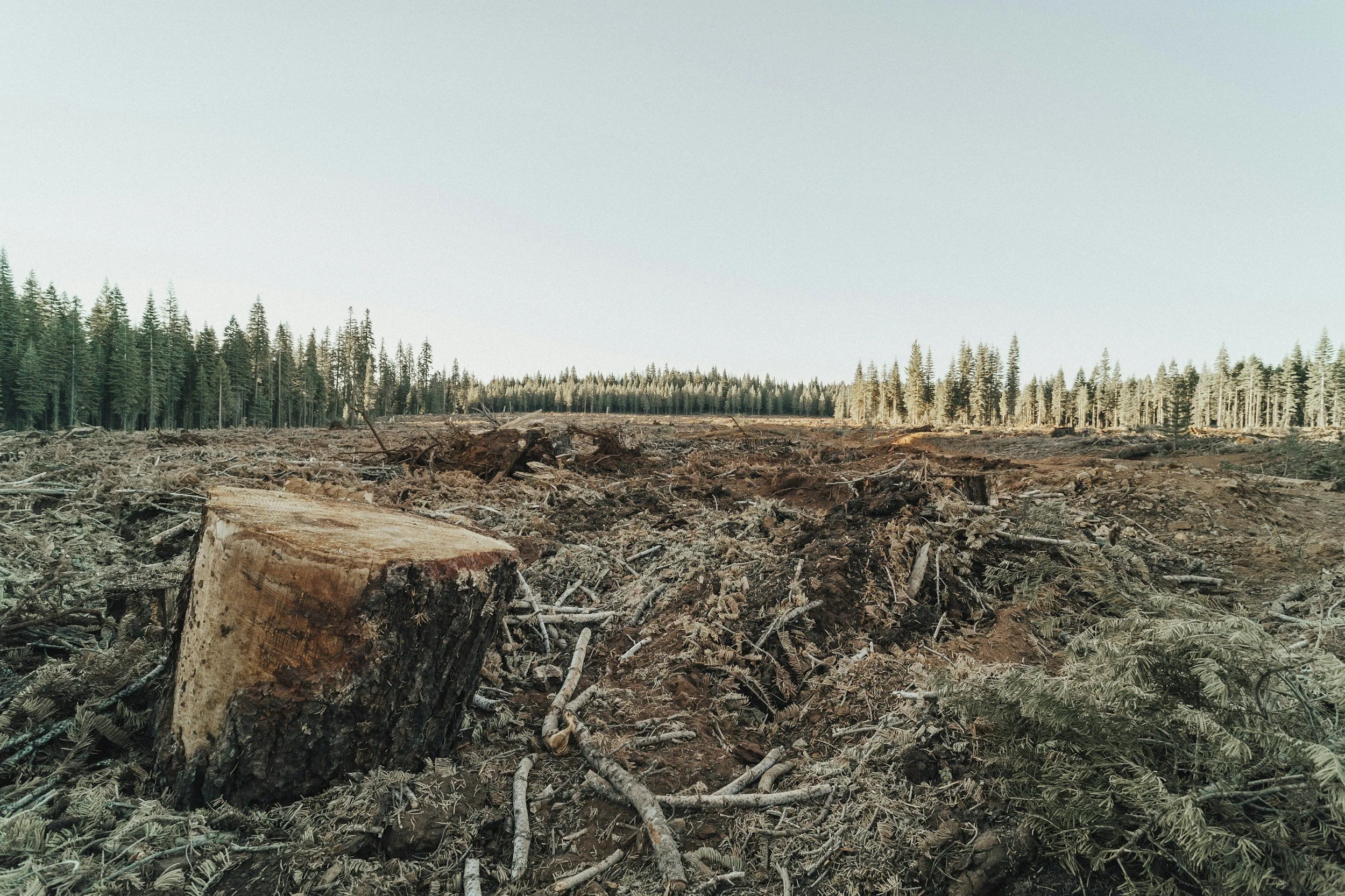
A tree stump with a clear in the foreground and forest in the background.
Central Alberta’s wooded parkland around Sylvan Lake, Eckville and Hoadley lies largely within Treaty 6 territory, while Red Deer lies near the boundary between Treaty 6 and Treaty 7 territories. The region is also Métis homeland and was travelled, occupied and used by Cree, Blackfoot, Saulteaux, Nakota, Dene and Métis communities long before homestead lands were surveyed.
When Finnish immigrants started arriving in the district after 1900, most by way of Ontario, Montana, or the mining towns of Minnesota and Michigan, they were taking up quarter-sections that ranged from lightly wooded parkland to heavily treed stands of trembling aspen, balsam poplar, and white spruce. Before much of the land could be farmed, trees had to be cleared from it.
That process had a name, a timeline set by federal law, and a set of specific tools. It also looked different in central Alberta than it did in Saskatchewan's Finnish bloc settlements, or in the Finnish farming districts of northern Minnesota that are better documented in the historical record.
The Fine Print of a Homestead
The Dominion Lands Act of 1872 gave a settler 160 acres for a $10 registration fee. In exchange, the settler had to build a habitable dwelling, live on the land for at least six months of each year for three years, and make the improvements and cultivate the acreage required under the regulations. The exact acreage required changed repeatedly as the regulations were amended — sources describe requirements ranging from roughly 10 acres in some periods to 40 in others — but the obligation itself didn't move. A homestead claim was provisional until the land showed evidence of being worked.
For a family arriving on a wooded quarter-section, that meant the clock started as soon as a homestead entry was made. Clearing wasn't a background task fitted in around farming; it was one of the conditions of owning the farm at all.
Axe, Saw, and Stump
The work followed a fairly standard sequence across the forest belt, whatever a settler's background. Trees were felled with an axe and crosscut saw. Straight, usable trunks were set aside for houses, barns, granaries, and fences. Smaller wood went to the woodpile. Brush was piled and burned. Stumps were the slowest problem: some were chopped out by hand, others pulled with a chain and a team of horses or oxen, and in some districts settlers used a stumping machine. Designs varied: some tripod-and-screw machines were operated by hand, while others used horses or oxen to provide the pulling force.
Clearing at this pace was slow. Research on Finnish immigrant farm families in northeastern Minnesota, working during the same era on cutover forest land, found that a typical farm had cleared a little more than eight acres after its first five years. Alberta's Finnish homesteaders worked with similar hand tools, but differences in tree cover and terrain mean no comparable clearing rate has been documented for Alberta.
Paying for the Farm With the Forest
Clearing land produced little immediate farm income; it made future cultivation possible. In the meantime, many Finnish homesteaders supplemented the farm with wage work in logging and other seasonal industries. Many men took winter work in logging camps, sawmills, mines, or railway construction, then returned in spring with wages that covered livestock, tools, and supplies the farm couldn't yet produce. This wasn't unique to Finnish households, but it was a well-established pattern among them specifically, tying the forest to the farm's finances even as the forest was being removed acre by acre.
Settling Apart, Not Together
One difference from other Finnish settlements in Canada is worth noting directly. Saskatchewan's New Finland, established in 1887–88 near the Qu'Appelle River, was a deliberate ethnic bloc settlement — Finnish families concentrated together by design. Alberta's Finnish settlers didn't follow that model. Accounts of the Sylvan Lake area describe Finnish families settling among other immigrant homesteads, while nearby Medicine Valley developed into one of Alberta's largest Estonian settlements.
One family's record illustrates the timeline. Matt and Maria Mattson, Finnish immigrants who had lived for a time in Belt, Montana, homesteaded at what was then called Snake Lake — now Sylvan Lake — in 1901. Their descendants still farm part of that original quarter-section, and the farm received an Alberta Century Farm & Ranch Award in 2001.
A more scattered settlement pattern meant that clearing land wasn't necessarily a Finnish-only undertaking, the way it might have been in a bloc settlement. Finnish families brought with them the practice of talkoot. In dispersed settlements, those exchanges of labour could include Estonian and other neighbouring immigrant households.
Final Thoughts
Clearing central Alberta's forest belt was shaped by four things running at once: a federal law that made clearing a condition of ownership, hand tools that made the work slow regardless of who was swinging them, off-farm wages that paid for a farm that wasn't yet producing anything, and a settlement pattern that put Finnish families in among Estonian and other neighbours rather than in a bloc of their own. None of that erases the fact that the land itself had a history before any of these families arrived. Much of the area lay within Treaty 6 territory and Métis homeland, where Indigenous communities continued to live, travel, and use the land.
Further Reading
Historica Canada. "Dominion Lands Act." The Canadian Encyclopedia.
"Finnish Immigrant Farm Women in Northeastern Minnesota." Swedish Finn Historical Society, drawing on research by Arnold R. Alanen and others.
Alanen, Arnold R. "Finns." Encyclopedia of the Great Plains, edited by David J. Wishart. University of Nebraska Press, 2004.
Van Cleef, Eugene. "Finnish Settlement in Canada." Geographical Review 42, no. 2 (1952): 253–266.
Jordan, Terry G., and Matti Kaups. The American Backwoods Frontier: An Ethnic and Ecological Interpretation. Johns Hopkins University Press, 1989.
Mather, Cotton, and Matti Kaups. "The Finnish Sauna: A Cultural Index to Settlement." Annals of the Association of American Geographers 53, no. 4 (1963): 494–504.
"Finnish settlers left steamy legacy in Alberta." The Western Producer, January 17, 2020.
Historica Canada. "Red Deer" and "Treaty 6." The Canadian Encyclopedia.


Before the candles could be dipped, everyone at Överby parsonage had work to do.
Edvard Ström spent part of his childhood there, on Sweden’s west coast, between 1814 and 1825. In recollections recorded late in the nineteenth century and published by Bohusläns Museum, he remembered the household twisting cotton and tow yarn into wicks while his aunt Anna Lisa prepared for candle making. A tall copper vessel was carried into the servants’ room, wrapped in blankets and mats to retain its heat, more than half-filled with boiling water and topped with melted tallow.