
Löyly: The Finnish Word at the Heart of Sauna
Language: Finnish
LÖY — lü
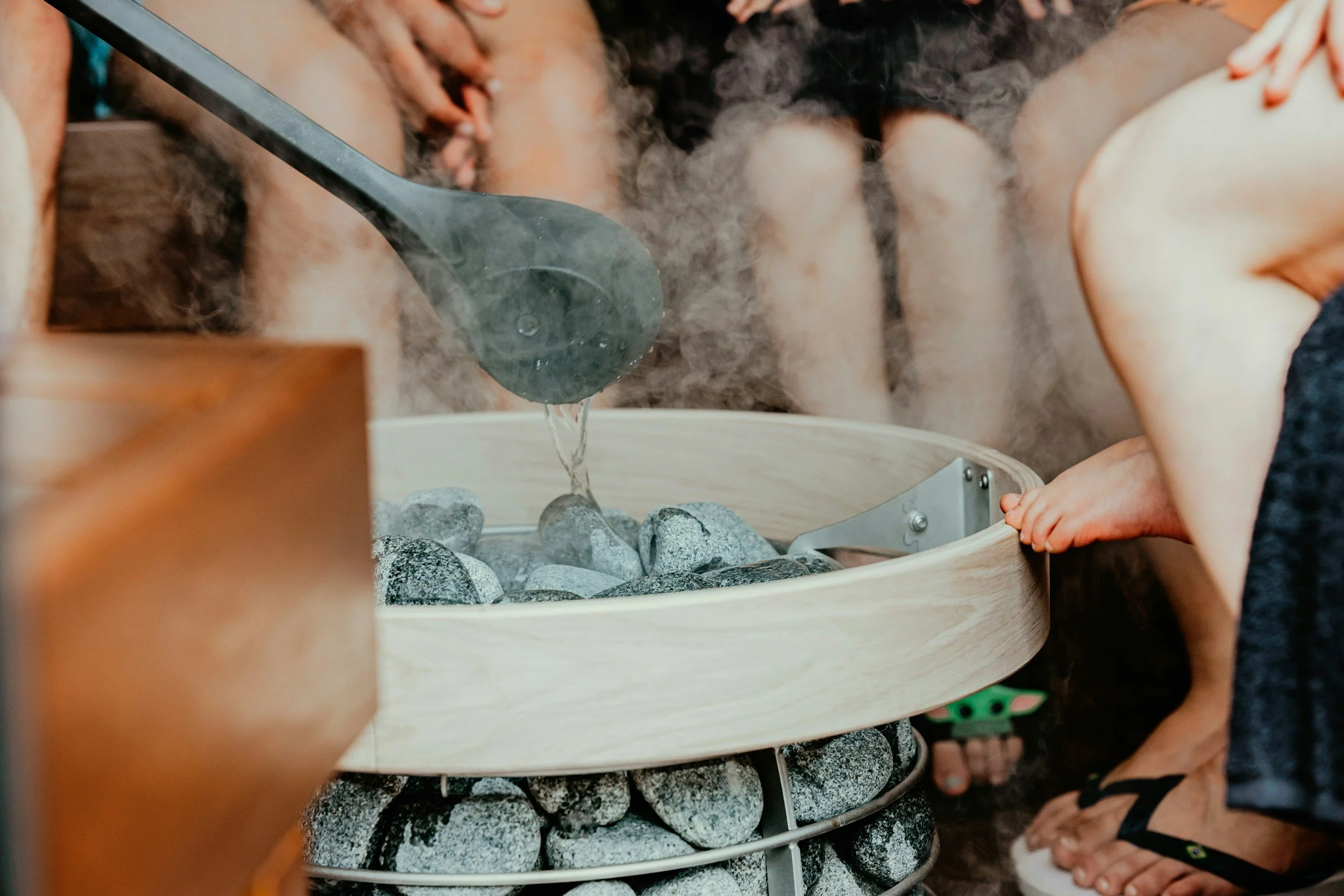
The ladle tips and water strikes the stones with a hiss, vanishes, and returns as a wave of humid heat. It rises toward the ceiling before rolling across the upper bench. A few seconds later, the whole room feels different.
That movement has a name in Finnish: löyly.
English translations usually settle on “steam” but the word covers more than the vapour released from wet stones. It can describe the heated wave moving through the room, the character of the heat, and the quality of the sauna session.
Finns speak of good or poor löyly, and a question about the löyly can ask what the entire sauna felt like. In his study of Finnish saunas in Manitoba, Charles M. Sutyla quotes architect Allan Konya’s description of löyly as the hot, slightly humid wave of air produced when water is thrown onto the stove stones.
In a first-person account published by Kamu Sauna in British Columbia, Juho describes good löyly descending from above and surrounding the body, while poor löyly strikes with an unpleasant force.
The room may already be hot when the ladle is lifted. Löyly begins when water, stones, air, and human judgment start working together.
A Word with an Older Life
In a 2016 linguistic study, Jussi Ylikoski notes that löyly has long been compared with North Sámi lievla, meaning steam, sauna vapour, or scent, and with Hungarian lélek, meaning soul or spirit. The Institute for the Languages of Finland identifies löyly as an old inherited Uralic word. Cognates in Estonian and Livonian can also carry meanings connected with spirit or life, while the Sámi forms are considered loans from Finnic.
“Steam” remains an incomplete English translation because modern Finnish also uses löyly to describe the felt quality of the sauna. The word’s history connects it with meanings that include sauna vapour, life, soul and spirit, but it does not prove one shared ancient belief about the sauna.
When Water Meets Stone
A sauna can be hot before anyone throws water so Löyly explicitly begins when water touches the stones.
The amount of water, the temperature of the stones, the height of the benches, ventilation, and the dimensions of the room all affect what follows. Sutyla treated löyly as an active part of sauna bathing rather than a decorative cloud above the stove. The bathers feel the wave move through the room and decide when the stones are ready for more water.
Finnish speakers can judge löyly much as someone might judge a fire or a loaf of bread. Heat alone does not determine the result. The person handling the ladle must notice how the room responds.
A small pour can produce an even wave. A larger pour can produce a more intense wave, while smaller amounts allow bathers to judge how the room responds before adding more water. The best löyly depends on attention rather than a fixed number on the thermometer. In a shared sauna, the person holding the ladle is making a decision for everyone on the benches.
The Sauna Has Its Own Order
Historical Finnish saunas served practical purposes that reached beyond recreation. People washed there and tended to health needs. In some periods and regions, women gave birth in the sauna because it offered warmth, hot water, and a space that could be cleaned. Juhani Peräsalo’s study of Finnish sauna history also records the sauna’s moral standing within the household. Bathers were expected to conduct themselves with the respect they would show in church.
The weekly rhythm mattered. Sutyla’s fieldwork among Finns in Manitoba found that Saturday evening remained the customary sauna time for many families, although routines changed with work, season, and local circumstances. Bathing arrangements also varied. Some households entered as families; others separated bathers according to age or sex.
These customs were never identical across all of Finland. Stove designs, bathing habits, family arrangements, and expectations differed by region and generation. Löyly provided a common point of recognition. Wherever the sauna stood, water on heated stones transformed a hot room into the experience Finns understood as sauna.
Want to learn about Finns in Alberta? Start here
Crossing the Atlantic
Finnish immigrants established communities across Canada, including districts in Manitoba, Saskatchewan, and central Alberta. Varpu Lindström-Best identified Finnish concentrations around Red Deer and Sylvan Lake, as well as Manitoba communities such as Lac du Bonnet, Elma, Rorketon, and Meadow Portage.
Immigrants preserved the sauna by building it again. Families needed a stove, stones, water, benches, and an enclosed room. The building could stand near a farmyard, a work camp, a lakeside cottage, or a Finnish community gathering place. Local materials altered its appearance, while the practice at its centre remained recognizable.
Sutyla’s Manitoba research shows that the tradition did not continue everywhere in the same way. Rural Finns who arrived before 1930 generally maintained the sauna. Many early Finnish residents of Winnipeg abandoned it as they adapted to urban housing and pressure to assimilate. Immigrants arriving after the Second World War promoted sauna more openly and helped renew the practice within Finnish communities.
The pattern complicates the usual story of immigrant traditions passing intact from one generation to the next. A sauna required room, fuel, materials, and money. It could disappear when families moved into city houses or apartments. It could return when later immigrants built clubs, cottages, new homes, and community buildings. Löyly continued wherever people could recreate the conditions that produced it.
Löyly on the Canadian Prairies
In Manitoba, the sauna became both a household practice and a statement of Finnish belonging. Sutyla found that changes in its use tracked changes within Finnish Canadian communities. Yvonne Lockwood reached a related conclusion in her study of Finnish-American life: building and using a sauna allowed immigrants and their descendants to express identity through repeated action.
A Finnish family did not need to display a national symbol on the wall for the room to feel Finnish. The stove was heated and water carried inside. On the benches, people watched the stones and decided when to add the next ladleful. Cultural knowledge lived in the sequence.
In central Alberta, documented examples include the sauna Sylvester Saha built near Sylvan Lake after arriving in 1902 and the Mattson family sauna, which was generally used once a week and more frequently during harvest. These accounts show that Finnish households rebuilt and maintained the practice in the district.
The word löyly held the most specific part of that knowledge. A stove could be copied. A building plan could be adjusted. Knowing how the room should respond after water met the stones came through practice.
When Sauna Becomes a Temperature
A thermometer gives one number. Löyly asks how the heat moves, how much water the stones can receive, whether the air remains comfortable, and when the room is ready for another ladleful.
Reducing sauna to dry heat leaves out the act that gives the Finnish practice its changing character. Water reaches heated stones. The room responds, and the bathers adjust. Sutyla’s Manitoba study places this wave of humid heat among the essential elements of Finnish sauna bathing.
A thermometer cannot report whether the heat moved evenly or whether the air became oppressive. It cannot tell anyone how the room felt after the hiss faded. Numbers describe conditions. Löyly describes the experience those conditions produced.
English offers words for vapour and humidity. Neither provides a tidy substitute. Löyly tells us what happened in the room.
Bringing Löyly Home
No Finnish ancestry is required to use the word with care. It begins with understanding that the person holding the ladle is affecting everyone present. In a shared sauna, water should be added with attention to the room and the other bathers rather than according to a fixed schedule.
The idea also changes how the sauna is remembered. A memorable session may be the evening when the stones held their heat, each ladleful moved evenly through the room, and nobody hurried the next round.
That is the lesson löyly carries from Finland into Finnish Canadian communities and beyond. Walls, insulation, a stove, and stones create the room. Its character appears when water falls.
The ladle tips again. Water disappears between the black stones. The hiss lasts a second. Then the wave reaches the bench, and everyone in the room knows whether the löyly is good.
Further Reading
Charles M. Sutyla. The Finnish Sauna in Manitoba. Ottawa: National Museums of Canada, 1977.
Yvonne R. Lockwood. “The Sauna: An Expression of Finnish-American Identity.” Western Folklore 36, no. 1 (1977): 71–84.
Juhani Peräsalo. “Traditional Use of the Sauna for Hygiene and Health in Finland.” Annals of Clinical Research 20, no. 4 (1988): 220–223.
Varpu Lindström-Best. The Finns in Canada. Ottawa: Canadian Historical Association, 1985.
Jussi Ylikoski. “Suomen kiuas, karjalan kiukua ja havaintoja etymologian tutkimusperinteestä.” Sananjalka 58, no. 1 (2016): 7–23.
Klaas Ruppel. “Löyly.” Institute for the Languages of Finland.
Juho. “What Is Löyly and Why Is It Important to an Authentic Finnish Sauna Experience?” Kamu Sauna Journal, 2023.
Heritage Park Historical Village. “Finnish Sauna.”


The beams are too heavy for one family to lift. The roof cannot be finished before winter comes. Livestock will need shelter before the snow arrives. Waiting until enough money has been saved to hire workers means it might never be finished.